9.
Escaping the Anxious-Avoidant Trap: How the Anxious-Avoidant Couple Can Find Greater Security
If you’ve discovered that most of your difficulties can actually be traced back to conflicting intimacy needs, is there anything I you can do about it?
Perhaps one of the most intriguing findings in adult attachment research is that attachment styles are stable but plastic. This means that they tend to stay consistent over time, but they can also change. Up to now, we’ve described in detail what happens in anxious-avoidant relationships when left to run their usual course. Here we want to offer these couples a chance to work together to become more secure.
Attachment research shows that people tend to become more secure when they are in a relationship with someone secure. But there is also hope for a couple’s future when neither partner is secure. Studies have found that security “priming”—reminding people of security-enhancing experiences they’ve had—can help them to create a greater sense of security. When people can recall a past relationship with a secure person or be inspired by a secure role model in their lives, they are often successful at adopting secure ways. As a person’s attachment style gradually changes toward greater security, he or she behaves more constructively in relationships and even enjoys better mental and physical health. And if both partners are able to do so—the results can be remarkable.
IDENTIFYING YOUR INTEGRATED SECURE ROLE MODEL
Priming for security can be as simple as thinking about secure people around you and how they behave in their relationships. To find such a role model, mentally review the various people in your life, past and present. The secure presence can be someone close like a parent or a sibling, or it may be someone you know more casually from work or through friends. What’s important is that this person has a secure attachment style and a secure way of dealing with people. Once you’ve come up with one or more such people, try to conjure specific images and recollections of the way they interact in the world: the kinds of things they say, how they act in different situations, what they choose to ignore and what they respond to, the way they behave when their partner is feeling down, and their general outlook on life and relationships. For example:
“Once when I disagreed with my manager, I came out very strongly against him. He showed a genuine interest in what I had to say and created a dialogue with me instead of a dueling match.”
“My best friend, Jon, and his wife, Laura, are always encouraging each other to do the things that they are passionate about. When Laura decided to leave her law firm and go into social work, Jon was the first to give her his blessing , even though it meant a serious financial cutback.”
Your Relationship with Your Pet as a Secure Role Model?
Suzanne Phillips, coauthor of the book Healing Together, describes our connection with our pets as a source of inspiration for our romantic relationships. In her writing, she points out that we tend to perceive our pets as selfless and loving despite their many misdemeanors: They wake us up at night, destroy our valuables, and demand our undivided attention, yet we tend to overlook these behaviors and feel positively toward them. In fact, our connection with our pets is an excellent example of a secure presence in our lives. We can tap into our attitudes toward our pets as a secure resource within us—we don’t assume our pets are doing things purposely to hurt us, we don’t hold grudges even when they eat something they shouldn’t or make a mess, we still greet them warmly when we come home (even after a rough day at the office), and we stick by them no matter what.
Go over all the secure examples that you’ve come up with and summarize the characteristics that you would like to adopt. This will become your integrated secure role model. This is what you want to strive for.
RESHAPING YOUR WORKING MODELS
In attachment research, “working model” is a phrase that describes our basic belief system when it comes to romantic relationships—what gets you going, what shuts you down, your attitudes and expectations. In short, what makes you tick in relationships. It is helpful to understand the ins and outs of your working model as a first step toward identifying patterns of thoughts, feelings, and actions that stand in the way of your becoming more secure.
Creating Your Relationship Inventory
The first order of business, therefore, is to become aware of the working model that governs your relationship behavior. Although you might have a good idea about your attachment style from what you’ve read so far, the relationship inventory will help you see more clearly how your attachment style affects your day-to-day thoughts, feelings, and behaviors in romantic situations.
The inventory will walk you through your past and present relationships from an attachment perspective. Research into the molecular mechanism of memory and learning reveals that whenever we recall a scene—or retrieve a certain memory to our conscious mind—we disrupt it, and by doing so, we alter it forever. Our memories are not like old books in the library, lying there dusty and unchanged; they are rather like a living, breathing entity. What we remember today of our past is in fact a product of editing and reshaping that occurs over the years whenever we recall that particular memory. In other words, our current experiences shape our view of our past ones. By creating your own attachment inventory, you reexamine your recollections of past relationship experiences from a fresh new perspective. Viewing them through an attachment lens will allow you to change some unhelpful beliefs that rely on those particular memories, and by so doing reshape your working model into a more secure one.
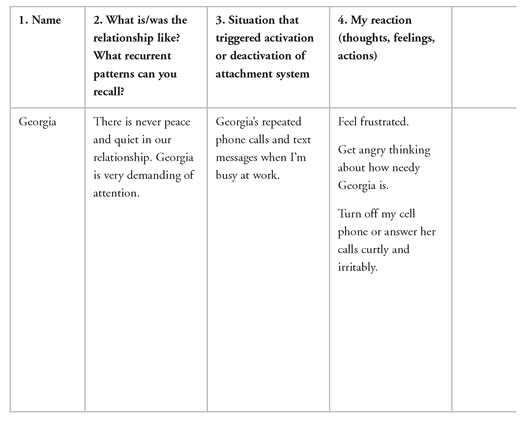
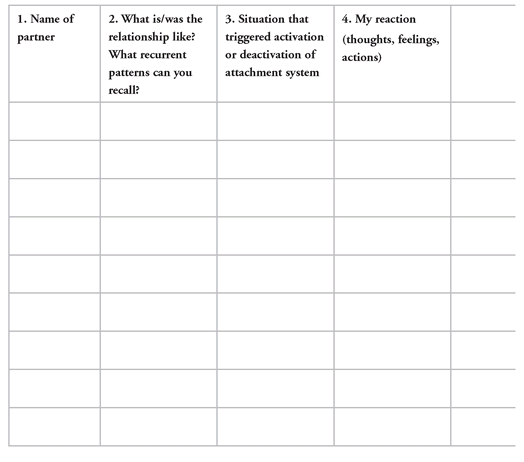
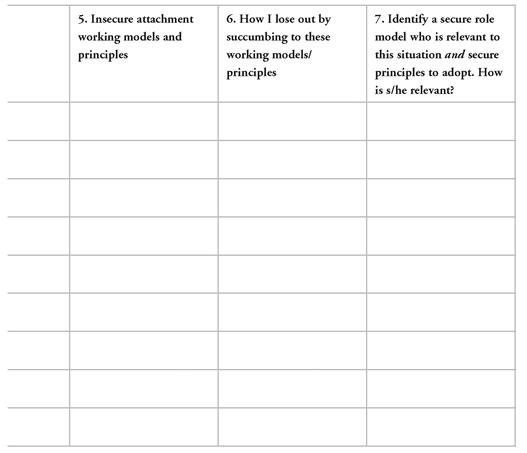
On pages 168-169 is the attachment relationship inventory. Taking the inventory is a task that should be done alone. Make sure to set aside enough quiet time to work on it thoroughly, so you really get a complete and accurate picture of yourself from an attachment perspective. Start by listing, in the left-hand column (1), the names of all your romantic partners, past and present. These can include people you’ve dated briefly. We suggest working vertically, one column at a time. Completing the inventory vertically encourages you to focus less on each particular scenario and to achieve an integrated picture of your working model across relationships. The more information you gather, the better. In column 2, write what you remember about the relationship: what it was like and what things stand out most when you try to recall your time together. Once you write down your general recollections of the relationship, column 3 allows you to take a closer look and identify specific scenarios that contribute to activation/deactivation of your attachment system. Column 4 asks how you responded to these situations: What did you do? What were you thinking? How did you feel? The lists below the inventory are provided to help you recall these reactions.
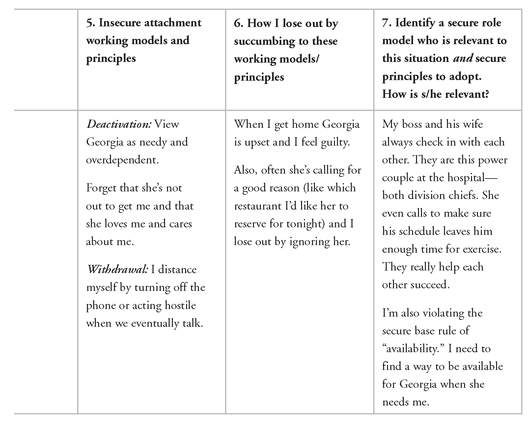
Column 5 is a crucial next step. You will need to reassess these experiences from an attachment perspective to gain insight into the issues that affected your relationships. What attachment issues underlie your reactions: Protest behavior? Deactivation? Refer to the lists as a guide. In column 6, you’re asked to consider ways in which your reaction—now translated into attachment principles—hurts you and gets in the way of your happiness. Finally, column 7 prompts you to consider new, secure ways of handling these situations using a security-enhancing role model in your life and the secure principles we outline in this book (and in the box on page 174).
RELATIONSHIP INVENTORY
Common Anxious Thoughts, Emotions, and Reactions
Thoughts
• Mind reading: That’s it, I know s/he’s leaving me.
• I’ll never find anyone else.
• I knew this was too good to last.
• All-or-nothing thinking: I’ve ruined everything, there’s nothing I can do to mend the situation.
• S/he can’t treat me this way! I’ll show him/her!
• I knew something would go wrong; nothing ever works out right for me.
• I have to talk to or see him/her right now.
• S/he’d better come crawling back to beg my forgiveness, otherwise s/he can forget about me forever.
• Maybe if I look drop-dead gorgeous or act seductive, things will work out.
• S/he is so amazing, why would s/he want to be with me anyway?
• Remembering all the good things your partner ever did and said after calming down from a fight.
• Recalling only the bad things your partner has ever done when you’re fighting.
Emotions
• Sad
• Angry
• Fearful
• Resentful
• Frustrated
• Depressed
• Hopeless
• Despairing
• Jealous
• Hostile
• Vengeful
• Guilty
• Self-loathing
• Restless
• Uneasy
• Humiliated
• Hate-filled
• Uncertain
• Agitated
• Rejected
• Unloved
• Lonely
• Misunderstood
• Unappreciated
Actions
• Act out.
• Attempt to reestablish contact at any cost.
• Pick a fight.
• Wait for them to make the first reconciliation move.
• Threaten to leave.
• Act hostile—roll your eyes, look disdainful.
• Try to make him/her feel jealous.
• Act busy or unapproachable.
• Withdraw—stop talking to your partner or turn away from him/her physically.
• Act manipulatively.
Common Avoidant Thoughts, Emotions, and Reactions
Thoughts
• All-or-nothing thinking: I knew s/he wasn’t right for me, this proves it!
• Overgeneralizing: I knew I wasn’t made to be in a close relationship.
• S/he’s taking over my life, I can’t take it!
• Now I have to do everything his/her way; the price is too high.
• I need to get out of here, I feel suffocated.
• If s/he was “the one” this kind of thing wouldn’t happen.
• When I was with (phantom X) this wouldn’t have happened.
• Malicious intent: S/he’s really out to annoy me, it’s so obvious. . . .
• S/he just wants to tie me down, this isn’t true love.
• Fantasize about having sex with other people.
• I’ll be better off on my own.
• Ugh, s/he’s so needy! It’s pathetic.
Emotions
• Withdrawn
• Frustrated
• Angry
• Pressured
• Unappreciated
• Misunderstood
• Resentful
• Hostile
• Aloof
• Empty
• Deceived
• Tense
• Hate-filled
• Self-righteous
• Contemptuous
• Despairing
• Scornful
• Restless
• Distrustful
Actions
• Act out.
• Get up and leave.
• Belittle your partner.
• Act hostile, look disdainful.
• Make critical remarks.
• Withdraw mentally or physically.
• Minimize physical contact.
• Keep emotional sharing to a minimum.
• Stop listening to your partner. Ignore him/her.
Possible Attachment Principles at Play
Anxious
• Protest behavior
• Activating strategies—any thought, feeling, or behavior that will result in an increased desire to reconnect
• Putting your partner on a pedestal
• Feeling small and inferior in comparison to your partner
• Seeing/remembering only the best in your partner after a fight (while forgetting his/her negative side)
• Mistaking an activated attachment system for love
• Living in the danger zone (see chart on page 83)
• Living on an emotional roller coaster—getting addicted to the highs and the lows
Avoidant
• Deactivating strategies
• Mistaking self-reliance for independence
• Inflating your own importance and self-esteem while putting your partner down
• Seeing only the negative in your partner and ignoring the positive
• Assuming malicious intent in your partner’s actions
• Disregarding your partner’s emotional cues
• Yearning for the phantom ex
• Fantasizing about “the one”
• Repressing loving feelings and emotions
Examples of Secure Principles
• Be available.
• Don’t interfere.
• Act encouragingly.
• Communicate effectively.
• Don’t play games.
• View yourself as responsible for your partner’s well-being.
• Wear your heart on your sleeve—be courageous and honest in your interactions.
• Maintain focus on the problem at hand.
• Don’t make generalizations during conflict.
• Douse the flame before it becomes a forest fire—attend to your partner’s upsets before they escalate.
It sometimes may be helpful to go over the inventory with an attachment-designated person (ADP), such as a family member, a close friend, or a therapist. Being able to turn to someone who is familiar with your patterns when your system goes into overdrive and your judgment is clouded by activation/deactivation can give you a new and different perspective. Your ADP can remind you of your destructive attachment tendencies and help you move toward a more secure emotional head space before you act out and hurt the relationship.
If you’ve completed the relationship inventory you have identified your working model and the ways in which it may interfere with your happiness and productivity. You’ve probably spotted the recurrent patterns in your relationships and the way in which you and your partners (past or present) tick each other off. You can even summarize these for yourself.
My Working Model—Summarizing the Inventory
Can you identify particular situations that are prone to activate (if you are anxious) or deactivate (if you are avoidant) your attachment system across relationships?
• ________________________________
• ________________________________
• ________________________________
Can you detect ways in which an inefficient working model has prevented you from achieving more security?
• __________________________________
• __________________________________
• __________________________________
What are the main attachment principles at play in your relationships?
• __________________________________
• __________________________________
• __________________________________
Go back to your inventory and ask yourself how the secure role models (or integrated secure role model) can shed new light on the relationship issues you are/were dealing with.
• What would they do if they were in such a situation?
• Which point of view would they bring to the table?
• What would they tell you if they knew you were dealing with this issue?
• How is your experience with them relevant to the situation?
The answer to these questions will help you complete the last—and crucial—column of the inventory.
The two examples below will allow you to better understand how this approach can work and how to use the inventory.
THE TEXT MESSAGE THAT SAVED THE DAY
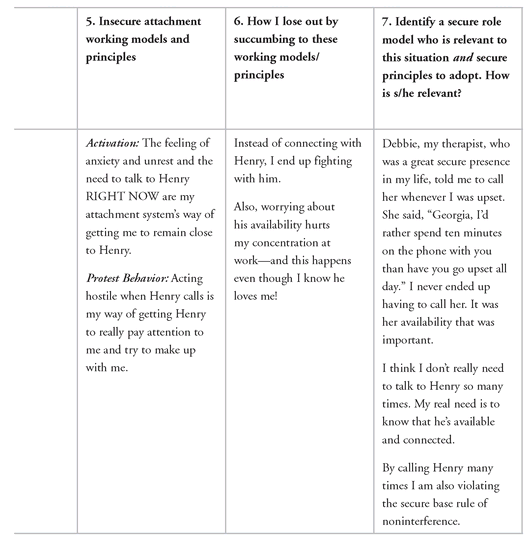
When we interviewed Georgia and Henry for the book, they were constantly quarreling. According to Henry, nothing he ever did was good enough for Georgia, and he was always being judged and criticized. Georgia, for her part, believed that the onus of the marriage was on her. She had to run after Henry to make even simple plans and was always the one to initiate everything—from buying a birthday present for his mother to deciding which apartment to rent. She felt very alone in the partnership. When we encouraged Georgia to start monitoring her working model, which was clearly anxious, she came up with a particular situation that occurred frequently and always upset her. Henry never had time to talk to her during the workday. She would call and leave a message, but he would rarely get back to her. Georgia’s inventory included the following entry:
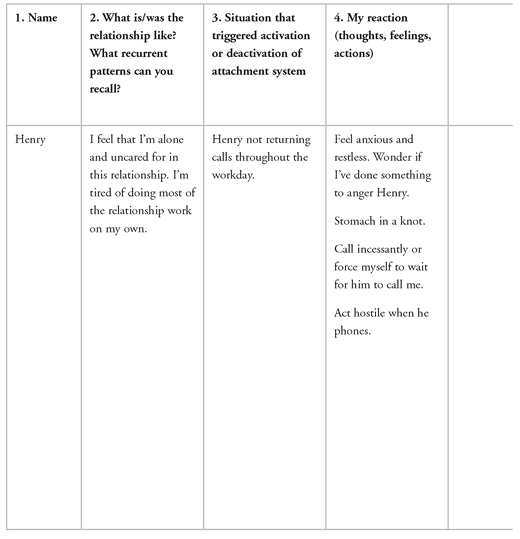

Henry, who has an avoidant attachment style, was busy at work with patients, and would get frustrated by Georgia’s incoming calls and text messages. When he eventually returned her calls, the dialogue would start off on a sour note that would affect the entire course of the conversation. This is what part of his inventory looked like:
Once both Georgia and Henry analyzed their working models, they started viewing their situation differently. Henry realized that by ignoring his wife’s needs and ridiculing her dependency, he was only making matters worse and causing unhappiness in the relationship. Georgia realized that by using protest behavior she was actually distancing Henry instead of making him want to be there for her, as she assumed. When they sat down and talked about this recurrent issue, they were both better prepared. Henry said that although he did think about her during the day, he was so busy that he just didn’t have time to stop and call. It was reassuring for Georgia to hear that Henry often thought about her when they were apart. She also understood his busy schedule. She just knew that she needed to feel more connected throughout the day.
Then they found a cool solution: Henry asked if it would be okay to send her a prewritten text message whenever he thought about her. It would only take a moment of his time but would reduce Georgia’s worry greatly. This solution worked wonders for their relationship. For Georgia, receiving a “thinking of you” message enabled her to calm down and concentrate better at work, and Henry felt less resentful once he realized that Georgia wasn’t out to destroy his career by endless nagging. In fact, by invoking his boss’s special relationship with his wife, he could see how a secure base could help advance his career. At night when they met, the tension was gone and the neediness and hostility were no longer there.
THE TOOTHPASTE INCIDENT
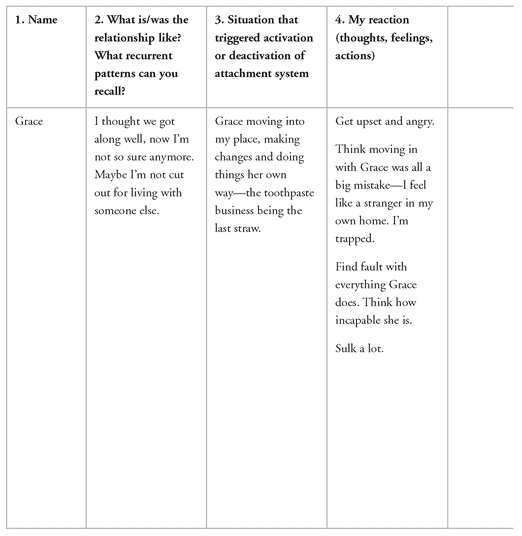
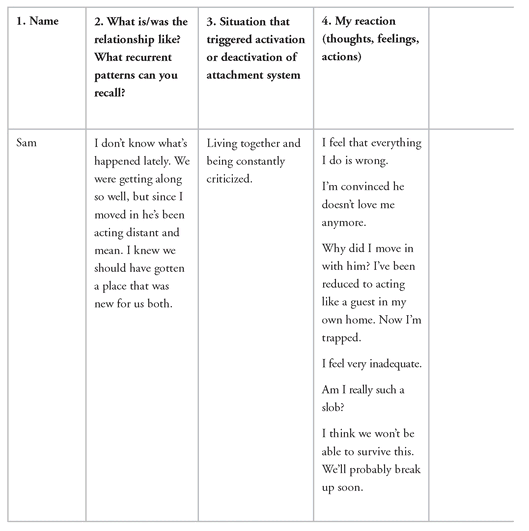
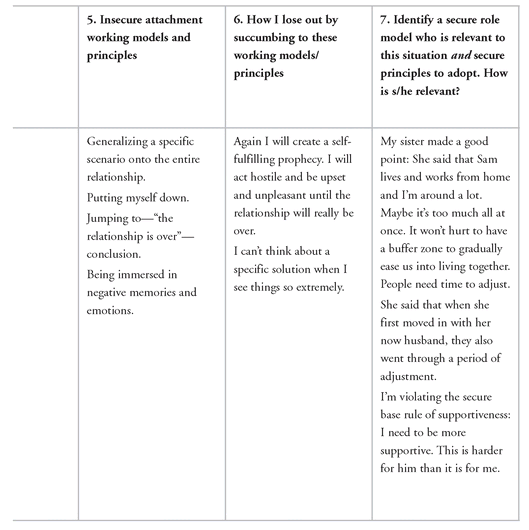
Sam really wanted Grace to move in with him when she moved to New York City. They’d been together for over two years and he thought that it would be nice to take their relationship to a higher level. Besides, they were staying at each other’s place all the time and think of the rent they would save! Grace preferred not to move into Sam’s apartment. She wanted to rent a bigger place instead, where they could both start on equal footing. But Sam refused; he loved his little apartment and saw no reason to spend money when he owned a place of his own. He was sure that they could make it work. He did have some hesitations, though. He’d never lived with anyone before and he was very set in his ways. But over the years, he’d also felt the loneliness that comes with self-sufficiency and wanted something more. Then when Grace moved in, Sam started to feel the pressure mounting. Sometimes he felt he was going to suffocate. Her things were everywhere. He felt that he was losing his quiet sanctuary, and quite literally that his home had been invaded. Finally one day he lost it—it was about the toothpaste. Grace always squeezed the toothpaste from the middle, while he made sure to carefully squeeze it from the bottom up. When he noticed the distorted toothpaste tube, he became furious and told Grace that she was sloppy and careless. Grace was caught off guard; she’d been trying very hard to make her presence in the apartment unobtrusive, and an attack was the last thing she expected.
A while later, after thinking things over, Sam made the following revelations:
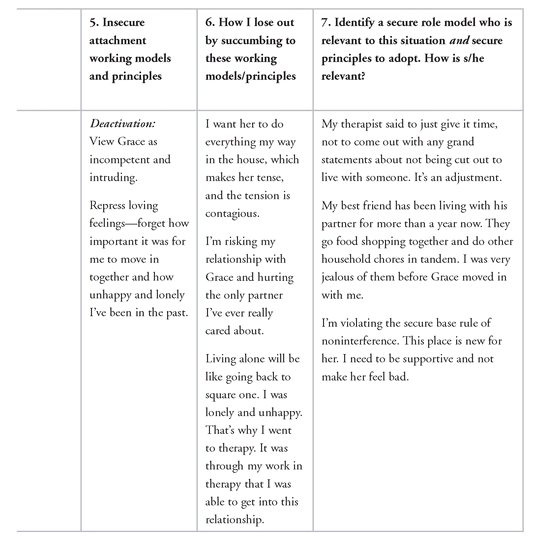
And this is what Grace’s entry looked like:
After doing his inventory, Sam realized that years of living alone and believing in his own self-sufficiency were now being challenged head-on. He was overwhelmed and discussed his new understanding with Grace. Grace realized that she was threatened by the fact that Sam was having difficulty adjusting to her presence. She also saw how she was interpreting the situation and reacting to it in a way that was harming the relationship. She liked her sister’s idea of finding a buffer zone. Since Grace’s close friend was going out of town for six months, Grace brought up the idea of subletting her friend’s studio apartment for a while so she would have a place of her own to do her art work and other hobbies without worrying about Sam’s reaction. Sam was surprised at her suggestion. Knowing that Grace now had an alternative made a huge difference to him. All at once he no longer felt suffocated and was less bothered by the changes she made. After six months, during which time Grace barely ever actually stayed at her sublet apartment, she didn’t bother to look for another sublet—Sam and she had adjusted to living together.
MAKE BECOMING SECURE AN ONGOING GROWTH PROCESS
Remember that attachment styles are stable and plastic—becoming more secure is an ongoing process. Whenever a new concern, dissatisfaction, or conflict occurs, enter the new information. This will help in your quest to break your insecure patterns. But moving toward security is not only about tackling problems in your relationship; it’s also about having fun together. Find ways to enjoy your time together as a couple—a walk in the park, a movie and dinner, watching a TV show that you both like—and make time to be physically close. Shedding your insecure working model will do wonders for your ability to function in the world at large. Dr. Sue Johnson, the founder of Emotionally Focused Couples Therapy (EFT) has demonstrated through her clinical work and writings that creating true security in the relationship and recognizing that you are emotionally dependent on your partner on every level is the best way to improve your romantic bond.
When you build a secure relationship, both individuals win: If you are the anxious partner, you get the closeness you crave, and if you’re the avoidant partner, you’ll enjoy much more of the independence you need.
WHAT IF THE GOAL OF SECURITY IS NOT REACHED?
What happens if despite your efforts to move your relationship away from “the trap” and the vicious insecure cycle, you are unable to do so? This can happen either because there is no genuine wish to change on the part of one or both partners or your attempts fail. We believe that when people are in an anxious-avoidant relationship, especially when they are unable to move to greater security, these discrepancies will always be a part of their lives and will never completely disappear. But we also strongly believe that knowledge is power. And it can be very valuable to know that your ongoing struggles as a couple are not because either of you is crazy, but rather because your relationship has a built-in clash that is not going to go away.
One of the most important benefits of this insight has to do with your self-perception. Intimacy clashes are very destructive for the non-avoidant partner, who is constantly being pushed away by the avoidant partner. We can see this happening in the examples we cite throughout the book, in behaviors such as maintaining a high degree of secrecy and then blaming the other person of being jealous and needy, in preferring separate beds, and in finding ways to spend less time together. If you are with an avoidant partner, you are constantly being rejected and rebuffed. After experiencing these distancing strategies for a while, you start to blame yourself. You may believe that if your partner was with someone else, s/he’d act differently; that with another s/he’d surely want to be closer than with you. You begin to feel unattractive and inadequate.
Understanding that your continual arguments actually have a hidden subtext to them—that they genuinely are irresolvable—changes your perception of your own role dramatically. Once you understand that your partner will always find areas of contention as a way of maintaining distance and that s/he will always need to withdraw, no matter whom s/he is with—you will no longer blame yourself for the relationship problems.
At least on the surface, the avoidant partner gets hurt less, because withdrawal is a one-sided move that doesn’t necessitate cooperation from your partner. However, although seemingly unperturbed, an important lesson to be learned is that indifference does not connote security. Avoidants need to actively suppress their attachment needs but tend to report being less happy in relationships. Though they often blame their unhappiness on their partner.
But how do people live with this understanding?
When we interviewed Alana, she told us about her relationship with her ex-husband, Stan. She recounted how they were able to find some stability in the relationship as long as Stan worked most of the time, and on weekends they did various separate chores and spent very little down time together. But things would become more difficult whenever Alana would ask him to go on a romantic getaway in the hope that it would bring them closer. On these occasions, Stan would always find an excuse for not going. They used to have a ritual whereby Alana would tell her friends and coworkers that she and Stan were going away for the weekend; she would get excited, make plans, and start to pack. A few days later she would call them sounding defeated and worn out, to say that something came up at the last minute, and they never went. Once it was his work, another time he wasn’t feeling well, and yet another time the car needed repairs. They’d have a huge fight and then things would calm down again—until the next time. For Alana, getting her hopes up, only to be disappointed again and again, was a painful experience.
Eventually Alana’s relationship with Stan ended. She never really grasped that her fights with him were about something much more fundamental than whether to go on vacation (or even about romance, for that matter). Instead they were about a big barrier that he put up between them. And even if at some deep level she did understand, she wasn’t able to truly accept this reality or live with it.
Other people do find a way to live in relative peace with colliding intimacy needs. How do they manage? They come to terms with the fact that when it comes to certain aspects of the relationship, things are not ever going to change. They understand that they can choose to live a Sisyphean life of ongoing disappointment and frustration, one in which they will continuously fight a losing battle. Or they can change their expectations. They learn to accept certain limitations and adopt a number of pragmatic life strategies:
• They admit to themselves that in certain areas, their mate is never going to be an active partner, and they stop urging him or her to change.
• They stop taking personal offense when their mate pushes them away and accept that this is simply his or her nature.
• They learn to do things on their own that they previously expected to do with their partner.
• They engage with like-minded friends in activities that their mate is unwilling to participate in.
• They learn to be thankful for what their mate does do and to overlook what he or she does not do.
We know countless people who, after having struggled with ongoing intimacy conflicts, finally make a shift in their mind-set and find a compromise that they are able to live with:
• Doug, 53, used to get furious at his wife on a daily basis when she came home hours later than expected. He finally decided to stop getting mad when she walked in and to greet her warmly instead. He made a conscious decision to make home into a place she would want to come home to instead of a battlefield.
• Natalie, 38, always dreamed of sharing her leisure time with her husband. After years of resentment and bitter fights over his refusal to spend weekends together, she decided to change. Today she makes plans for herself. If he wants to join (as rarely happens), he’s welcome aboard. But if not, it’s “so long and see you later.”
• Janis, 43, is married to Larry. Larry, who was married before, doesn’t take an active role in raising their joint children. Janis has come to accept that when it comes to the kids (and several other areas of their life together), she is quite literally on her own. She no longer expects him to participate and no longer gets angry when he refuses to do so.
All these individuals share chronic, ongoing intimacy collisions with their partners. They have chosen to let go of the dream of being truly intimate with their partners and have found a way to live with limited togetherness. They compromise. But make no mistake: The compromise is in no way mutual; it is in fact wholly one-sided. Instead of engaging in endless conflict that results in nothing but frustration and disappointment, they have decided to change their expectations and reduce conflict to tolerable proportions.
DECIDING TO LET GO OF THE DREAM
Do we recommend taking this route? Our answer is—“It depends.” If you’re in an ongoing relationship riddled with intimacy clashes that you have not been able to resolve, and yet you want to remain in the bond for whatever reason, then yes, this is the only way to live in relative peace. Your satisfaction level in the relationship will be lower than that of people who don’t experience such battles. But it will also be higher than that of people who choose to relive these fights day in and day out without ever accepting that they are about fundamental differences that aren’t going to go away.
If, however, you’re in a relatively new or uncommitted relationship and are already experiencing a lot of intimacy collisions, we advise you to think long and hard about whether you want to make so many concessions in order to be with this person. There is a major difference between couples who are dealing with non-attachment-related issues and those who are engaged in intimacy struggles. While the first couples want to find a common ground and reach a resolution that will bring them closer together, the latter either engage in ongoing, irreconcilable fights or one of the two is forced to compromise unilaterally in areas that are near and dear to him or her.
But there’s more. This attachment collision can go from bad to worse. The next chapter depicts how intimacy clashes can get out of hand, what it takes to recognize the situation, and most important, how to leave it behind.