8.
The Anxious-Avoidant Trap
When the two people in a couple have colliding intimacy needs, their relationship is likely to become more of a storm-tossed voyage than a safe haven. Here are three examples of what we mean.
THE DIRTY LAUNDRY
Janet, 37, and Mark, 40, have been living together for almost eight years. For the past two years they’ve been having an ongoing dispute about whether to buy a washing machine. Mark is strongly in favor—it will save them a lot of time and hassle. Janet is adamantly opposed—their Manhattan apartment is tiny, and fitting in another appliance will mean cramping their style even more. Besides, as she sees it, she’s responsible for the laundry, so why is Mark making such a big deal about it? When they discuss the subject, they both become highly emotional and it usually ends by Janet clamming up or Mark exploding.
What are they fighting about?
To get at the real issue, let’s add the following piece of information to the equation: When Janet does the laundry, it’s on weekends and she goes to her sister’s place around the block. This is the sensible thing to do—her sister has a washing machine, it’s free and less trouble. She then idles away the entire day there. Janet has an avoidant attachment style and is always finding opportunities to do things without Mark. For Mark, who has an anxious attachment style, the desire for a washing machine is really a wish for something else altogether—to be close to Janet.
When viewed in this light, we can see that the washing machine dispute is only a symptom of the real issue—the fact that Mark and Janet have very different needs when it comes to closeness and spending time together.
A ROMANTIC BED-AND-BREAKFAST IN VERMONT
Susan, 24, and Paul, 28, decide to go on a spontaneous weekend trip to Vermont. When they get there, they check out two B&Bs. Both places are cozy and inviting. One has a room with two single beds and the other has a room with one large queen-size bed. Paul wants the room with the two single beds, because the view is spectacular. Susan wants the one with the large bed—she can’t imagine going on a romantic getaway and having to sleep in a separate bed. Paul is a little dismissive of Susan. “We sleep in the same bed every night, what’s the big deal? At least we can enjoy the view here.” Susan feels ashamed that she has this strong need to be close to Paul at night, but still, she just can’t imagine them sleeping in separate beds on their vacation. Neither wants to give in, and the argument threatens to spoil the weekend.
What is this disagreement about? On the face of it, a difference in taste when it comes to hotel rooms. Susan’s insistence seems a bit extreme. But what if you knew that Paul hates to cuddle with her before going to sleep? That this bothers Susan greatly and that she feels rejected by his behavior? What if you knew that she’s sure that with two separate beds he will rush to his own the minute the sex is over? In this fuller context, she doesn’t seem so unreasonable anymore. We can interpret her concern as a fundamental need for closeness that is going unmet.
WHEN FACEBOOK AND “ABANDONMENT” ISSUES MEET
Naomi, 33, and Kevin, 30, have been seeing each other exclusively for six months and have a couple of disagreements they can’t resolve. Naomi is upset that Kevin hasn’t “unfriended” a couple of ex-girlfriends from his list on Facebook. She is convinced he is flirting with other women. Kevin, on the other hand, doesn’t like the fact that Naomi makes a habit of calling him whenever he’s out having drinks with his pals, so he screens her calls. Kevin believes that Naomi has serious abandonment issues and is overly jealous—and he frequently tells her so. Naomi tries to control her gnawing doubts and worries, but they just won’t go away.
There is no hard and fast relationship rule about keeping ex-girlfriends on your Facebook account or remaining in touch with them. There is also no right or wrong when it comes to phoning your boyfriend when he’s out with friends. In certain situations, these behaviors might make perfect sense. But Naomi and Kevin’s disagreements are not really about these questions at all, and that is why they’re unable to reach a resolution. Their conflict is about how close and committed they want to be to each other. Kevin, who has an avoidant attachment style, wants to keep a certain distance between himself and Naomi, and he does so using various strategies—he remains secretive about his comings and goings and he stays in touch with old flames despite Naomi’s obvious discomfort. Naomi, for her part, tries to get closer to Kevin by eliminating the barriers and distractions he has placed between them. But without his genuine desire to get closer, her efforts are futile; after all, it takes two willing individuals to create intimacy.
All three cases we’ve described have one thing in common: While one partner truly wants intimacy, the other feels very uncomfortable when things become too close. This is often the case when one of the partners in a bond is avoidant and the other is either anxious or secure—but it’s most pronounced when one partner is avoidant and the other anxious.
Research on attachment repeatedly shows that when your need for intimacy is met and reciprocated by your partner, your satisfaction level will rise. Incongruent intimacy needs, on the other hand, usually translate into substantially lower satisfaction. When couples disagree about the degree of closeness and intimacy desired in a relationship, the issue eventually threatens to dominate all of their dialogue. We call this situation the “anxious-avoidant trap,” because like a trap, you fall into it with no awareness, and like a trap, once you’re caught, it’s hard to break free.
The reason people in an anxious-avoidant relationship find it particularly hard to move toward more security is primarily because they are trapped in a cycle of exacerbating each other’s insecurities. Take a look at the diagram on page 158. People with an anxious attachment style (lower circle on the right) cope with threats to the relationship by activating their attachment system—trying to get close to their partner. People who are avoidant (lower circle on the left) have the opposite reaction. They cope with threats by deactivating—taking measures to distance themselves from their partners and “turn off ” their attachment system. Thus the closer the anxious tries to get, the more distant the avoidant acts. To make matters worse, one partner’s activation further reinforces the other’s deactivation in a vicious cycle, and they both remain within the relationship “danger zone.” In order to move toward more security—the safe zone in the diagram—both members of the couple need to find a way to feel less threatened, get less activated/deactivated, and get out of the danger zone.
THE NUTS AND BOLTS OF THE ANXIOUS - AVOIDANT TRAP
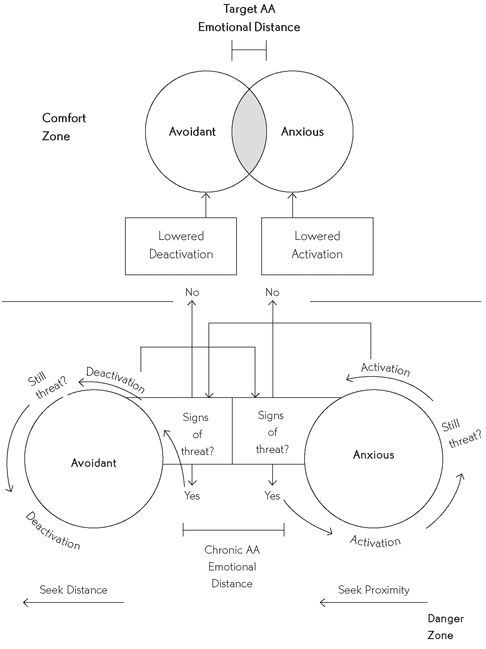
Here is what characteristically happens in many anxious-avoidant relationships:
TELLTALE SIGNS OF THE ANXIOUS-AVOIDANT TRAP
1. The roller-coaster effect. In the relationship you never sail along on an even keel. Instead, every once in a while, when the avoidant partner makes him/herself available to the anxious partner, the latter’s attachment system is temporarily quieted and you achieve extreme closeness—leading to the feeling of a “high.” This closeness, however, is perceived as a threat by the avoidant partner and is quickly followed by withdrawal on his or her part—only to create renewed dissatisfaction for the anxious partner.
2. The emotional counterbalancing act. If you’re avoidant, you often inflate your self-esteem and sense of independence in comparison to someone else. If you’re anxious, you are programmed to feel “less than” when your attachment system gets activated. Frequently avoidants feel independent and powerful only to the extent that their partner feels needy and incapable. This is one of the main reasons avoidants hardly ever date one another. They can’t feel strong and independent in relation to someone who shares the same sentiment as they do.
3. Stable instability. The relationship may last for a long time, but an element of uncertainty persists. As illustrated on page 158, you may remain together but with a feeling of chronic dissatisfaction, never finding the degree of intimacy that you are both comfortable with.
4. Are we really fighting about this? You may feel that you’re constantly fighting about things you shouldn’t be fighting about at all. In fact, your fights aren’t about these minor problems but about something else altogether—the amount of intimacy between you.
5. Life in the inner circle as the enemy. If you are anxious, you find that you’re getting treated worse instead of better once you become the person closest to the avoidant partner. We’ll explore this further in the next chapter.
6. Experiencing the trap. You develop the eerie sense that the relationship is not right for you, but you feel too emotionally connected to the other person to leave.
WHY ARE INTIMACY DIFFERENCES SO DIFFICULT TO RECONCILE?
If two people are in love, can’t they find a way to be together and work out their differences? We wish the answer was a simple yes, but we’ve often seen that it’s impossible to find a resolution acceptable to both the anxious partner and the avoidant partner, regardless of how much love they feel for each other. Typically, if the relationship runs its usual course (we will show you later that this does not have to be so) despite differing intimacy needs, the anxious partner is usually the one who has to make concessions and accept the rules imposed by the avoidant partner.
So even if the relationship is left to its own devices and lasts for a long time (in a stably unstable manner), without an attempt to steer it toward a secure place, things don’t usually get better—and may get worse. Here’s why:
• Intimacy differences can spill over into more and more areas of life—radically different intimacy needs don’t stop with seemingly trivial matters like one person wanting to hold hands more often than the other. These differences reflect diametrically opposed desires, assumptions, and attitudes. In fact, they affect almost every aspect of a shared life; from the way you sleep together to how you raise your children. With every new development in the relationship (getting married, having kids, moving to a new home, making money, or becoming ill) these basic differences will manifest themselves, and the gap between partners may widen as the challenges become greater.
• Conflict is often left unresolved because the resolution itself creates too much intimacy. If you are anxious or secure, you genuinely want to work out a relationship problem. However, the resolution itself often brings a couple closer together—this is a scenario that, however unconsciously, the avoidant partner wants to avoid. While people with an anxious or secure attachment style seek to resolve a disagreement to achieve greater emotional closeness, this outcome is uncomfortable for the avoidant who actually seeks to remain distant. In order to dodge the possibility of getting closer, avoidants tend to grow more hostile and distant as arguments progress. Unless there is recognition of the process involved in an anxious-avoidant conflict, the distancing during conflict tends to repeat itself and causes a lot of unhappiness. Without addressing the issue, the situation can go from bad to worse.
• With every clash, the anxious person loses more ground: During bitter fights between anxious and avoidant partners, when there are no secure checks and balances in place, people with anxious attachment style tend to get overwhelmed by negative emotions. When they feel hurt, they talk, think, and act in an extreme manner, even to the point of threatening to leave (protest behavior). However, once they calm down, they become flooded with positive memories and are then overcome with regret. They reach out to their partner in an attempt to reconcile. But they are often met with a hostile response, because avoidants react differently to a fight. They turn off all attachment-related memories and remember the worst of their partner.
What often happens at this point, if you are anxious, is that you not only fail to resolve the original conflict but now find yourself in a worse position than you were in the first place. Now you have to plead just to return to your initial, unsatisfactory status quo (and often have to compromise for less). Any hopes for a better life together get washed down the drain.