5.
Living with a Sixth Sense for Danger: The Anxious Attachment Style
The famous seventeenth-century philosopher Baruch Spinoza said: “All happiness or unhappiness solely depends upon the quality of the object to which we are attached by love.” So choose wisely when you are getting involved with someone, because the stakes are high: Your happiness depends on it! We find this to be particularly true for people with anxious attachment style. By being unaware of the attachment system, they risk suffering a great deal in relationships, as can be seen in the example of Amir’s colleague Emily.
YOU’RE ONLY AS TROUBLED AS THE RELATIONSHIP YOU’RE IN
When Emily was in her psychiatry residency, she decided she also wanted to become a psychoanalyst. Before starting classes at the psychoanalytic institute, she was required to embark on her own analysis for at least a year, going to therapy four times a week, lying on the couch and talking about whatever came to mind. In the beginning, Emily was doing very well. In fact, she appeared so put together that her analyst thought that she would be done with the analysis within two years max—unheard of, considering that analysis usually lasts at least four to five years.
Then she met David, whom she fell for very quickly. David, an aspiring actor, turned out to be bad news. He gave her mixed signals about wanting to be together, and this really unnerved Emily. It changed her behavior until she appeared to have completely destabilized. We used to run together around the reservoir in Central Park, and she would bring both her work pager and cell phone with her (and in those days cell phones were relatively big and heavy!). She would alternate checking first the one and then the other every few minutes just to see if he had called. At work she would spend hours tracking David’s activities on the then-novel Internet, creating a false Internet persona and chatting him up in the chat rooms he frequented. In short, she became obsessed.
Her analyst could not make sense of this horrible transformation in his most promising candidate. From a resilient, together person, Emily began to change into someone with “masochistic borderline personality traits.” It now seemed that analysis would take many years.
A SENSITIVE ATTACHMENT SYSTEM
But Emily’s was not a case of masochism or borderline personality disorder. It was a simple case of an activated attachment system. People with an anxious attachment style like Emily have a supersensitive attachment system. As we mentioned in previous chapters, the attachment system is the mechanism in our brain responsible for tracking and monitoring the safety and availability of our attachment figures. If you have an anxious attachment style, you possess a unique ability to sense when your relationship is threatened. Even a slight hint that something may be wrong will activate your attachment system, and once it’s activated, you are unable to calm down until you get a clear indication from your partner that he or she is truly there for you and that the relationship is safe. People with other attachment styles also get activated, but they don’t pick up on subtle details that people with an anxious attachment style do.
To demonstrate how sensitive the attachment system of people with an anxious attachment style is, a study from Chris Fraley’s lab at the University of Illinois at Urbana-Champaign—he is the same researcher who designed the ECR-R attachment styles inventory—in collaboration with Paula Niedenthal from Blaise Pascal University in Clermont-Ferrand, France, found a unique way of measuring the vigilance to social cues of the anxious attachment style. They used a “morph movie” technique—a computerized movie in which a face initially displays a specific emotional expression (e.g., anger) and gradually evolves into one displaying a neutral expression. Participants were asked to stop the movie at the frame at which they believed the original emotion had dissipated. They found that people with an anxious attachment style were more likely to perceive the offset of emotion earlier than other people. Also, when the task was reversed—starting with a neutral face and gradually moving to a pronounced expression—more anxious individuals perceived the onset of the emotion earlier. These findings suggest that people with an anxious attachment style are indeed more vigilant to changes in others’ emotional expression and can have a higher degree of accuracy and sensitivity to other people’s cues. However, this finding comes with a caveat. The study showed that people with an anxious attachment style tend to jump to conclusions very quickly, and when they do, they tend to misinterpret people’s emotional state. Only when the experiment was designed in such a way that anxious participants had to wait a little longer—they couldn’t react immediately when they spotted a change, but had to wait a little longer—and get more information before making a judgment did they have an advantage over other participants. This is an important lesson for someone with an anxious attachment style: If you just wait a little longer before reacting and jumping to conclusions, you will have an uncanny ability to decipher the world around you and use it to your advantage. But shoot from the hip, and you’re all over the place making misjudgments and hurting yourself.
Once activated, they are often consumed with thoughts that have a single purpose: to reestablish closeness with their partner. These thoughts are called activating strategies.
Activating strategies are any thoughts or feelings that compel you to get close, physically or emotionally, to your partner. Once he or she responds to you in a way that reestablishes security, you can revert back to your calm, normal self.
Activating Strategies
Thoughts and Feelings That Compel You to Seek Closeness with Your Partner
• Thinking about your mate, difficulty concentrating on other things.
• Remembering only their good qualities.
• Putting them on a pedestal: underestimating your talents and abilities and overestimating theirs.
• An anxious feeling that goes away only when you are in contact with them.
• Believing this is your only chance for love, as in:
• “I’m only compatible with very few people—what are the chances I’ll find another person like him/her?”
• “It takes years to meet someone new; I’ll end up alone.”
• Believing that even though you’re unhappy, you’d better not let go, as in:
• “If she leaves me, she’ll turn into a great partner—for someone else.”
• “He can change.”
• “All couples have problems—we’re not special in that regard.”
In Emily’s case, her attachment system was right on target. During the course of their relationship, she learned that David was watching Internet porn for hours while she was at work and he was supposedly out auditioning. She also found out that he was flirting online with other girls (including her made-up persona) in various chat rooms. But she still had a hard time breaking up with him. She was bombarded by activating strategies similar to those we’ve outlined above, thinking that he would change, that everyone has problems, and so on. It took over a year before she could muster the courage to sever the tie. During that time and for quite a while after the break, Emily spent her analysis talking mostly about him. Years later, after she married a great guy and went back to being her resilient self, she looks back at the whole experience with bewilderment. She can’t believe she wasted her time in therapy examining the deep-seated roots of her “fanatical” behaviors surrounding that relationship. If only she had met a good guy sooner—one who didn’t continuously activate her attachment system—she would have spared herself from the unnecessary scrutiny of her “masochistic borderline personality traits.”
THE WORKING OF THE ATTACHMENT SYSTEM
For someone who gets attached very quickly and has a very sensitive attachment system, learning how the system functions is invaluable. Many people with anxious attachment style, like Emily, live with a chronically activated attachment system without realizing it. On the following page we illustrate how the attachment system works.
THE ATTACHMENT SYSTEM: FINDING YOUR WAY TO THE COMFORT ZONE
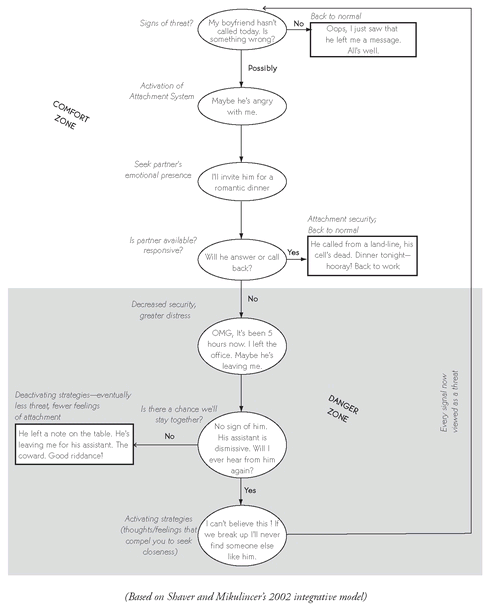

While Emily was with David, in terms of relationships, she lived her life in the danger zone. She felt like a tightrope walker without a safety net, anxiously struggling to keep her emotional balance as she went through endless cycles of activation, with only rare, brief respites of feeling secure before the cycle began again. Her thoughts, feelings, and behaviors were governed by the fact that David was not truly available to her. She felt an almost constant sense of threat to the relationship. She was always busy trying to minimize it by staying close to him—be it by spending many precious hours online at work pretending to be someone else or by constantly talking about him in analysis or to her friends. In this way, she kept him in her mind at all times. All these seemingly erratic thoughts and behaviors—activating strategies—had one goal: to establish closeness with David. Had David been consistently available to Emily, these activating strategies would have been nipped in the bud instead of escalating out of control, and she would never have had to leave the relationship comfort zone.
Now Emily no longer finds herself stuck in the danger zone. Her husband is loving, caring, and most important, available. She is still very aware, however, of the powerful force of an activated attachment system. Were she ever to enter another relationship with someone who wasn’t consistently available, she would most likely revert back to her old “obsessed” self. The thought that something like that could happen again sends chills down her spine.
LIVING IN THE COMFORT ZONE: RYAN AND SHAUNA
Ryan and Shauna were coworkers who fell in love. They’d been together for several months when Ryan left that workplace to take a high-paying job with a prestigious firm. For the first time, the couple didn’t spend their workdays together anymore. When Ryan went on his first business trip with his new colleagues, he missed Shauna and tried to call her. The call went to voice-mail after two rings. He knew that wasn’t right, got really upset, and called again. This time it went directly to voice-mail. He didn’t leave a message. He felt hurt that she had pushed the “ignore” button the first time and then turned off her phone completely the second time. He found it hard to concentrate during his business meeting, but he promised himself he wouldn’t call her for the rest of his trip. Luckily, an hour later Shauna texted to apologize for not picking up—she hadn’t been able to answer because her boss was standing right next to her when he called. He was relieved and called her right back.
Ryan, who has an anxious attachment style, has a sixth sense for attachment-related cues; he is very much in tune with the small details related to his girlfriend’s availability: He paid attention to how many times the phone rang before going to voice-mail. He correctly concluded that Shauna hit the “ignore” button and then turned off her phone, cues that might have gone unnoticed by someone with a different attachment style. He was especially sensitive because he was used to having Shauna three offices down from his, and this was his first trip with his new firm.
Fortunately for Ryan, Shauna has a secure attachment style and was able, without much effort, to effectively respond to him, reestablish contact, and calm his attachment system. Unlike Emily, Ryan did not find himself in the relationship danger zone, because his anxieties were met by reassurance.
Notice that if you feel unsettled in a relationship situation, all that is required is a minimal reassurance from your partner—one text message in Shauna’s case—to get back on track. But if you don’t get that reassurance, your worries about the relationship will quadruple, and it will take a lot more than a simple text to calm your attachment system. This is a very important insight for anyone in a relationship. The more attuned you are to your partner’s needs at the early stages—and he or she to yours—the less energy you will need to expend attending to him or her later.
In fact, had Shauna not reacted as she had, Ryan would have continued to find it hard to concentrate at work (activating strategies), and would probably have either acted distant or exploded on the phone (protest behavior) when she eventually did call. All of which would have been very destructive for the relationship.
Protest Behavior—Letting Your Attachment System Get the Best of You
Excessive attempts to reestablish contact: • Calling, texting, or e-mailing many times, waiting for a phone call, loitering by your partner’s workplace in hopes of running into him/her.
Withdrawing: • Sitting silently “engrossed” in the paper, literally turning your back on your partner, not speaking, talking with other people on the phone and ignoring him/her.
Keeping score: • Paying attention to how long it took them to return your phone call and waiting just as long to return theirs; waiting for them to make the first “make-up” move and acting distant until such time. When Ryan decided not to leave a message for Shauna after she screened his calls, he was keeping score (“If she’s not answering my calls, I won’t leave her a message”).
Acting hostile: • Rolling your eyes when they speak, looking away, getting up and leaving the room while they’re talking (acting hostile can transgress to outright violence at times).
Threatening to leave: • Making threats—“We’re not getting along, I don’t think I can do this anymore,” “I knew we weren’t really right for each other,” “I’ll be better off without you”—all the while hoping s/he will stop you from leaving.
Manipulations: • Acting busy or unapproachable. Ignoring phone calls, saying you have plans when you don’t.
Making him/her feel jealous: • Making plans to get together with an ex for lunch, going out with friends to a singles bar, telling your partner about someone who hit on you today.
Protest behavior is any action that tries to reestablish contact with your partner and get their attention. There are many ways that protest behavior can manifest itself, anything that can jolt the other person into noticing you and responding to you.
Protest behavior and activating strategies can cause you to act in ways that are harmful to the relationship. It is very important to learn to recognize them when they happen. (In chapter 8, you’ll find the relationship inventory, which is designed to help you identify your protest behaviors and find more constructive ways of handling difficult situations.) These behaviors and strategies can also continue long after your partner is gone. This is part of what heartache is all about—the longing for someone who is no longer available to us when our biological and emotional makeup is programmed to try to win them back. Even if your rational mind knows you shouldn’t be with this person, your attachment system doesn’t always comply. The process of attachment follows its own course and its own schedule. This means you will continue to think about the other person and will be unable to push them out of your mind for a very long time.
It turns out that people with anxious attachment styles are particularly susceptible to falling into a chronically activated attachment system situation. A study conducted by Omri Gillath, Silvia Bunge, and Carter Wendelken, together with two prominent attachment researchers, Phillip Shaver and Mario Mikulincer, found fascinating evidence for this. Using fMRI technology, they asked twenty women to think about—and then stop thinking about—various relationship scenarios. Intriguingly, they found that when women with an anxious attachment style thought about negative scenarios (conflict, breakup, death of partner), emotion-related areas of the brain became “lit up” to a greater degree than in women with other attachment styles. What’s more, they found that regions of the brain associated with emotional regulation, such as the orbitofrontal cortex, were less activated than in woman with other attachment styles. In other words, the brains of people with an anxious attachment style react more strongly to thoughts of loss and at the same time under-recruit regions normally used to down-regulate negative emotions. This means that once your attachment system is activated, you will find it much harder to “turn it off” if you have an anxious attachment style.
Understanding the attachment system is crucial for people with an anxious attachment style. Therein lies their chance for a happy, fulfilling relationship.
We’ve divided our guidance for people with an anxious attachment style into two separate routes—the first is for those of you who are unattached. Finding a secure partner in the first place is the best option available for you if you are single. It can work like magic to prevent hardship before it even starts—but going secure might be trickier than you think. The rest of this chapter is dedicated to directing singles with an anxious attachment style toward a secure partner, avoiding pitfalls on the way. The second route is for anyone who has an anxious attachment style—both those currently in a relationship and those who are still on the lookout for the right partner. It entails reshaping your attachment working models—basically rethinking your attitudes and beliefs about relationships from an attachment perspective—as a segue toward retooling yourself with more secure relationship skills. Parts Three and Four are dedicated to this second group.
THE SECRET TO FINDING A GOOD RELATIONSHIP IF YOU ARE ANXIOUS
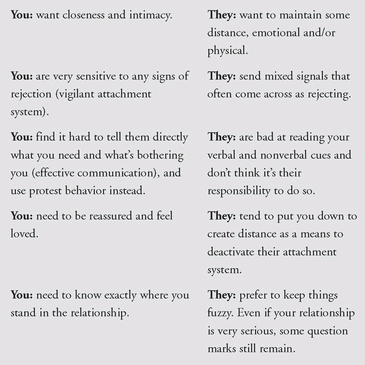
Emily, who you met at the beginning of the chapter, was unaware of attachment science. She didn’t know that she had an anxious attachment style. She was also unaware that the man she was obsessed with, David, had an avoidant attachment style. If she had known, she would have understood that being anxious means that she thrives on intimate, supportive relationships that are stable and long-lasting, and that uncertainty and emotional unavailability get her activated and preoccupied, or in a word, miserable. She would also have known that certain people—namely, avoidants—intensify her worries and feelings of inadequacy, while others—secures—pacify them. Emily, like most anxious people, paradoxically often ends up dating people with an avoidant attachment style even though findings in adult attachment make a clear case for people with an anxious style going well with secures. Why is this so? And most important, how can you find happiness and avoid unnecessary heartache?
GRAVITATIONAL PULL?
A number of studies have looked into the question of whether we are attracted to people based on their attachment style or ours. Two researchers in the field of adult attachment, Paula Pietromonaco, of the University of Massachusetts, and Katherine Carnelley, of the University of Southampton in the UK, found that avoidant individuals actually prefer anxiously attached people. Another study, by Jeffry Simpson of the University of Minnesota, showed that anxious women are more likely to date avoidant men. Is it possible, then, that people who guard their independence with ferocity would seek the partners most likely to impinge on their autonomy? Or that people who seek closeness are attracted to people who want to push them away? And if so, why?
Pietromonaco and Carnelley believe that these attachment styles actually complement each other in a way. Each reaffirms the other’s beliefs about themselves and about relationships. The avoidants’ defensive self-perception that they are strong and independent is confirmed, as is the belief that others want to pull them into more closeness than they are comfortable with. The anxious types find that their perception of wanting more intimacy than their partner can provide is confirmed, as is their anticipation of ultimately being let down by significant others. So, in a way, each style is drawn to reenact a familiar script over and over again.
THE EMOTIONAL ROLLER COASTER
But there’s another reason you might be attracted to an avoidant partner if you are anxious. In Emily’s case, David’s subtle indicators of uncertainty and unavailability made her feel insecure. This is often what happens, even very early in the relationship, if you are anxious and dating an avoidant. Quite soon into the relationship you start to get mixed signals. He (or she) calls, but takes his time about it; he’s interested in you, but lets you understand that he’s still playing the field. You are left guessing. Every time you get mixed messages, your attachment system is activated and you become preoccupied with the relationship. But then he compliments you or makes a romantic gesture that gets your heart racing, and you tell yourself he’s interested after all; you’re elated. Unfortunately, the bliss is very short-lived. Quickly the positive messages become mixed once again with ambiguous ones and again you find yourself plunging down that roller coaster. You now live in suspense, anticipating that next small remark or gesture that will reassure you. After living like this for a while, you start to do something interesting. You start to equate the anxiety, the preoccupation, the obsession, and those ever-so-short bursts of joy with love. What you’re really doing is equating an activated attachment system with passion.
If you’ve been at it for a while, you become programmed to get attracted to those very individuals who are least likely to make you happy. Having a perpetually activated attachment system is the opposite of what nature had in mind for us in terms of gratifying love. As we’ve seen, one of Bowlby and Ainsworth’s most important insights is that in order to thrive and grow as human beings, we need a secure base from which to derive strength and comfort. For that to happen, our attachment system must be calm and secure.
Remember, an activated attachment system is not passionate love. Next time you date someone and find yourself feeling anxious, insecure, and obsessive—only to feel elated every once in a while—tell yourself this is most likely an activated attachment system and not love! True love, in the evolutionary sense, means peace of mind. “Still waters run deep” is a good way of characterizing it.
If You’re Anxious, You Shouldn’t Be Dating Someone Avoidant Because:
THE LAW OF LARGE NUMBERS—WHY YOU ARE MORE LIKELY TO MEET AVOIDANTS WHEN YOU GO OUT ON A DATE
There is one last reason you will probably meet and date a fair share of avoidant people. Consider the following three facts:
• People with an avoidant attachment style tend to end their relationships more frequently. One study found that of individuals who entered a new marriage following a divorce, the avoidant ones were more likely to divorce again. They also suppress loving emotions and therefore “get over” partners very quickly so they can start dating again almost immediately. Conclusion: Avoidants are in the dating pool more frequently and for longer periods of time.
• People with a secure attachment style usually don’t go through many partners before they find one that they happily settle down with. Once things click, they form a long-lasting, committed relationship. Conclusion: People with a secure attachment style take a very long time to reappear in the dating pool, if at all.
• Studies have found that avoidants are unlikely to be in a relationship with other avoidants, because they lack the emotional glue to stay together. In fact, one study that looked at dating couples didn’t find even one pair that was avoidant-avoidant. Conclusion: Avoidants don’t date each other; they are more likely to date people with different attachment styles.
Now let’s put the pieces of this puzzle together.
When you meet someone new, the probability that they have an avoidant attachment style is high—much higher than their relative size in the population—25 percent. Not only are they recycled back into the dating pool more quickly, but they are not dating one another (at least not for long), nor are they dating secure people, that much because secures are less available. Who are they meeting? That’s right: You and other potential partners with an anxious attachment style.
WHAT HAPPENS WHEN YOU DO MEET SOMEONE SECURE?
Let’s say you get past the statistical obstacles and do meet someone secure. Do you realize you’ve stumbled upon a gold mine or do you let it pass you by? Several years ago Rachel tried to set up her neighbor Chloe with her acquaintance Trevor—a real (secure) catch. Trevor, then in medical school, was looking to meet someone new after his girlfriend of ten years left him. He had been with her from the age of 18 to 28. He hadn’t wanted to break up even though she was always discontented; finally she left him. He was very sad for a long while but was ready to start dating again. Trevor was very good-looking, had a great sense of humor, and was a superb athlete. He was strong-willed and stable and came from a well-to-do, educated family. All the traits you would want in a partner, right?
Not quite. Chloe met him once and was utterly uninterested. She conceded that he was very handsome and even attractive, but “the spark was missing.” At the time, Rachel was dumbfounded. She didn’t understand why she was turning him down.
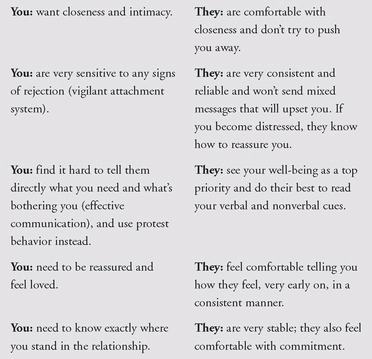
In hindsight, we do understand: If you are anxious, the reverse of what happens when you meet someone avoidant happens when you meet someone secure. The messages that come across from someone secure are very honest, straightforward, and consistent. Secures are not afraid of intimacy and know they are worthy of love. They don’t have to beat around the bush or play hard to get. Ambiguous messages are out of the mix, as are tension and suspense. As a result, your attachment system remains relatively calm. Because you are used to equating an activated attachment system with love, you conclude that this can’t be “the one” because no bells are going off. You associate a calm attachment system with boredom and indifference. Because of this fallacy you might let the perfect partner pass you by.
Chloe had to go through terrible hardship because she assumed an activated attachment system was a prerequisite for love. Tony, who eventually became her husband, seemed confident and intriguing at first, but he never missed a chance to put her down.
Luckily, both Trevor’s and Chloe’s stories have happy endings. Trevor did not stay available for long. He quickly found a great partner and they have been together ever since. They traveled around the world, got married, and had a couple of kids. He is a wonderful father and husband. Chloe had a harder time, but after several years of agony with Tony, she got her act together and learned to appreciate the stability and love of a secure partner. She divorced Tony and later met Bruce, who is as loving and caring as Trevor.
Anyone can have a happy ending like that. It’s not entirely up to chance. The trick is not to get hooked on the highs and lows and mistake an activated attachment system for passion or love. Don’t let emotional unavailability turn you on.
If You’re Anxious, You Should Be Dating Someone Secure Because:
WHAT HAPPENS WHEN YOU FOLLOW COMMON DATING ADVICE?
Say you decide to follow the advice of many popular relationship books. They offer guidelines to help you “land” a partner, such as: Don’t make yourself too available, say you’re busy even when you’re not, don’t call him—wait for him to call you, don’t appear to care too much, act mysterious. Presumably, you preserve your dignity and independence in this way and gain your partner’s respect. But in fact, what you are doing is behaving in a way that is not true to your genuine needs and feelings. You wave these aside to appear strong and self-sufficient. And indeed, these books and the advice they give are right; these behaviors may indeed make you seem more attractive. What they don’t mention, because they are unaware of attachment science, is that they will make you seem more attractive to a very particular kind of partner—an avoidant one. Why? Because, in essence, what they are advocating is that you ignore your needs and let the other person determine the amount of closeness/distance in the relationship. The avoidant person can have his/her cake and eat it too, so to speak—s/he can enjoy the thrill and closeness you naturally project when you are together without having to consider your needs for intimacy and togetherness the rest of the time. By being someone you’re not, you’re allowing another to be with you on his or her own terms and come and go as s/he pleases.
Another problem is that if this type of game playing is only an act for you, it’s going to backfire in the long run. First, your avoidant partner will quickly catch on to you—they are good at detecting people who want to impinge on their autonomy. Second, eventually you’ll think it’s time to let your true colors show. After all, what you really want is to reach a high degree of intimacy, to spend a lot of quality time together, to be able to let down your guard. But you’ll find that when you do so, your avoidant partner will suddenly get cold feet and start to disengage. Either way, you lose, because you are attracting the wrong kind of partner for you.
A COACHING SESSION FOR THE ANXIOUS ATTACHMENT STYLE ON A DATE
1. Acknowledge and accept your true relationship needs.
Do we recommend that you do all the pursuing, fulfill your partner’s every wish, and call incessantly? Definitely not. We suggest a completely different approach. It stems from the understanding that you—given your anxious attachment style—have certain clear needs in a relationship. If those needs are not met, you cannot be truly happy. The key to finding a mate who can fulfill those needs is to first fully acknowledge your need for intimacy, availability, and security in a relationship—and to believe that they are legitimate. They aren’t good or bad, they are simply your needs. Don’t let people make you feel guilty for acting “needy” or “dependent.” Don’t be ashamed of feeling incomplete when you’re not in a relationship, or for wanting to be close to your partner and to depend on him.
Next, use this knowledge. Start assessing people you date on the basis of their ability to meet those needs. Instead of thinking how you can change yourself in order to please your partner, as so many relationship books advise, think: Can this person provide what I need in order to be happy?
2. Recognize and rule out avoidant prospects early on.
The second step is to recognize and rule out people with an avoidant attachment style early on. This is where our questionnaire for deciphering the style of others comes in handy. But there are also other ways to tell whether you’ve met someone avoidant. Arthur Conan Doyle coined the term “smoking gun” in one of his Sherlock Holmes detective novels. A smoking gun has since become a reference for an object or a fact that serves as conclusive evidence of not just a crime but any type of undeniable proof. We like to call any signal or message that is highly indicative of avoidance a smoking gun:
SMOKING GUNS THAT INDICATE YOU’RE DATING SOMEONE AVOIDANT
• Sends mixed messages—about his/her feelings toward you or about his/her commitment to you.
• Longs for an ideal relationship—but gives subtle hints that it will not be with you.
• Desperately wants to meet “the one”—but somehow always finds some fault in the other person or in the circumstances that makes commitment impossible.
• Disregards your emotional well-being—and when confronted, continues to disregard it.
• Suggests that you are “too needy,” “sensitive,” or “overreacting”—thus invalidating your feelings and making you second-guess yourself.
• Ignores things you say that inconvenience him or her—doesn’t respond or changes the topic instead.
• Addresses your concerns as “in a court of law”—responding to the facts without taking your feelings into account.
• Your messages don’t get across—despite your best efforts to communicate your needs, he or she doesn’t seem to get the message or else ignores it.
Note that it is not specific behaviors that threaten to become smoking guns but rather an emotional stance—an ambiguity about the relationship that goes hand in hand with a strong message that your emotional needs are not so important to him or her. He or she may say the right things at times, but his/her actions tell a different story.
As you’ll see in the next section, effective communication is an excellent tool for disarming these smoking guns.
3. A new way of dating: Be your authentic self and use effective communication.
The next step is to start expressing your needs. Most anxious people easily fall into the trap that relationship books—and society at large—set for them. They feel that they are too demanding and needy and so they try to accommodate their partner’s need for distance and boundaries (if they’re involved with someone avoidant). It’s simply more socially acceptable to maintain a cool, self-sufficient façade. So they hide their wishes and mask their discontent. In actuality, you are missing out when you do so, because by expressing those needs you achieve two goals. First, you are being your authentic self, which has been found to contribute to our general feelings of happiness and fulfillment, and being happy and fulfilled is probably one of the most attractive traits you can offer a partner. Second and no less important, once you are your authentic self, if your partner is incapable of meeting your genuine needs, you can determine that early on. Not everyone has relationship needs compatible with your own, and that’s fine. Let them find someone else who wants to be kept at arm’s length, and you can go about finding someone who will make you happy.
What do we mean by “being your authentic self ” and “expressing your needs”? Amir’s patient Janet can illustrate this point well. At 28, she had been going out with Brian for more than a year when he decided to end the relationship. He wasn’t ready to get serious and needed his space. She was absolutely devastated and couldn’t stop thinking about him for many months. She wouldn’t even consider dating anyone else because she still felt so connected to him. Six months later, as though in answer to her prayers, Brian called her and wanted to get back together again. Of course Janet was elated. A couple of weeks into the renewed relationship, Amir asked her how it was going. She said that they were taking things very slow and she was letting him set the pace, as she had in the past. She knew he was afraid of commitment, and she didn’t want to scare him away again.
Amir strongly suggested that instead of falling into the same pattern that Brian set the first time, this time she should make her wishes absolutely clear. After all, he was the one who wanted to get back together, and he had to prove he had changed and was worthy of her love. Amir suggested spelling things out point-blank, as in “I love you very much; I need to know that you are there for me all the time. I want to know I can talk to you every day and not just when it’s convenient for you. I don’t want to have to cover up my wish to spend time with you for fear of driving you away.”
But Janet believed that if she held out long enough, giving him his space and plenty of time, he would learn to appreciate her. That if she played it cool and self-assured, he would be more attracted to her. Perhaps not surprisingly, Janet’s relationship with Brian slowly deteriorated until it finally fizzled out completely. He called less and less, continued to do as he wished without taking her well-being into account, and finally disappeared without even a real break-up talk. If Janet had let her authentic self shine through and used effective communication to voice her feelings and needs, she would have ended the sad ordeal much earlier, knowing she had given it her best shot but that Brian was simply incapable of providing what she needed. Or else Brian would have understood from day one that if he was serious about getting back together, he was going to have to rise to the occasion and take Janet’s needs into account. He would know exactly what was expected of him, no guesswork required.
(For more about how to voice your authentic self using effective communication, see chapter 11.)
4. The abundance philosophy.
As we discussed earlier in the chapter, there are a disproportionate number of avoidants in the dating pool. Another useful step for successfully maneuvering through the pool is what we call the abundance (or “plenty of fish in the sea”) philosophy—understanding that there are many unique and wonderful individuals out there who may be superb partners for you. Try giving several people a chance, without settling on one person very early on, making sure to give a wide berth to those with potential smoking guns.
This calls for a crucial change in your anxious thinking. You tend to assume that meeting someone suitable is an unlikely occurrence, but it doesn’t have to be that way. There are many charming, intelligent people out there who can make you happy, but there are also many who are not right for you. The only way to make sure that you meet potential soul mates is to go out with a lot of people. It’s a simple law of probability—the more you meet, the greater the chances you’ll find the one who is a good match for you.
But it’s much more than just a probability issue. If you have an anxious attachment style, you tend to get attached very quickly, even just on the basis of physical attraction. One night of sex or even just a passionate kiss and, boom, you already can’t get that person out of your mind. As you know, once your attachment system is activated, you begin to crave the other person’s closeness and will do anything in your power to make it work even before you really get to know him/her and decide whether you like that person or not! If you are seeing only him/her, the result is that at a very early stage you lose your ability to judge whether he or she is really right for you.
By using the abundance philosophy, you maintain your ability to evaluate potential partners more objectively. What you are actually doing is desensitizing your attachment system and tricking it into being easier on you. Your system will no longer get so easily activated by one person because it will be busy evaluating the availability of a lot of different people, and you won’t be as likely to obsess about anyone in particular. You can quickly rule out people if they make you feel insecure or inadequate, because you haven’t built all your hopes on them. Why would you waste time with someone who is unkind to you when you have several other potential partners lined up who treat you like royalty?
When you’re seeing several people—which has become very feasible in the Internet and Facebook age—it also becomes easier to make your needs and wishes clear; you’re not afraid that by doing so you’ll chase away a rare prospect; you don’t have to tiptoe around or hide your true feelings. This allows you to see whether someone is able to meet your needs before you reach the point of no return.
Nicky, 31, was an extreme case for whom this approach to dating worked like magic. Nicky was attractive, social, and witty, yet she rarely made it past the first few days or weeks of a relationship. She had a highly anxious attachment style; she craved intimacy and closeness but was so convinced that she would never meet anyone that being alone had become a self-fulfilling prophecy.
In romantic situations, she was very sensitive and got easily hurt and would act defensively, not returning phone calls and remaining silent (using protest behavior) until the relationship would reach a dead end. Later she would torment herself by turning things over and over in her mind (an activating strategy). It would be very difficult for her to let go and move on. Also, by keeping silent and not calling, Nicky seemed to attract a string of avoidant men who felt more comfortable with the lack of communication. But Nicky was not happy.
Finally, at our suggestion, she told all her friends to keep an eye out for potential prospects and also signed up for several online dating services. She started meeting lots of new people, thereby increasing her odds of meeting the right man—a secure man. Dating many people and not having time to get too anxious over any one particular prospect brought about a change in her attitude. Whereas before, she saw every man that she met and liked (and she was picky) as her last chance to find happiness, now prospects were plentiful. It’s not that she didn’t experience disappointments; some men didn’t even get past the first date for one reason or another. But what did change were her anxious thought patterns—her working model for relationships:
• She saw hard evidence that many people found her attractive, even if they didn’t turn out to be the perfect match. So she no longer interpreted unsuccessful dates as proof of some deep-seated problem in her. Her self-confidence increased greatly and it showed.
• When someone she was interested in started to disengage or act avoidant, she found it much easier to simply move on without losing precious time. She could say to herself, “This person is just not right for me, but the next one might be.”
• When she met someone she really liked, she obsessed about him less and didn’t resort as much to protest behavior. Gone (or at least reduced) were the oversensitivity and the defensiveness that made her act in self-defeating ways.
A year after her dating experiment began, she met George. He was warm and loving and he adored her. She allowed herself to open up and be vulnerable with him. These days she often jokes that in a strange twist of fate (although she knows she took an active part in making fate happen), among her friends—many of whom were in long-term relationships since college—she wound up having the happiest, most secure relationship of all!
5. Give secure people a chance.
But the abundance philosophy loses its effectiveness if you fail to recognize a keeper when you find one. Once you’ve recognized someone you’ve met as secure, remember not to make impulsive decisions about whether s/he is right for you. Remind yourself that you might feel bored at first—after all, there is less drama when your attachment system isn’t activated. Give it some time. Chances are, if you are anxious, you will automatically interpret calmness in the relationship as a lack of attraction. A habit of years is not easy to shed. But if you hold out a little longer, you may start to appreciate a calm attachment system and all the advantages it has to offer.
Beware: Attachment Stereotyping
By dividing attachment behavior along gender lines, we can fall into the common trap of equating avoidance with masculinity. Research findings, however, prove that there are many men who are far from being avoidant—they communicate freely, are loving and affectionate, do not retreat during conflict, and are consistently there for their partner (i.e., are secure). Another misperception is that we associate the anxious attachment style with femininity when in fact most women are secure and there are plenty of men who have an anxious attachment style. However, it is important to keep in mind that there are also women who fit the avoidant description. When it comes to attachment and gender, the most important fact to remember is that the majority of the population—both male and female—are secure.
A FINAL WORD
A final word for you—the anxious reader. There is no one for whom attachment theory has more to offer than men and women with an anxious attachment style. Although you suffer the consequences of a bad match and an activated attachment system more intensely, you also stand to gain the most from understanding how the attachment system works, which relationships have the capacity to make you happy, and which situations can make you a nervous wreck. We have witnessed people who have managed to walk away from loneliness to find the companionship they longed for, using the principles outlined in this chapter. We’ve also witnessed people who have been in long-term relationships that brought out the worst in them, but understanding and utilizing attachment principles marked the beginning of a new phase of their relationship—a more secure phase.