4.
Step Two: Cracking the Code—What Is My Partner’s Style?
Figuring out other people’s attachment styles is usually trickier than identifying your own. For one, you know yourself best—not just how you behave but also what you feel and think when you are in a relationship. Second, you can take your own quiz to help with the process. When you start dating someone new, however, you aren’t likely to whip out our quiz and start grilling your date about his or her past relationships. Luckily, without even knowing it, most people give away almost all the information you need to determine their attachment style in their natural, day-to-day actions and words.
The trick is to know what to look for, be a keen observer and ardent listener. In attachment studies, researchers bring people to the lab and ask them about their romantic relationships. The attitudes that people display toward intimacy and closeness and the degree to which they are preoccupied with their relationships determine their attachment style. But from our experience, this information is also readily available outside the lab, if you know what to look for.
Understanding attachment will change the way you perceive new people you meet, but it will also give you surprising insight into your partner if you are already in a relationship.
In dating situations, your thinking will shift from “Does he or she like me?” to “Is this someone I should invest in emotionally? Is he or she capable of giving me what I need?” Going forward with a relationship will become about choices you have to make. You’ll start asking yourself questions like: “How much is this person capable of intimacy? Is he sending mixed messages or is he genuinely interested in being close?” Using this chapter as a guide, with time and practice you will develop and fine-tune your ability to determine someone’s attachment style early on. Keep in mind that when you’re excited about someone, your objectivity is compromised and you tend to create a rosy picture of him or her. Anything that doesn’t fit into this picture fades into the background. In the initial stages of dating, however, it’s important to pay equal attention to all messages coming through and address them securely. This will help you determine if the relationship is right for you and ensure it is going in a positive direction.
If you are currently in a relationship, you might already have an idea about your partner’s attachment style from what you’ve read so far, and you can use the tools provided in the following pages to sharpen your skills. Your thinking will shift as well. You’ll no longer ask yourself, “Why is she always pushing me away?” Instead you’ll say, “It really isn’t about me at all—she just doesn’t feel comfortable with too much closeness.” Uncovering your partner’s attachment style will allow you to better understand the particular challenges that you face as a couple—an essential step toward using attachment principles to improve your bond.
QUESTIONNAIRE: DETERMINING YOUR PARTNER’S ATTACHMENT STYLE
Following is a questionnaire designed to help you establish your partner’s or date’s attachment style.
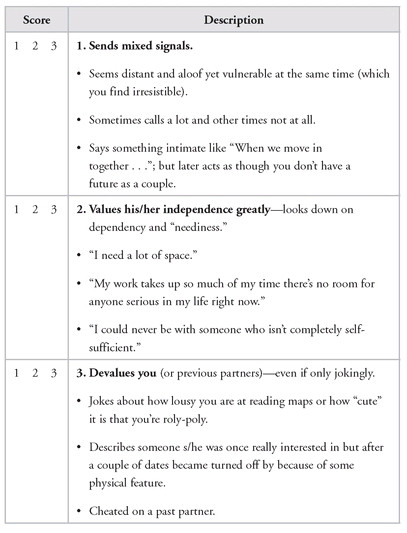
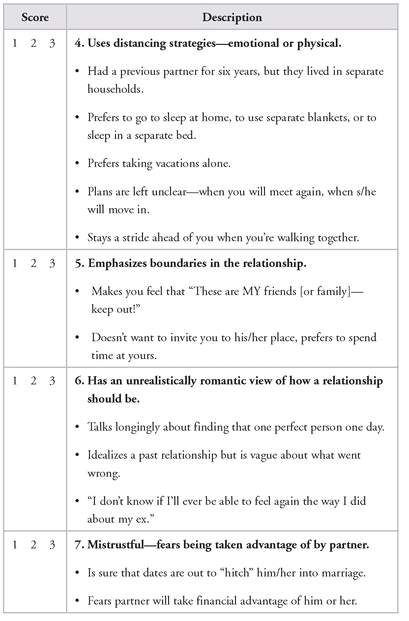
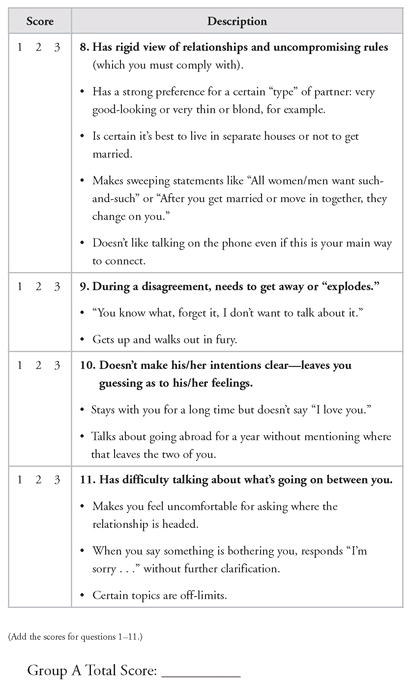
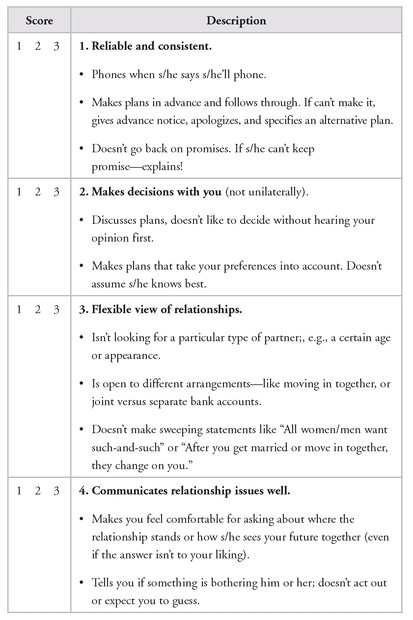
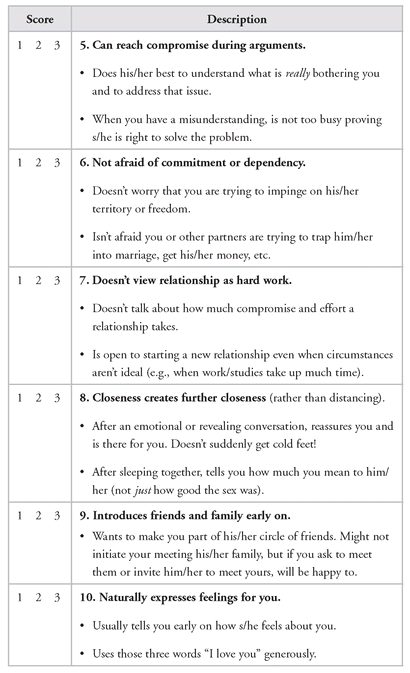
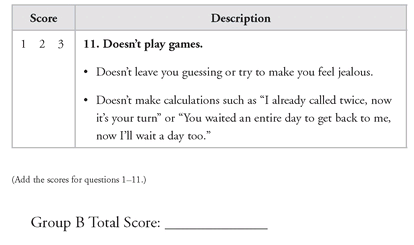
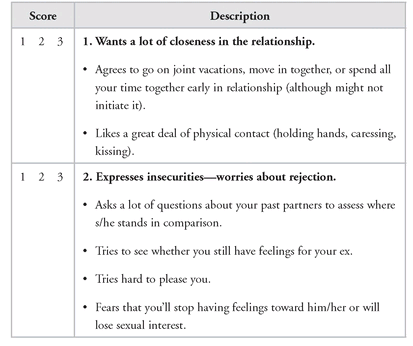
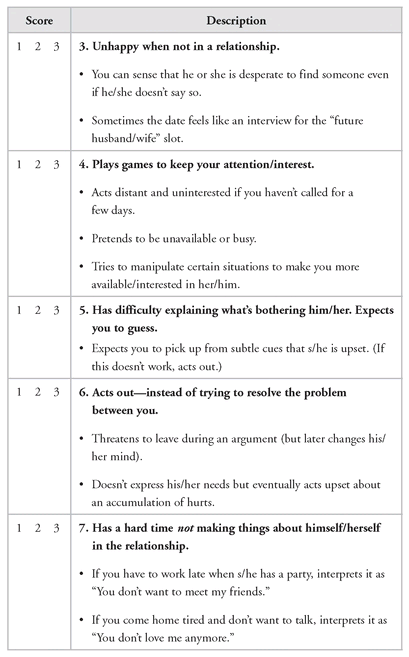
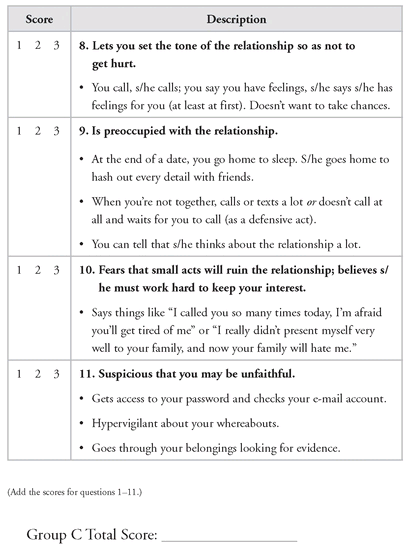
The questionnaire is divided into three groups. Each describes certain characteristics illustrated with a few examples. Note that if the characteristic in general is true of your partner, you should score it as true. It is also enough that only one example, and not all, be true of your partner to mark it as true. After reading each characteristic, decide on the basis of all your interactions and conversations with your partner or date whether it is true of him/her. The truer it is, the higher you should score, based on the following scale:
SCORING KEY 1. Very untrue of him or her
2. Moderately true of him or her
3. Very true of him or her
GROUP A
GROUP B
GROUP C
SCORING KEY
1. 11-17: Very low. Your partner definitely doesn’t have this attachment style.
2. 18-22: Moderate. Your partner shows a tendency toward this attachment style.
3. 23-33: High. Your partner definitely has this attachment style.
As a rule of thumb, the higher the score, the stronger the inclination toward that style. Any score of 23 or above indicates a strong likelihood of a particular attachment style. If your partner is high on two attachment styles, chances are that those are the avoidant and anxious ones. Some of the behaviors of these two styles are outwardly similar (even though they originate from very different romantic attitudes). In that case, go ahead to the “Golden Rules” on page 62 to make a better assessment.
Score of 23 or above for group A: It seems that your partner/ date has an avoidant attachment style. This means that you can’t take closeness and intimacy for granted. Someone secure or anxious has a basic wish to be close; with someone avoidant that basic desire is missing. While they have a need for attachment and love—they too posses a basic mechanism in the brain to get attached—they tend to feel suffocated when things get too close. With avoidants, everyday interactions and conversations, whether they’re about which channel to watch on TV or how to raise the kids, are actually negotiations for space and independence. You often wind up complying with their wishes—because otherwise they will withdraw. Research shows that avoidants hardly ever date one another. They simply lack the glue that keeps things together.
Score of 23 or above for group B: Your partner/date has a secure attachment style. Such people want to be close; at the same time they are not overly sensitive to rejection. They are also great communicators and know how to get their message across in a way that is straightforward yet not accusing. Once you get close to someone with this attachment style, you don’t have to negotiate intimacy anymore: It becomes a given. This frees both of you to enjoy life and grow. They listen to your point of view and try to make things work in a way that will be acceptable to you both. They have an innate understanding of what a romantic partnership means—namely, that your partner’s well-being is your own and vice versa. These qualities allow you to be your most authentic self, which research has shown to be one of the most important factors contributing to your overall happiness and well-being.
Score of 23 or above for group C: Your partner/date has an anxious attachment style. This is not necessarily a bad thing as long as you take the trouble to get into his or her mind-set. Someone with an anxious attachment style craves intimacy but is also very sensitive to even the smallest of perceived threats to this closeness. Sometimes they’ll interpret your unconscious actions as a threat to the relationship. When this happens, they become flooded with apprehension, but they lack the skills to communicate their distress to you effectively. Instead, they resort to a lot of acting out and drama. This can create a vicious cycle as they become even more sensitive to slights and their distress is compounded. This does sound daunting, but before you call it quits, it is important to know that if you’re sensitive and nurturing enough to calm their fears—which is very doable—you will win a greatly loving and devoted partner. Once you are receptive to their basic needs for warmth and security, their sensitivity can become an asset; they’ll be very much in tune with your wants and will be helpful and dedicated. What’s more, they will also gradually learn how to communicate their fears and emotions better and you will need to second-guess them less and less.
THE GOLDEN RULES FOR DECIPHERING ATTACHMENT STYLES
If you’re still in doubt, here are what we call the five Golden Rules to help you home in on his or her attachment style:
1. Determine whether s/he seeks intimacy and closeness.
This is the number-one question to ask yourself about your partner. All other attachment traits and behaviors stem from this one overriding issue. If the answer is no, you can be pretty sure your partner/date has an avoidant attachment style. If the answer is yes, your partner/date has either a secure or anxious style (see chapter 3 to learn more about the two dimensions that determine attachment styles). When trying to answer this question, let go of preconceptions. There is no one type of personality that is avoidant, nor one that is either secure or anxious. He might be cocky and self-assured and still really crave closeness. On the flip side, she might be nerdy and clumsy and still be averse to intimacy. Ask yourself, what does this particular behavior indicate about his or her attitude toward intimacy and closeness? Are they doing or not doing something because they want to minimize intimacy?
Suppose you are dating someone with children from a previous marriage. She might not want to introduce you to them because she is thinking of their well-being and believes it is too early for them to deal with a new man in her life, which is perfectly legitimate. On the other hand, it could be a way for her to keep you at a distance and maintain her separate life. You have to look at the whole picture and see how this behavior fits in. Depending on how much time has passed and how serious the relationship is, does it still seem right for her to be so protective of the kids? What makes sense in the initial stages of the relationship doesn’t make sense after two years. Does she introduce you to other family members and close friends? Has she considered your well-being and explained the situation, allowing you to express your feelings about it? If the answer to any of these questions is no, then this is not just about her children’s best interests; it is more about keeping you at bay.
2. Assess how preoccupied s/he is with the relationship and how sensitive s/he is to rejection.
Does he get easily hurt by things you say? Is he worried about your future together or about whether you love him enough to stay faithful? Is he very sensitive to details in the relationship that suggest distancing, such as when you make decisions that don’t take him into account? If the answer to these questions is yes, it is likely he has an anxious attachment style.
3. Don’t rely on one “symptom,” look for various signs.
Looking at one behavior, attitude, or belief is not enough to determine your partner’s attachment style. That is why there is no one characteristic that can establish someone’s style but rather a combination of behaviors and attitudes that together create a coherent pattern. It is the whole picture that tells the true story. Not being allowed to meet your partner’s kids can be very frustrating, but if she is also able to talk about the subject, listen to your frustration, and find other ways to let you into her life, it doesn’t necessarily indicate an inability to be close.
4. Assess his/her reaction to effective communication.
This is probably one of the most important ways to uncover your partner’s attachment style:
Don’t be afraid to express your needs, thoughts, and feelings to your partner! (See chapter 11 for more on effective communication.) What often happens when we’re dating is that we censor ourselves for different reasons: We don’t want to sound too eager or needy or we believe it’s too soon to raise a certain topic. However, expressing your needs and true feelings can be a useful litmus test of the other person’s capacity to meet your needs. The response, in real time, is usually much more telling than anything he or she could ever reveal of their own accord:
• If s/he’s secure—s/he’ll understand and do what’s best to accommodate your needs.
• If s/he’s anxious—you’ll serve as a useful role model. He or she will welcome the opportunity for greater intimacy and start to become more direct and open.
• If s/he’s avoidant—s/he will feel very uncomfortable with the increased intimacy that your emotional disclosure brings and will respond in one of the following ways:
• “You’re too sensitive/demanding/needy.”
• “I don’t want to talk about it.”
• “Stop analyzing everything!”
• “What do you want from me? I didn’t do anything wrong.”
• He or she will consider your needs on a certain matter only to disregard them again very soon after.
• “Geez, I said I was sorry.”
5. Listen and look for what he or she is not saying or doing.
What goes unsaid or undone by your partner can be just as informative as what he or she is doing and saying. Trust your gut feeling. Consider these examples:
At midnight on New Year’s Eve, Rob kissed his girlfriend and said, “I’m so glad that I’m with you. I hope that this will be the first of many new years for us together.” His girlfriend kissed him back but did not reply. Two months later they separated.
During an argument, Pat told her boyfriend, Jim, that it bothered her that they never made plans ahead of time. She felt more comfortable and secure if she had advance notice and a better sense of their plans. Jim didn’t answer; he just changed the subject. He continued calling only at the last minute. She mentioned it again, but again he ignored her. Finally Pat gave up on the relationship.
In these cases, what Rob’s girlfriend and Jim didn’t say spoke louder than any words.
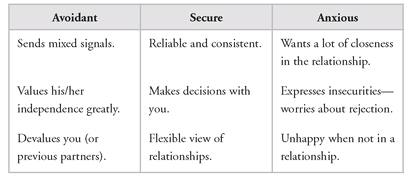
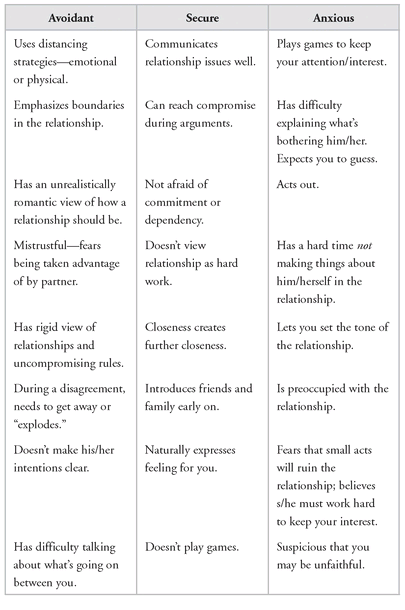
CRACKING OTHERS’ ATTACHMENT STYLE CHEAT SHEET
Golden Rules:
Determine whether s/he seeks intimacy and closeness.
Assess how preoccupied s/he is with the relationship and how sensitive s/he is to rejection.
Don’t rely on one “symptom,” look for various signs.
Assess his/her reaction to effective communication.
Listen and look for what he or she is not saying or doing.
DECIPHERING ATTACHMENT STYLES WORKSHOP
Read the following accounts. Can you identify the attachment style in each case? Cover the answers with a piece of paper if you really want to test yourself, keeping in mind the prevailing traits and Golden Rules we’ve just outlined (see the chart above).
1. Barry, divorced, 46.
Relationship? I don’t want to hear about it now. I am still licking the wounds from my divorce. I want to make up for the time that I was married. I want to feel that women desire me. I want lots of sex. I know I have to be careful, though, because every woman that I go out with immediately starts to fantasize about what kind of father I’ll be to her kids and how our last names will sound together. I’ve been dating someone for almost a year now, her name is Caitlin and she’s great in every way. I know she would love for us to become more serious, but it will take me a long time before I’m ready to trust another woman, to commit and love. But even then I know exactly what I don’t want and what I’m not willing to compromise on. Like what? Well, she’ll have to be financially self-sufficient because I already have one woman milking me dry; I have no intention of supporting two! But there are also some other lines that I’m not willing to cross.
Attachment Style: ________________
Answer: Avoidant. You might be saying to yourself that the guy just went through a divorce and is bound to be cautious. That may be so, but until we hear evidence to the contrary—he’s avoidant. He says that even after he falls in love he will not compromise, that he values his independence, that he’s mistrustful. Notice how he even talks about “her kids”? He could be talking about a woman with children from a previous marriage, but it’s also possible that even when imagining their joint kids, Barry views them as “her kids.” The language that he uses creates distance. He’s also afraid of being taken advantage of by women who want to tie him down in marriage and of being exploited financially. Consider the first Golden Rule: Determine if s/he seeks intimacy and closeness. You know he doesn’t; he talks about wanting to be sought after and a lot of sex but mentions nothing about emotional support or closeness.
2. Bella, single, 24.
Mark and I have been dating for a year and a half. We’re very happy together. Don’t get me wrong, not everything was perfect from day one. There were several things that bothered me about Mark at first. One example is that when we met, Mark was inexperienced sexually, and to be quite honest, I had to literally coach him in bed. I wasn’t going to live the rest of my life sexually frustrated! But that’s ancient history. Also, I’m much wilder than he is. Mark is a serious, down-to-earth type of guy; in fact, at first I thought he was too geeky for me to date. But I couldn’t have made a better choice—Mark is warm and dependable—qualities that are priceless. I love him to bits.
Attachment Style: ____________
Answer: Secure. The clearest and most decisive clue that Bella is secure is the fact that she coached Mark in bed. This is a great example of communicating relationship issues clearly and effectively. She encounters a problem, wants to solve it, and feels confident enough to do so. Were Bella anxious she might blame herself for Mark’s deficiencies in bed; she might conclude that he’s simply not attracted to her and therefore not making that extra effort to please her. Alternatively, she might grin and bear the situation so as not to harm the relationship. If Bella were avoidant, she wouldn’t blame herself, but she might use Mark’s incompetence to belittle him, a distancing strategy, and probably wouldn’t coach him in the matter-of-fact way that she did. It is also apparent that Bella has flexible views of couplehood. Although Mark did not meet her definition of the “ideal man,” she made the mental transition without much hesitation and, more important, is very satisfied with her decision in retrospect. Here too, if she were avoidant, she might make the same compromise, but most likely she would feel cheated for having to make it. Lastly, Bella expresses her feelings for Mark openly and naturally.
3. Janet, single, 23.
I’ve finally met a great guy, a really great guy. Tim and I have been out together twice and I already feel myself falling in love. It’s so hard to find someone I’m compatible with—I’m only attracted to a certain type of man, and then what are the chances he’ll also find me attractive? The odds are against me on this one. So now that I’ve met Tim, I want to make sure I do everything right. I can’t afford to make any mistakes. One wrong move and I could jeopardize the entire relationship. I’m waiting for him to set the pace because I don’t want to seem too eager. Perhaps a text message would be okay? That might seem laid back and spontaneous, don’t you think? Or maybe I’ll forward him some funny e-mail as part of a distribution list?
Attachment Style: __________
Answer: Anxious. Janet is typically anxious. She seeks closeness, feels incomplete on her own, and is very preoccupied with the relationship. Granted, on the first few dates people of all attachment styles get excited about the other person and think about them a lot. However, with Janet it goes a step further—she views relationships as rare and fragile and believes that any small, inappropriate act on her part has the capacity to ruin them. Therefore, she turns over in her head every move she makes, countless times, so as not to make a “mistake.” She also chooses to let Tim set the tone and pace of the relationship. Last, because she’s insecure, she plays games by considering ways of indirectly getting in touch with Tim without putting herself on the line, such as making up a distribution list as an excuse to send him an e-mail.
4. Paul, single, 37.
I just ended my relationship with Amanda. I’m very disappointed, but I know I could never have spent my life with her. We dated for a couple of months and at first I was sure I’d found the woman of my dreams. But different things about her started to bother me. For one thing, I’m convinced she’s had cosmetic surgery and that’s a real turn-off. Also, she’s not that sure of herself, which I find unappealing. And once I stop having feelings toward someone, I can’t stay a minute longer. I’ll just have to keep searching. I know that the right woman is somewhere out there waiting for me, and no matter how long it takes, we will meet and be together. It’s a visceral feeling; I can see her smile and feel her embrace. I know that when we meet I will immediately feel a sense of calm and quietness. No matter how many times I fail, I promise myself that I will continue to look.
Attachment Style: __________
Answer: Avoidant. This one might be confusing. Paul is yearning for the woman of his dreams, so he must be secure or anxious, right? Wrong. His description of an ideal “true love” should raise a red flag. Also, people with different attachment styles tend to explain why they are still alone in a different manner: People who are anxious often feel that there is something wrong with them; secures will have a more realistic view of things, and avoidants often sound like Paul—they attribute their single status to external circumstances, such as not having met the right girl. This is a good opportunity to look beyond what is said to what is not said: If you don’t get a clear understanding of why this person hasn’t met “the one” even though he’s dated a great number of women, you should try to read between the lines. There are also hints in the way Paul describes his relationship with Amanda—he was very excited about her, but after they got close, he started noticing little things about her that turned him off. Devaluing your partner when things become too close is very typical of people with an avoidant attachment style and is used as a way to create emotional distance.
5. Logan, single, 34.
I’ve only dated three people in my life, including Mary. When we met a couple of years ago, I remember Mary was very unsettled by this fact. She kept grilling me about my past relationships, and when she realized I really had told her about all my relationships and was not holding anything back, she looked puzzled and asked if I hadn’t felt I was missing out on something. Hadn’t I been worried that I was by myself for too long? Or that I wasn’t going to find someone? Honestly, the thought that I wouldn’t find someone never crossed my mind. Sure, I had my share of disappointments, but I figured that when the time was right it would happen. And it did. I knew I loved Mary almost immediately and told her so. When did she reciprocate? I’m actually not sure, but I knew she was crazy about me even before she told me.
Attachment Style: ________________
Answer: Secure. There are several clues here that Logan has a secure attachment style. He is not preoccupied with relationships nor does he fear remaining alone, which rules out an anxious attachment style (although it sounds like his girlfriend, Mary, is anxious for these reasons). The question remains whether Logan has an avoidant or secure style. Several indicators rule out an avoidant style: First, he seems to be very forthcoming with Mary about his past relationships, puts all his cards on the table, and isn’t annoyed by her nosiness (and doesn’t embellish his romantic history as someone anxious might do). Second, he feels comfortable expressing his feelings for Mary very early on, which is a typically secure trait. If he were avoidant, he’d be more likely to send mixed signals. Also, notice that he doesn’t engage in any game playing—he doesn’t keep track of when Mary reciprocates; he is simply true to himself and acts in the most genuine manner without letting other considerations rule.
6. Suzanne, single, 33.
This Valentine’s Day will mark the beginning of the year when I will find my husband. I’m tired of being alone; I’m sick of coming back to an empty home, going to the movies by myself, having sex with myself or with some stranger. This year I will find someone wonderful who will be mine! In the past, I devoted myself completely to my partners and got badly hurt. I lost faith in finding someone good. But I have to overcome the fear of getting hurt. I’m willing to put myself out there, willing to take a risk and lose myself. I understand that no pain, no gain, and without me opening my heart there is no chance that someone could enter. I will not give in to desperation. I deserve to be happy!
Attachment Style: ______________
Answer: Anxious. This is a clear account of someone anxious who’s been hurt many times before. She’s very absorbed in finding someone. She wants to get out there and find her soul mate, but because she is unfamiliar with attachment principles, she doesn’t know who to avoid and who to trust. Suzanne is very different from Paul in example 4. She is not looking for the “ideal” partner. We get an idea of what the matter is and why she hasn’t met someone yet—she gets close and then gets hurt, but she continues to yearn for closeness. Paul will not get close until he meets the “right woman.” People like Suzanne are one of the reasons we wrote this book. She desperately wants to meet someone, yet she’s been burned before and fears rejection. She knows the painful fallout of dating the wrong guy and she’s become fearful of that pain almost to the point of giving up. Because she craves intimacy, she feels lonely and incomplete, but she has no clue how to assess potential partners. With knowledge of applied adult attachment, we have seen people like Suzanne learn how to navigate the world of dating, steer clear of avoidants, and land safely in the arms of a nurturing, secure partner.