3.
Step One: What Is My Attachment Style?
The first step toward applying attachment theory to your life is to get to know yourself and those around you from an attachment perspective. In the next chapter, we’ll walk you through the process of determining your partner or prospective partner’s attachment style based on various clues. But let’s begin by assessing the person you know best—yourself.
WHICH ATTACHMENT STYLE AM I?
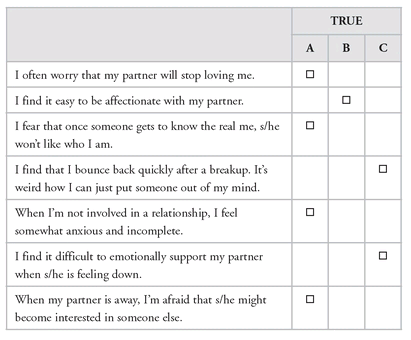
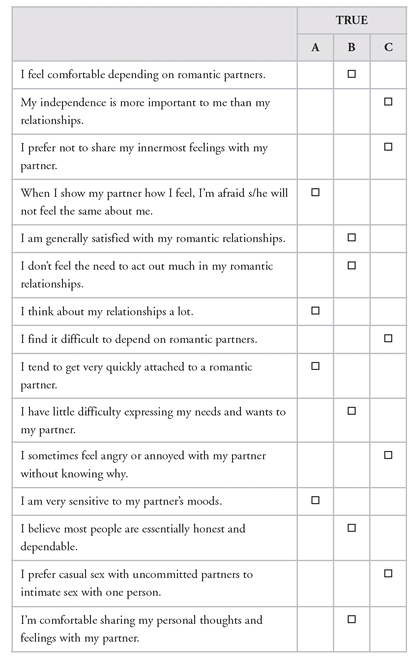
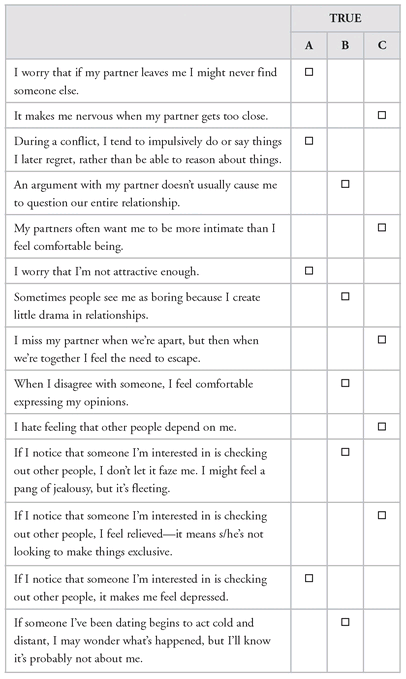
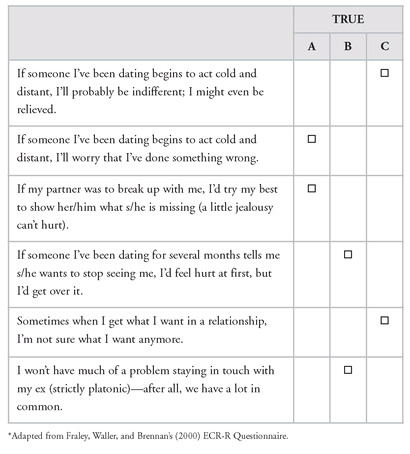
Following is a questionnaire designed to measure your attachment style—the way you relate to others in the context of intimate relationships. This questionnaire is based on the Experience in Close Relationship (ECR) questionnaire. The ECR was first published in 1998 by Kelly Brennan, Catherine Clark, and Phillip Shaver, the same Shaver who published the original “love quiz” with Cindy Hazan. The ECR allowed for specific short questions that targeted particular aspects of adult attachment based on two main categories: anxiety in the relationship and avoidance. We present a modified version that we think works best in everyday life.
Attachment styles are stable but plastic. Knowing your specific attachment profile will help you understand yourself better and guide you in your interactions with others. Ideally this will result in more happiness in your relationships.
Check the small box next to each statement that is TRUE for you. (If the answer is untrue, don’t mark the item at all.)
Add up all your checked boxes in column A: __________
Add up all your checked boxes in column B: __________
Add up all your checked boxes in column C: __________
Scoring Key
The more statements that you check in a category, the more you will display characteristics of the corresponding attachment style. Category A represents the anxious attachment style, Category B represents the secure attachment style, and Category C represents the avoidant attachment style.
Anxious: You love to be very close to your romantic partners and have the capacity for great intimacy. You often fear, however, that your partner does not wish to be as close as you would like him/her to be. Relationships tend to consume a large part of your emotional energy. You tend to be very sensitive to small fluctuations in your partner’s moods and actions, and although your senses are often accurate, you take your partner’s behaviors too personally. You experience a lot of negative emotions within the relationship and get easily upset. As a result, you tend to act out and say things you later regret. If the other person provides a lot of security and reassurance, however, you are able to shed much of your preoccupation and feel contented.
Secure: Being warm and loving in a relationship comes naturally to you. You enjoy being intimate without becoming overly worried about your relationships. You take things in stride when it comes to romance and don’t get easily upset over relationship matters. You effectively communicate your needs and feelings to your partner and are strong at reading your partner’s emotional cues and responding to them. You share your successes and problems with your mate, and are able to be there for him or her in times of need.
Avoidant: It is very important for you to maintain your independence and self-sufficiency and you often prefer autonomy to intimate relationships. Even though you do want to be close to others, you feel uncomfortable with too much closeness and tend to keep your partner at arm’s length. You don’t spend much time worrying about your romantic relationships or about being rejected. You tend not to open up to your partners and they often complain that you are emotionally distant. In relationships, you are often on high alert for any signs of control or impingement on your territory by your partner.
WHAT IF I’M STILL NOT SURE?
When people hear about attachment styles, they often have no difficulty recognizing their own style. Some people tell us right away, “I’m anxious,” “I’m definitely avoidant,” or “I think I’m secure.” Others have a harder time figuring it out. If you scored high on more than one attachment style, you may find it helpful to learn that two dimensions essentially determine attachment styles:
• Your comfort with intimacy and closeness (or the degree to which you try to avoid intimacy).
• Your anxiety about your partner’s love and attentiveness and your preoccupation with the relationship.
What we find particularly helpful is the way in which Brennan and his colleagues present attachment styles in graphic form, which provides a bird’s-eye view of attachment styles that helps you understand how your attachment style relates to those of others. Your location on these two axes determines your attachment style, as the following schematic shows:
THE TWO ATTACHMENT DIMENSIONS
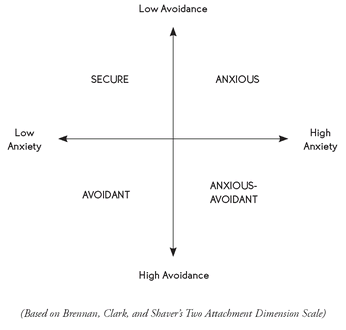
• If you feel comfortable with intimacy with your romantic partner (i.e., are low on intimacy avoidance) and don’t obsess much about the relationship or about your partner’s ability to love you back (i.e., are low on relationship anxiety) but coast along with it—you’re probably secure.
• If you crave intimacy and closeness (i.e., are low on intimacy avoidance) but have a lot of insecurities about where the relationship is going, and little things your partner does tend to set you off (i.e., are high on relationship anxiety)—you’re probably anxious.
• If you feel uncomfortable when things become too close and intimate and value your independence and freedom more than the relationship (i.e., are high on intimacy avoidance) and don’t tend to worry about your partner’s feelings or commitment toward you (i.e., are low on relationship anxiety)—you’re probably avoidant.
• If you are both uncomfortable with intimacy and very concerned about your partner’s availability, you have a rare combination of attachment anxiety and avoidance. Only a small percentage of the population falls into this category and if you are one of them, you can benefit from information on both the anxious and avoidant attachment styles.
Out of the Mouths of Babes
Where do these classifications come from? Interestingly enough, they come from watching babies’ behavior. Attachment styles were first defined by researchers observing the way babies (usually 9 to 18 months old) behaved during the strange situation test (a reunion with a parent after a stressful separation, described on page 29).
Here’s a short description of how attachment styles are defined in children. Some of their responses can also be detected in adults who share the same attachment style.
Anxious: This baby becomes extremely distressed when mommy leaves the room. When her mother returns, she reacts ambivalently—she is happy to see her but angry at the same time. She takes longer to calm down, and even when she does, it is only temporary. A few seconds later, she’ll angrily push mommy away, wriggle down, and burst into tears again.
Secure: The secure baby is visibly distressed when mommy leaves the room. When mother returns, he is very happy and eager to greet her. Once in the safety of her presence, he is quick to be reassured, calm down, and resume play activity.
Avoidant: When mommy leaves the room, this baby acts as though nothing has happened. Upon her return, she remains unmoved, ignores her mom, and continues to play indifferently. But this façade doesn’t tell the whole story. In fact, inside, baby is neither calm nor collected. Researchers have found that these babies’ heart rates are actually just as elevated as other babies who express immense distress, and their cortisol levels—a stress hormone—are high.