Impediment Removal
AUDIENCE
Whole Team
We fix the problems that slow us down.
Impediments. Blockers. Obstacles, barriers, hindrances, snags, threatening risks (also known as looming future impediments). All words describing issues that can derail team performance. They may be obvious. “The network is down.” They may be subtle. “We misunderstood the customers’ needs and have to start over.” Or, “We’re stuck!”
Some impediments hide in plain sight. Some emerge from a complex situation. Some are the symptom of a larger issue, and some don’t have a single root cause, but are a many-headed hydra. Some are an unstoppable force, such as bad weather, with the weight of culture and tradition behind them. And some, the most precious of all, are in your control and easily resolved.
Regardless of their source, impediments hinder the team and can even bring progress to a full stop. Impediment removal gets the team back up to speed.
Some team members expect people with leadership titles to take on impediment removal, but removing impediments is a team responsibility. Don’t wait for your coach or manager to notice and solve your team’s impediments. Take care of them yourself.
Similarly, some teams create impediment or risk boards to keep track of everything that’s in their way. I don’t recommend it. Instead, address impediments as soon as you recognize them. Bring them up in your next stand-up, retrospective, or task planning session, and decide how you’ll overcome each one.
Identifying Impediments
To remove impediments, you must first identify them. Ask questions such as:
-
“What slows us down?”
-
“What do we need that we don’t have yet?”
-
“Where could we make more progress if only…?”
-
“What stopped us or kept us from…?”
-
“What repeatedly contributes to defects time after time?”
-
“What skills do we need that we don’t have yet?”
If your team can’t make progress, but no impediments seem to stand in your way, rely on Willem Larsen’s TRIPE: Tools, Resources, Interactions, Processes, and Environment. [Larsen2021] Add each category to the questions in the preceding list: What Tools slow us down? What Resources slow us down? What Interactions slow us down? And so forth.
Circles and Soup
What should you do about your impediments? Think in terms of “Circles and Soup.” Surrounding each team is a relatively small circle of things they control and a larger circle of things they influence. Beyond that lies the soup: the unchangeable facts of your team’s existence. The soup can neither be changed nor influenced. All you can do is change how your team responds.
The following activity, based on [Larsen2010], uses this idea to help your team decide how to respond to your impediments:
Step one. Use simultaneous brainstorming (see “Work simultaneously”) to identify action items that will improve your team’s ability to get work done. Write each one on a separate sticky note, either physical or virtual.
Step two. Draw three concentric circles on a whiteboard, as shown in Figure 11-2. Leave room for sticky notes in each circle.
Step three. Working simultaneously, place the sticky notes into each category, as follows:
-
Team controls. The team can perform this action itself.
-
Team influences. The team can recommend a change or persuade another party to help.
-
The soup. The team has no control and little ability to influence.
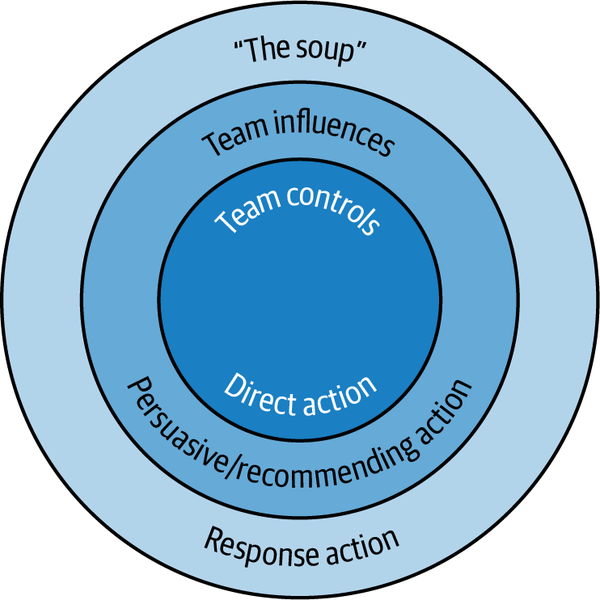
Figure 11-2. Circles and soup
Step four. Choose an item from one of the circles, starting with the innermost circle, and create tasks for it. Repeat as necessary.
Always end by asking, “What else can we do to prevent this from getting in our way again?”
Control: Take direct action
During the daily stand-up meeting, a pair of team members reported an obstacle: “We need help. The business rules for this story don’t make sense to us.” Another team member said, “I’ve seen that one before.” After the meeting, a few people familiar with the problem got together to clear up the misunderstanding. They also discussed ways to avoid similar misunderstandings in future.
In a short retrospective before a break, a remote mob programming team discussed a new background noise. It was making it difficult to hear one another. Then, a team member piped up, “That’s my fan! I didn’t realize it was pointed at my microphone.” The team member adjusted the fan and the distracting background noise stopped.
When your team controls the solution to an impediment, take action and fix it.
Influence: Persuade or recommend
At the weekly retrospective meeting, the team listed “unclear business rules” as an ongoing impediment. The team recorded specific examples of when similar issues had happened in the past, and identified “better access to subject matter experts” as the preferred solution. A senior engineer volunteered to take the examples to one of the team’s key stakeholders so they could come up with solutions together.
When your team doesn’t control the solution to an impediment, but your stakeholders do, ask them to help you.
Effective influencing actions depend on understanding your stakeholders. If you chartered your team’s context, you should have a context diagram that shows your stakeholder groups. (See “Boundaries and interactions”.) As a reminder, your team’s stakeholders are everyone who affects or is affected by your team’s work.
To better understand how to influence your stakeholders, create a stakeholder commitment chart, as shown in Figure 11-3.3
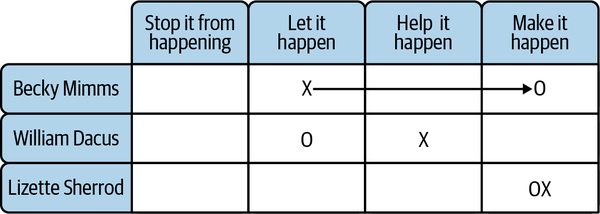
Figure 11-3. Stakeholder commitment chart
Each row of the chart represents a stakeholder’s commitment to helping the team:
-
Stop it from happening. The stakeholder will try to stop you.
-
Let it happen. The stakeholder won’t help you, but they won’t get in your way, either.
-
Help it happen. The stakeholder will help, if you take the lead.
-
Make it happen. The stakeholder will actively drive things forward.
Use the chart as follows:
-
Key stakeholders. List the names of your team’s key stakeholders in the first column. If the stakeholder is a group, use the name of your team’s contact person for the group.
-
Required commitment. Discuss the level of commitment your team needs from each stakeholder. Put an “O” (for “target”) in the appropriate column.
-
Present status. Determine each stakeholder’s level of commitment to removing the impediment. It may require research from team members with political savvy. Put an “X” in the appropriate column.
-
Determine needs. When the X (present status) is to the left of the O (required commitment), draw an arrow from left to right to connect them. This tells the team who they have to move. If there are a lot of shifts, prioritize which stakeholders to work with first.
-
Plan strategy. As a team, decide how you will influence each stakeholder to provide the level of commitment you need.
When you have the commitment you need, you can ask the “help it happen” and “make it happen” stakeholders to help you with your impediment.
Soup: Change your response
After the yearly performance review, the team was disappointed to learn some people were ranked higher than others and got correspondingly higher bonuses. Team members were upset because they were a highly effective team, and everyone contributed to the team’s success. Efforts to make the situation more fair failed: stack ranking was a company-wide policy. So the team agreed that, next year, whoever got the biggest bonus percentage would throw a party for the whole team. It’s not the solution they wanted, but it turned a potentially divisive situation into something they can look forward to.
The soup is “the way things are” in your organization. It connects to organizational culture, business strategy, or business environment. When the solution to your impediment is in “the soup,” you can only change the way you respond.
In any troublesome situation, we have three possible responses: change the situation, change others, or change ourselves. The soup can’t be changed, and changing others isn’t practical, so only one choice remains. Change yourselves. Recognize that the impediment isn’t going away, so make facing the impediment more palatable, as far as possible.
When confronting a “soup” impediment, look for a minimum of three different ways to respond to it. It may help to come up with 5 or 10 different responses, and encourage some of them to be wacky or completely unlikely. Then sift the ideas for the three most viable, and choose one to try.
Questions
What if a team member says nothing is in their way, but we don’t see any progress?
If someone seems stuck, but constantly reports that nothing’s in their way, check in. Something may be happening in their personal life that’s causing them to be distracted at work, and they may feel too vulnerable and unsafe to admit it. Or, they may actually be stuck, but too attached to their task to ask for help, wanting to figure it out for themselves.
Set up a time to talk. Be compassionate. Ask about the behavior that’s prompting you to check in. It’s the only way you can discover the impediment to admitting impediments. Help the team member notice the disconnect between their report and the outcomes. Encourage them to share the issue. Stress that the team collectively owns the work (see “COLLECTIVE OWNERSHIP”) and it’s always okay to ask for help or to hand off a task to someone else. Pairing and mobbing can help prevent this problem.
What if all our impediments are due to other people or teams?
It’s tempting to blame “them” for your problem, but finger-pointing prevents your team from choosing actions it controls. Think about how your team’s behavior is contributing to the problem. Are there ways you can engage differently? Find the part of the dynamic you can own.
Schedule an inter-group conversation with “them” to explore the impediment. (You can ask a neutral party to mediate.) Explain the impact on the team and seek a mutually satisfying solution.
Prerequisites
Every team encounters impediments, but not every impediment can be removed. Some issues will lie beyond your team’s reach, no matter how much they affect you.
Remember to take a broad view. Too much narrow focus on local team impediments leads to solutions that cause new problems or shift the obstacles to someone else. When approaching impediments, try to keep a systems thinking perspective.
Beware of using impediments as excuses for slow progress. It’s easy to turn impediments into scapegoats.
Alternatives and Experiments
Impediment removal is ultimately about helping your team be faster and more effective. Experiment freely.
For example, Appreciative Inquiry turns the situation around. Rather than focusing on team problems, look for what sparks energy for the team, and do it more. Track down the practices or events that move team progress forward. Analyze where things are going well, and explore how the team can create even more similar advantages. Focusing on expanding team strengths often has the effect of reducing problems as a side benefit.
The Lean Improvement kata is another approach that’s focused on longer-term impediments. Jesper Boeg’s book Level Up Agile with Toyota Kata [Boeg2019] is a software-oriented guide to this approach. It’s particularly well-suited to addressing impediments to producing high-quality products.
Further Reading
The Little Book of Impediments [Perry2016] is a thorough examination of how to find, track, and eliminate impediments in a handy ebook format.
3 The stakeholder commitment chart is adapted from [Beckhard1992].