
CHAPTER 16
HIGH-PERFORMANCE LEADERSHIP AND MANAGEMENT
By Steve Bell and Karen Whitley Bell
“Leadership really does have a powerful impact on results. . . . A good leader affects a team’s ability to deliver code, architect good systems, and apply Lean principles to how the team manages its work and develops products. All of these,” the research shows, “have a measurable impact on an organization’s profitability, productivity, and market share. These also have an impact on customer satisfaction, efficiency, and the ability to achieve organizational goals.”1 Yet, Nicole, Jez, and Gene also observe that “the role of leadership on technology transformation has been one of the more overlooked topics in DevOps.”
Why is that? Why have technology practitioners continuously sought to improve the approach to software development and deployment as well as the stability and security of infrastructure and platforms, yet, in large part, have overlooked (or are unclear about) the way to lead, manage, and sustain these endeavors? This holds for large legacy enterprises as well as digital natives. Let’s consider this question not in the context of the past—why we haven’t—but instead for the present and future: why we must improve the way we lead and manage IT2 and, indeed, reimagine the way everyone across the enterprise views and engages with technology.
We are in the midst of a complete transformation in the way value is created, delivered, and consumed. Our ability to rapidly and effectively envision, develop, and deliver technology-related value to enhance the customer experience is becoming a key competitive differentiator. But peak technical performance is only one part of competitive advantage—necessary but not sufficient. We may become great at rapidly developing and delivering reliable, secure, technology-enabled experiences, but how do we know which experiences our customers value? How do we prioritize what we create so that each team’s efforts advance the larger enterprise strategy? How do we learn from our customers, from our actions, and from each other? And as we learn, how do we share that learning across the enterprise and leverage that learning to continuously adapt and innovate?
The other necessary component to sustaining competitive advantage is a lightweight, high-performance management framework that connects enterprise strategy with action, streamlines the flow of ideas to value, facilitates rapid feedback and learning, and capitalizes on and connects the creative capabilities of every individual throughout the enterprise to create optimal customer experiences. What does such a framework look like—not in theory but in practice? And how do we go about improving and transforming our own leadership, management, and team practices and behaviors to become the enterprise we aspire to be?
A HIGH-PERFORMING MANAGEMENT FRAMEWORK IN PRACTICE
Throughout this book, Nicole, Jez, and Gene discuss several Lean management practices that have been found to correlate with high organizational performance—specifically, “profitability, market share, and productivity . . . [in addition to measures that capture] broader organizational goals—that is, goals that go beyond simple profit and revenue measures.”3 Each of these practices is, in some way, synergistic and interdependent with the others. To illustrate how these leadership, management, and team practices work together, and to show the foundational thinking that enables them, we share the experiences of ING Netherlands, a global financial institution that pioneered digital banking and is recognized for its customer-centric technology leadership. Today, IT is leading ING’s digital transformation effort.
“You have to understand why, not just copy the behaviors,”4 says Jannes Smit, IT Manager of Internet Banking and Omnichannel at ING Netherlands, who, seven years ago, decided to experiment with ways to develop organizational learning among his teams. There are many ways we could describe this management practice in action. Perhaps the best way is to take you on a virtual visit—albeit from the pages of a book. (ING is happy to share the story of their learning, but they’re not willing to show you what’s on the walls!) We’ll share with you the sights and sounds and experiences of a day at ING, showing you how practices, rhythms, and routines connect to create a learning organization and deliver high performance and value.
What you see today bears little resemblance to what we first observed as we periodically visited to facilitate what they called “boot camps” to rethink how Jannes and his managers led and managed teams. Like many enterprise IT organizations, they were located offsite from the main campus and were viewed by many as a function rather than as a vital contributor in realizing enterprise strategy. Today, we enter at the main corporate headquarters, where Jannes’ teams are now located one floor below the C-suite. The space is open and light. After security, we pass through a large, open social area—coffee bars and snack kiosks overlooking gardens—designed to create intimate spaces to gather, visit, and share ideas. We then enter the Tribe’s suite. Immediately to our left is a large room with glass walls, creating visibility to the space within. This is the Obeya room where the Tribe lead’s work, priorities, and action items are visualized for the teams and anyone else who may schedule a meeting in this space or visit between meetings to update or review status. Here Jannes meets on a regular cadence with his direct reports, where they can quickly see and understand the status of each of his strategic objectives. Four distinct zones are visualized: strategic improvement, performance monitoring, portfolio roadmap, and leadership actions, each with current information about targets, gaps, progress, and problems. Color coding is used—red and green—to make problems immediately visible. Each IT objective ties directly, in measurable ways, to enterprise strategy (see Figure 16.1).
Figure 16.1: Leadership Obeya (360-Degree Panorama)
Two years ago, ING underwent a significant shift to a multidimensional, matrixed structure organized along lines of business, enabling the continuous flow of customer value (what Lean practitioners call value streams). Each line of business is organized as a tribe delivering a portfolio of related products and services (for example, the Mortgage Services Tribe). Each tribe is comprised of multiple self-steering teams, called squads, each responsible for a distinct customer mission (for example, the Mortgage Application Squad). Each squad is guided by a product owner, led (in case of IT) by an IT-area lead, and sized according to Bezos’ Two Pizza Rule—no team can be so large that it would require more than two pizzas to feed them. Most squads are cross-functional, consisting of engineers and marketers, collaborating as a single team with a shared understanding of customer value. At ING, this team composition is referred to as BizDevOps. Recently, they identified a need for a new bridging structure which they plan to call a product area lead, to align multiple, closely related squads. This new role wasn’t planned—it emerged through experience and learning. There are also chapters, comprised of members of the same discipline (for example, the Data Analytics Chapter), who are matrixed across squads and bring specialized knowledge to promote learning and advancement among squad members. And finally, there are centers of expertise, bringing together individuals with particular capabilities (for example, communications or enterprise architects—see Figure 16.2).
We move on from Jannes’ Obeya, accompanied by Jannes’ internal continuous improvement coaches: David Bogaerts, Jael Schuyer, Paul Wolhoff, Liedewij van der Scheer, and Ingeborg Ten Berge. Together, they form a small but effective Lean Leadership Expertise Squad and coach the leaders, chapter leads, product owners, and IT-area leads who, in turn, coach their chapter or squad members, creating a leveraged effect to change behavior and culture at scale.
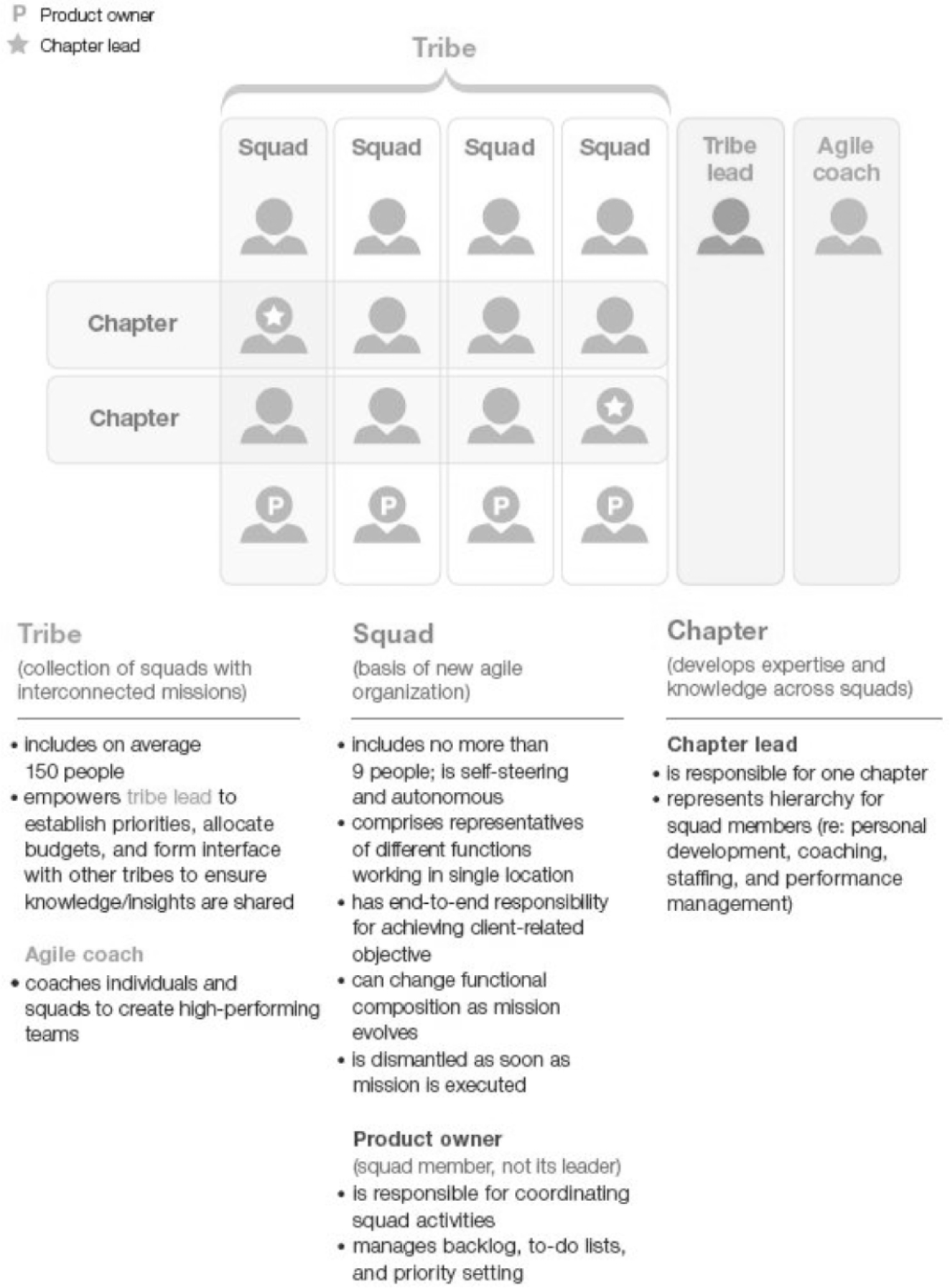
Figure 16.2: ING’s New Agile Organizational Model Has No Fixed Structure—It Constantly Evolves. (Source ING)
Just ahead is a squad workspace—an open area with windows and walls that are covered in visuals (their own Obeya) that enable the squad to monitor performance in real time, and see obstacles, status of improvements, and other information of value to the squad. Across the middle of the space flows a row of adjustable-height tables, with adjustable-height chairs, enabling squad members to sit or stand, facing each other across their screens. The chairs are of different shapes and colors, making the space visually interesting and ergonomically sound. Squad visuals share some characteristics; the similarities in Obeya design enable colleagues outside the squad to immediately understand, at a glance, certain aspects of the work, promoting shared learning. Standard guidelines include visualizing goals, present performance and gaps, new and escalated problems, demand, WIP, and done work. Visualizing demand helps prioritize and keep the WIP load small. The visuals also have some differences, recognizing that the work of each squad is somewhat unique and each squad is the best judge of what information—and what visualization of that information—best serves them to excel at their work.
As we pass through, the squad is conducting its daily stand-up, where rapid learning and feedback takes place. Standing in front of a visual board displaying demand and WIP, each member briefly reports what she/he is working on (WIP), any obstacles, and what has been completed. As they speak, the visual is updated. These stand-ups usually last around 15 minutes; they have significantly reduced the time people spend in meetings compared to the meeting times before daily stand-ups became a way of work.
During the stand-ups, problems are not solved, but there is a routine in place to ensure they are rapidly resolved. If the problem requires collaboration with another squad member, it is noted, and those members will discuss it later in the day. If the problem requires IT-area lead support to resolve, the problem is noted and escalated. The IT-area lead may resolve it quickly, or take it to her/his stand-up to raise it with other IT-area leads or tribe leads to resolve. Once resolved, that information is rapidly relayed back through the channel. The problem remains visualized until it is resolved. Similarly, if the problem is technical in nature, it will be shared with the appropriate chapter or center of expertise. This pattern of vertical and horizontal communication is a leadership standard work practice called “catchball” (see Figure 16.3).
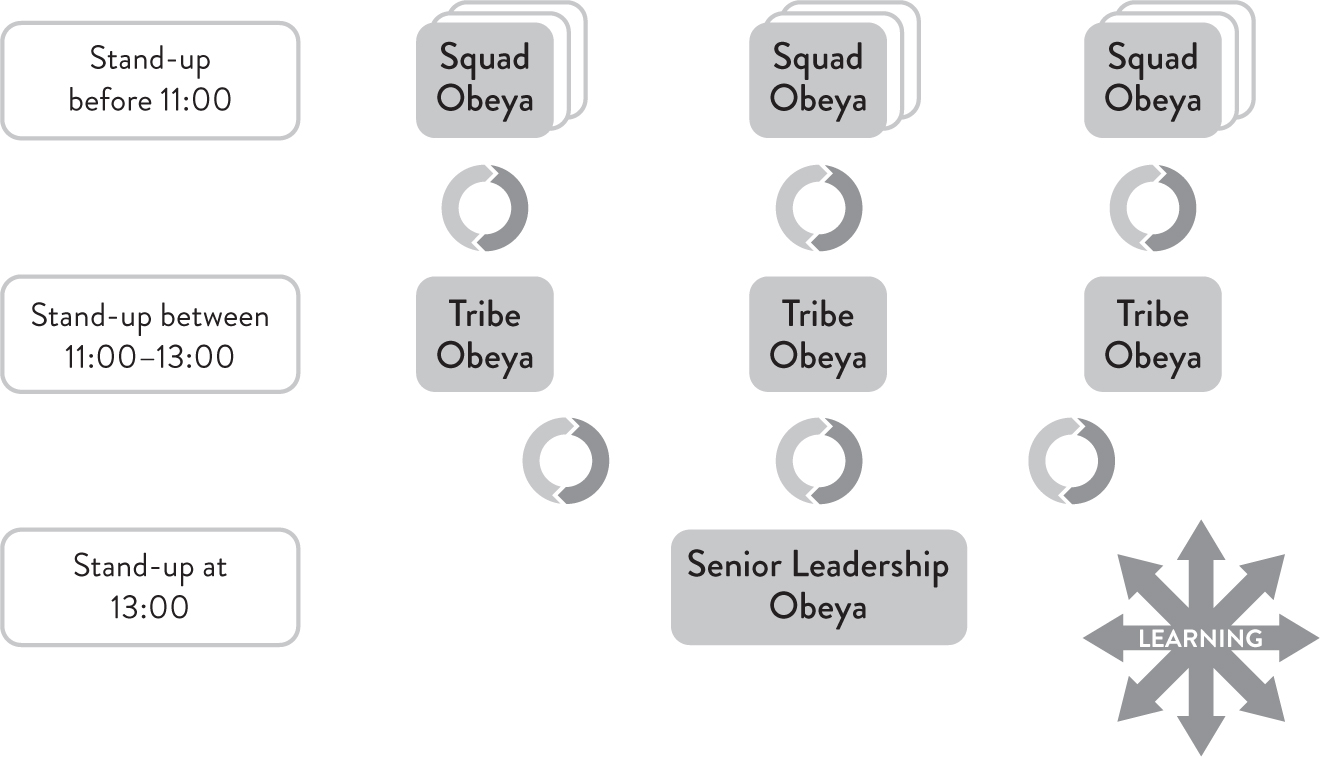
Figure 16.3: Stand-up and Catchball Rhythm
Using the same communication framework, other relevant learning is also relayed among squads, chapters, centers of expertise, and tribes, creating a natural vertical and horizontal flow of learning across all dimensions of the organization. This enables the squads to self-determine how best to craft their work to support overall enterprise strategy and enables effective prioritization. The tribe lead, in this case Jannes, also learns from the squad and chapter members, including lessons learned in their direct interaction with customers. This enables him to adapt his strategic thinking and goals and share insights with his peers and superiors.
This practice of rapid exchange of learning, enabling the frontline teams to learn about strategic priorities and the leaders to learn about customer experience from frontline team customer interaction, is a form of strategy deployment (Lean practitioners use the term Hoshin Kanri). It creates, at all levels, a continuous, rapid feedback cycle of learning, testing, validating, and adjusting, also known as PDCA.
In addition to regular stand-ups with squads, product owners, IT-area leads, and chapter leads, the tribe lead also regularly visits the squads to ask questions—not the traditional questions like “Why isn’t this getting done?” but, rather, “Help me better understand the problems you’re encountering,” “Help me see what you’re learning,” and “What can I do to better support you and the team?” This kind of coaching behavior does not come easily to some leaders and managers. It takes real effort, with coaching, mentoring, and modeling (mentoring is being piloted within the Omnichannel Tribe, with plans for expansion) to change behavior from the traditional command-and-control to leaders-as-coaches where everyone’s job is to (1) do the work, (2) improve the work, and (3) develop the people. The third objective—develop the people—is especially important in a technology domain, where automation is disrupting many technology jobs. For people to bring their best to the work that may, in fact, eliminate their current job, they need complete faith that their leaders value them—not just for their present work but for their ability to improve and innovate in their work. The work itself will constantly change; the organization that leads is the one with the people with consistent behavior to rapidly learn and adapt.
Not far from that squad space in a glass-enclosed meeting space with whiteboard-covered walls, a telepresence monitor, easel pads, and colorful, comfy chairs, we visit with Jordi de Vos, a young engineer whose entire career has been under Jannes’ new way-of-working. Jordi is a chapter lead who also leads the effort toward one of the way-of-work strategic improvement objectives (recall that there are strategic improvement, performance monitoring, and portfolio roadmap strategic objectives). Jordi shares with others what he’s learning about team security—the psychological safety for individuals to openly discuss problems and obstacles with no fear of harm or reprisal. He talks about this and other research he’s discovering, how he’s experimenting to learn what will resonate most among the squads, and what measurable changes are created and sustained. A fixed percentage of each squad’s and chapter’s time is allocated for improvement. Jordi says that the squads think of improvement activities as just regular work.
We ask Jordi what it’s like to work within this culture. He reflects for a moment then shares a story. Jannes’ tribes had been challenged by senior leadership to be twice as effective. “There was a tough deadline and lots of pressure. Our tribe lead, Jannes, went to the squads and said, ’If the quality isn’t there, don’t release. I’ll cover your back.’ So, we felt we owned quality. That helped us to do the right things.”
Too often, quality is overshadowed by the pressure for speed. A courageous and supportive leader is crucial to help teams “slow down to speed up,” providing them with the permission and safety to put quality first (fit for use and purpose) which, in the long run, improves speed, consistency, and capacity while reducing cost, delays, and rework. Best of all, this improves customer satisfaction and trust.
After this visit, we walk past more squad workspaces and more glass-enclosed meeting spaces, each with the same elements but different in their colors, textures, and furnishings. Back in the Leadership Obeya, we meet up with the coaching team for a healthy lunch and reflect on the many positive changes we’ve seen since our last visit. They share reflections on their current challenges and some of the approaches they are experimenting with to continue to spread and grow a generative culture, focusing on “going deep before going wide.” Nevertheless, the pressure is there to scale wide and fast. Right now, one of the coaching team members is focusing on supporting culture change in just a few countries outside the Netherlands. Given that ING operates in over 40 countries, the discipline to allow time and attention for learning, rather than go for large scale change, is remarkable.
Another challenge the coaches are experimenting with is dispersed teams. With recent restructuring, some squads now have members from more than one country, so the coaching team is experimenting with, and measuring, ways to maintain the same high level of collaboration and learning among cross-border squads (it’s very hard to virtually share two pizzas).
Not surprisingly, several of the most senior leaders and several other tribe lead peers want their own Obeya. The coaching team is hoping to approach this slowly enough so that real learning can occur. Transformational, generative leadership extends well beyond what is on the Obeya walls and the rhythm and routine of how you talk about it. “As a leader, you have to look at your own behaviors before you ask others to change,” says Jannes. He will be the first to tell you that he is still learning. And in that, we believe, lies the secret to his success.
After lunch we head to the C-suite where we see a few of the senior leaders’ Obeyas beginning to take shape. We run into Danny Wijnand, a chief design engineer who worked under Jannes until he was promoted last year to lead his own tribe. Danny reflects on the spread of this new way of work, beyond Jannes’ tribes and out into the C-suite and across the rest of ING. “You get impatient wanting to speed their learning but then you realize you went through this yourself, and it took time. Storytelling is important, but they have to have their own learning.”
Back again on the tribe floor, we visit with Jan Rijkhoff, a chapter lead. We wanted to learn about his chapter’s current approach to problem solving. Over the years, they have experimented with different problem-solving methods, including A3, Kata, Lean startup, and others, and finally settled on a blend of elements that they found helpful, creating their own approach. In our walk today, we have seen evidence of multiple problem-solving initiatives in flight and visualized on the walls.
Their approach is to gather the right people who have experience and insights into the problem to rigorously examine the current condition. This rigor pays off, as the team gains insights that increase the probability of identifying the root cause rather than just the symptoms. With this learning, they form a hypothesis about an approach to improvement, including how and what to measure to learn if the experiment produces the desired outcomes. If the experiment is a success, they make it part of the standard work, share the learning, and continue to monitor to ensure the improvement is sustained. They apply this problem-solving approach at all levels of the organization. Sometimes a problem at a senior-leader level is analyzed and broken down into smaller parts, cascading to the chapter or squad level, for front-line analysis and controlled experimentation, with the learning feeding back up. “This approach works,” Paul tells us when we meet up again, “because it helps people to embrace change, letting people come up with their own ideas, which they can then test out.”
Amidst this colorful, creative work environment, with a philosophy of “make it your own,” the idea of standard work may seem to be antithetical, even counterproductive. After all, this is knowledge work. Consider the notion of process (the way something is done) and practice (doing something that requires knowledge and judgment). For example, Scrum rituals are process; the act of understanding customer needs and writing the code is practice. So, when teams have a standard way of work, whether that work is to release effective code or to conduct a team stand-up meeting, following that standard saves a lot of time and energy. At ING, standard work is established not by imitating a way of work that is prescribed in a book or used successfully by another company. Instead, a team within ING experiments with different approaches and agrees upon the one best way to do the work. That rhythm and routine is spread to all similar teams. As conditions change, the standard is reevaluated and improved.
We catch up with Jannes as he concludes his day with a visit to the Leadership Obeya—to add a few Post-It note updates and to see what updates have been made by others. We ask about his thoughts on the journey they’ve been on. “The beginning insight was that our teams were not learning and not improving,” he shared. “We were not able to get them to a level where they would be a continuously learning team. I saw that they wrestled with problems and other teams had solutions, and we were not able to bring them together to learn. When we were not able to learn as management, we were not able to help the teams to learn. We had to learn ourselves to become a learning team. We [his management team] experienced our own learning, then we went to the teams to help them learn to become a learning team.”
We then asked about his approach to culture change. “Before, I never discussed culture,” he said. “It was a difficult topic and I did not know how to change it in a sustainable way. But I learned that when you change the way you work, you change the routines, you create a different culture.”
“Senior management is very happy with us,” he adds with a broad smile, obviously proud of the people in his tribes. “We give them speed with quality. Sometimes, we may take a little longer than some of the others to reach green, but once we achieve it, we tend to stay green, when a lot of the others go back to red.”
TRANSFORMING YOUR LEADERSHIP, MANAGEMENT, AND TEAM PRACTICES
We are often asked by enterprise leaders: How do we change our culture?
We believe the better questions to ask are: How do we learn how to learn? How do I learn? How can I make it safe for others to learn? How can I learn from and with them? How do we, together, establish new behaviors and new ways of thinking that build new habits, that cultivate our new culture? And where do we start?
At ING Netherlands, they began with a leader who asked himself these questions. He then brought on good coaches, tasked with challenging every person (including himself) to question assumptions and try new behaviors. He gathered his management team, saying, “Let’s try this together. Even if it doesn’t work, we will learn something that will help us to be better. Will you join me in this and see what we can learn?”
Each quarter his management team would come together for new learning and, over the next months, put that learning into practice. What, at first, felt uncomfortable for everyone became a little easier and, finally, became a habit—something they just did, just in time for the next learning cycle. They stretched and, just when they felt comfortable, stretched again. All along, they would reflect together and adjust when needed.
We recall in one boot camp session early on we challenged the management team members to develop simple leader standard work routines: visual management, regular stand-ups, and consistent coaching for their team members—replacing the long meetings and fire-fighting behaviors they were accustomed to. To develop this new way of working, first they needed to understand how they currently spent their time. The skepticism and discomfort were obvious; nevertheless, for several weeks each of them recorded and measured how they spent their time each day. They shared what they learned with each other, and together developed new ways to work.
When we returned for the next boot camp three months later, Mark Nijssen, one of the managers, welcomed us by saying, “I’ll never go back to the old way of working again!” Not only was adoption of basic leader standard work successful in helping them improve their effectiveness, they also managed to achieve the goal of making 10% of their time available to work on what they choose.
This willingness to experiment with new ways of thinking and working has led ING to where they are today. But it’s important to recognize that there is no checklist or playbook. You can’t “implement” culture change. Implementation thinking (attempting to mimic another company’s specific behavior and practices) is, by its very nature, counter to the essence of generative culture.
At the end of this chapter is a table representing many of the practices described in this virtual visit to ING. Those marked with an (*) are practices that research shows to correlate with high performance. It’s our hope that future research will explore the full range of practices listed here. This table is not to be used as a checklist but rather as a distillation or general guidelines for developing your own behaviors and practices (see Figure 16.4).
As you have seen in our virtual visit to ING, a high-performance culture is far more than just the application of tools, the adoption of a set of interrelated practices, copying the behaviors of other successful organizations, or the implementation of a prescribed, expert-designed framework. It is the development, through experimentation and learning guided by evidence, of a new way of working together that is situationally and culturally appropriate to each organization.
As you begin your own path to creating a learning organization, it’s important to adopt and maintain the right mindset. Below are some suggestions we offer, based on our own experiences in helping enterprises evolve toward a high-performing, generative culture:
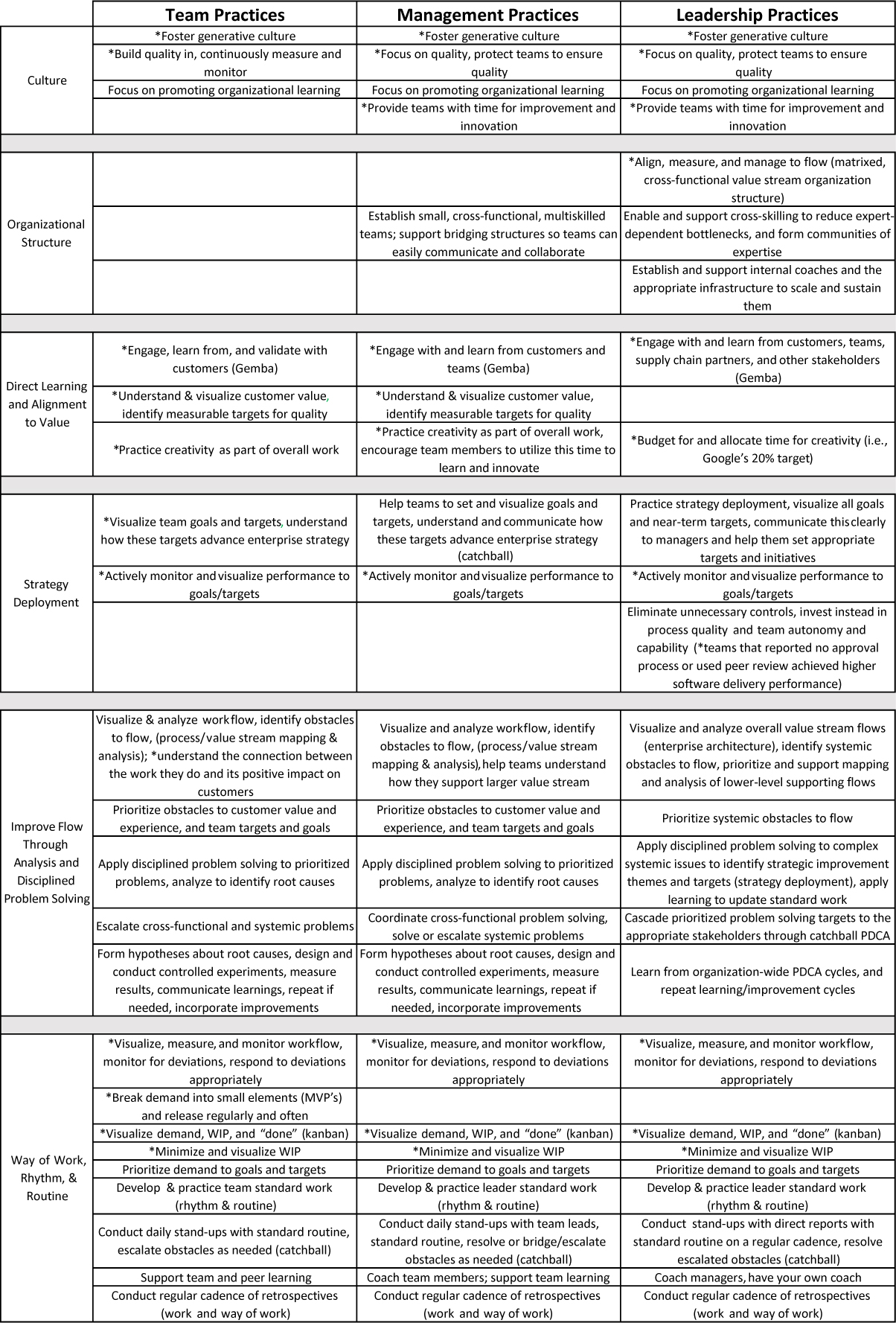
Figure 16.4: High-Performance Team, Management, and Leadership Behaviors and Practices (not a complete list, for a larger, downloadable version visit https://bit.ly/high-perf-behaviors-practices)
As you learn a new way of leading and working, you, and those you bring along with you on this journey, will explore, stretch, make some mistakes, get a lot right, learn, grow, and keep on learning. You’ll discover better and faster ways to engage, learn, and adapt to changing conditions. In doing so, you’ll improve quality and speed in everything you do. You’ll grow your own leaders, innovate, and outperform your competition. You’ll more rapidly and effectively improve value for customers and the enterprise. As the research shows, you’ll “have a measurable impact on an organization’s profitability, productivity, and market share. These also have an impact on customer satisfaction, efficiency, and the ability to achieve organizational goals.”
We wish you all the best on your learning journey!
Steve and Karen
1 See Chapter 11, pp. 115-116.
2 Note from Nicole, Jez, and Gene. The term “IT” is used throughout this chapter to refer to the software and technology process-much more than just a single function within the technology group at a company, like IT support or the helpdesk.
4 This and all other direct quotes from ING staff are personal communications with the authors of this chapter.