8
Alcohol
One thing I learned as a parent of teenagers is that while you can try to set your own tone in your own household, you are really sharing parenting with all the parents of your kids’ friends—adults you might not have otherwise chosen to be intimate role models for your kids. This can be a problem! For instance, an overenthusiastic divorced dad of one of my son’s friends decided to win popularity points with his son by hosting a teen party for which he supplied cases and cases of beer. (Maybe his frontal lobes had not fully myelinated!) I can leave it to the readers’ imagination as to what happened at the party, which wasn’t a mystery, certainly, to the parents who arrived to pick up their offspring. (Many of the partygoers did not yet have their driver’s licenses, and there is a midnight curfew in Massachusetts for under-eighteen drivers.) The alcohol on their kids’ breath was a less-than-subtle hint as to what had happened. Fortunately there were no untoward events or mishaps at the get-together, but the incident should serve as a reminder to parents that we are all in this together and that we are a community of parents trying to bring up a community of adolescents. The problem is that you simply can’t control what other parents do. I used this example with my kids to explain why, when one of my boys was going to a friend’s house for a late-night party or sleepover, I would call the parents of the friend, especially if I’d never met them. While I know I completely embarrassed my sons at times, I stood resolute in my own detective work.
I’ve been lucky. So many others have not. For instance, that very same year there was a story tucked inside the Milford Daily News, a small community newspaper in an old colonial town southwest of Boston. The headline was five simple words: “Taylor Meyer Laid to Rest.” The details of the death were unusual, but sadly, the cause was not. Taylor was a pretty, blond seventeen-year-old, an honors student, who on the evening of Friday, October 17, 2009, was thinking only about having fun with a few of her friends. It was homecoming night for King Philip Regional High School in nearby Wrentham, and Taylor, a senior, started partying early, drinking Bacardi rum from a bottle in the basement of a friend’s house. A short time later she stopped at the home of another friend, where she downed five cans of beer before arriving at the homecoming football game at halftime wearing only a tank top in the cool night air. When the game ended, at least two dozen students, including Taylor, continued to party at a nearby abandoned airport, a local teen gathering spot that had benches and fire pits and plenty of well-sheltered space to drink alcohol without being seen by either neighbors or police.
Taylor drank five more beers at the airstrip, then decided to leave to meet her cousin. Drunk and stumbling, she started off in the wrong direction, was straightened out by friends, then wandered off again. Three days later her body was found, covered with bruises and abrasions, facedown, in a muddy area about a hundred yards from where the party had taken place. Taylor had drowned. At her autopsy, her blood alcohol level was measured at 0.13, nearly twice the legal driving limit.
“If recreational drugs were tools, alcohol would be a sledgehammer,” the psychiatrist Aaron White wrote in a paper for the National Institute on Alcohol Abuse and Alcoholism in 2004. Every day in the United States 4,750 young people between the ages of twelve and twenty take their first full drink of alcohol. According to the National Institutes of Health, any alcohol use by underage youth is considered to be alcohol abuse, and in 2009 more than a quarter of young people—nearly 10.5 million teens—reported taking a drink sometime in the past thirty days. Of the 10.5 million youths who had taken a drink, nearly 7 million admitted to binge drinking, and more than 40 percent of individuals who start drinking before the age of thirteen will develop alcohol abuse problems later in life, according to a report in the Journal of Substance Abuse.
It comes as no surprise, then, that each year approximately five thousand people under the age of 21 die as a result of drinking. In 1965 the average age when a person first used alcohol was 17.5. Now it’s 14. Alcohol saturates American culture. Even when adolescents are not taking a drink, they are being exposed to it. Researchers at Dartmouth’s Geisel School of Medicine in Hanover, New Hampshire, conducted a survey in which they found that teenagers who watch PG-rated movies with scenes of people drinking alcohol are twice as likely as teens who don’t watch these movies, or watch only G-rated movies, to drink alcohol and even to binge-drink. This is not an entirely American phenomenon. In France, where the minimum drinking age is eighteen, teenagers organize vodka parties via Facebook. In 2011 the French city of Lyon banned the nighttime sale of alcohol (except in bars and restaurants) to discourage teenage parties.
The reality is that when adolescents drink, whether in the United States, France, or Finland, they drink a lot, often consuming four or five or more drinks in one session. Binge drinking is defined as consuming more than four or five drinks in a single session—a span of about two hours. Studies have shown that binge drinking typically begins around the age of thirteen and peaks between ages eighteen and twenty-two. The numbers jump dramatically with high school students. More than half of all high school seniors admit to having been drunk at least once, and nearly one million high school students across the country admit to being frequent binge drinkers.
Novelty-seeking, poor judgment, and risk-taking behavior are partly to blame for teenage binge drinking, but there is a social component as well. Scientists have found that college students tend to pattern their drinking on the amounts they perceive their peers to be consuming: if your son’s college roommate downs a six-pack every night, chances are your son will, too. What’s even more alarming, though, is that researchers also found that college students consistently overestimate the amount others drink. In other words, even if your son’s roommate is really drinking only three beers a night, it’s likely your son perceives his roommate to be drinking a six-pack.
As a society we want to prevent alcohol consumption by anyone under the legal minimum age of twenty-one, and we want to prevent it 100 percent of the time—which of course is impossible. Equally ridiculous is for us as a society to say once you turn twenty-one you can drink as much as you want. While we need to have laws and regulations enforced, the problem with having a hard-and-fast line of demarcation for alcohol consumption is that the brain doesn’t suddenly turn on the fully wired switch when a certain chronological age is reached. Also, making anything, especially alcohol, taboo to teenagers makes it that much more attractive. Remember, the teen brain is a novelty-seeking, risk-taking machine.
This fact, however, should not be the only reason to discourage teenage drinking. Every day we read and hear stories about teens who drink and drive and get into accidents, often with tragic results, but the dangers of even moderate use of alcohol by teenagers are far more insidious and lifelong. There are two primary misconceptions we as adults often have about the harms of underage drinking. First, we tend to think an adolescent’s young body and brain are not as mature as an adult’s, and therefore not as equipped to handle the immediate physiological effects of alcohol. On the other hand, because of that very youth and inexperience, we tend to believe a teenager can bounce back more quickly than an adult after a bout of drinking. Teens are resilient, at the height of their physical powers, right?
No. First of all, adolescent brains, compared with adult brains, are much better at handling the sedative aspects of drinking, including drowsiness, hangovers, and the lack of coordination. The neurotransmitter GABA, which inhibits synaptic firing, is enhanced by alcohol, and researchers have discovered that GABA receptors in several brain structures, including the cerebellum (which controls motor coordination), increase in number throughout adolescence. With fewer overall GABA receptors than adults, however, teens, especially young teenagers, experience fewer of the inhibitory effects that are enhanced by higher levels of GABA in adults. Less inhibition of activity in key brain structures such as the cerebellum means less sedation, less impairment of motor skills, and fewer coordination problems. Less inhibition means greater tolerance, and greater tolerance can result in an incentive to keep drinking. Add in peer pressure and the fact that teens spend so much time in social situations and are also more likely to drink in groups, and you have a recipe for alcohol abuse.
Tolerance for the immediate effects of drinking, however, belies the devastating long-term consequences of alcohol on the adolescent brain. More and more studies are turning up evidence of damage to cognitive, behavioral, and emotional functioning. Attention deficit, depression, memory problems, and reduction in goal-directed behavior have all been linked to alcohol abuse in teens. The damage appears to be worse for girls, perhaps because their brains develop slightly earlier than boys’. Alcohol has been shown to affect the size and efficiency of the prefrontal cortex, the site of executive functioning, as well as the hippocampus, so vital to learning and memory. In fact, researchers have shown a direct correlation between hippocampal volume and the age of onset of alcohol abuse. The earlier the use—and the longer the abuse—the smaller the hippocampus. Alcohol blocks glutamate receptors that are key for building new synapses, and this explains why people who drink heavily have major memory problems.
Alcohol can directly affect the way our synapses work, especially those used for memory. Going back to our explanation of synapses and learning, and the process of LTP (long-term potentiation—see Chapter 4), we can see how this works.
Researchers used slices of rat hippocampus and measured LTP at synapses after a burst stimulus. Normally they would expect that the burst stimulus (like a period of memorization) would result in an increase in the strength of the synaptic response to a single stimulus. What they did was bathe the slice in alcohol—or, as we scientists say, EtOH (which stands for ethyl alcohol)—and then try the same experiment with the burst stimulus. (Figure 19.) However, in the presence of EtOH, almost nothing happens. When this is washed out and the very same pathway is stimulated, the synapses are able to respond normally again and show LTP.
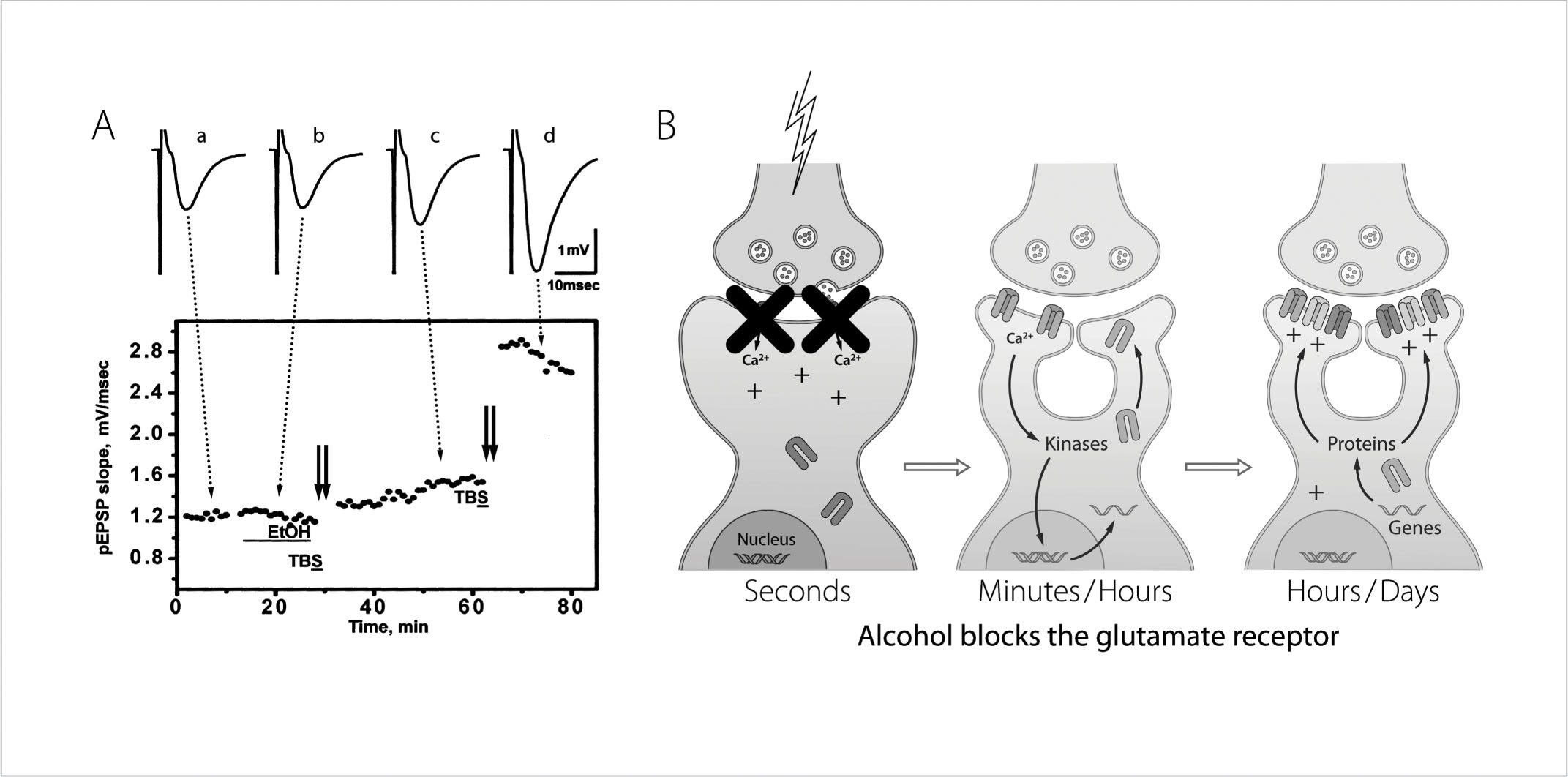
FIGURE 19. Alcohol Decreases LTP: A. Researchers looked at LTP in adult rat brains, presenting the burst stimulus both before (a) and after (b) introducing alcohol (ethanol, or EtOH). EtOH blocked LTP induction, but when it was washed out and the burst stimulus was introduced again (c), the LTP came back (d). B. Alcohol blocks glutamate receptors at the start of the synaptic plasticity process, so no LTP occurs.
This explains why episodes of intoxication often include memory lapses. When alcohol consumption is small to moderate, a person suffers what are commonly called cocktail party memory deficits—the kind of memory lapses that include someone’s name or part of a conversation. In laboratory tests, these alcohol lapses are typically reflected in problems remembering items on word lists or the recognition of new faces. When rapid or binge drinking results in a blackout—a period of time for which the person cannot remember critical information or entire events—the hippocampal damage can be severe, impairing, in particular, a person’s ability to create new long-term memories.
What has been emerging in recent research is that alcohol impairs memory much more easily in adolescents compared with adults. Going back to the LTP experiments, it looks as though brain slices from adult rats show effects of alcohol as just described but that they recover, while slices from adolescent rats cannot recover as easily. (Figure 20.)
The hippocampus is one of only two brain structures that produce new neurons from infancy through adulthood. Hippocampal neurogenesis is important for learning, and learning is affected by alcohol. Michael Taffe at the Scripps Research Institute has used primates to study the effects of binge drinking on the hippocampus during adolescence and has found that alcohol not only kills off neurons in the hippocampus but also impairs the hippocampus’s ability to produce new ones. After controlled experiments with adolescent rhesus monkeys, in which four monkeys were given regular doses of alcohol equal to a strong cocktail for an hour a day, every day, over a period of eleven months, Taffe discovered a significant reduction not just in the number of neurons in the monkeys’ hippocampi but also in the number of neural stem cells. Stem cells, of course, are responsible for generating fresh cells, in this case fresh neurons. But because of the effects of alcohol, the stem cells in the brains of these adolescent monkeys were unable to divide into more mature cell types. After just two months of drinking, there were fewer neuronal stem cells. After eleven months of heavy drinking, the production of neurons in the monkeys’ hippocampi was slashed by more than half, and what neurons remained looked damaged. Interestingly, other studies in rats have shown that alcohol exposure increases a special type of the excitatory glutamate receptor, the NMDA receptor, in the cortex, and overactivation of NMDA receptors can cause brain cells to die, a process termed excitotoxicity. This is actually the same process whereby brain cells die during prolonged seizures and strokes.
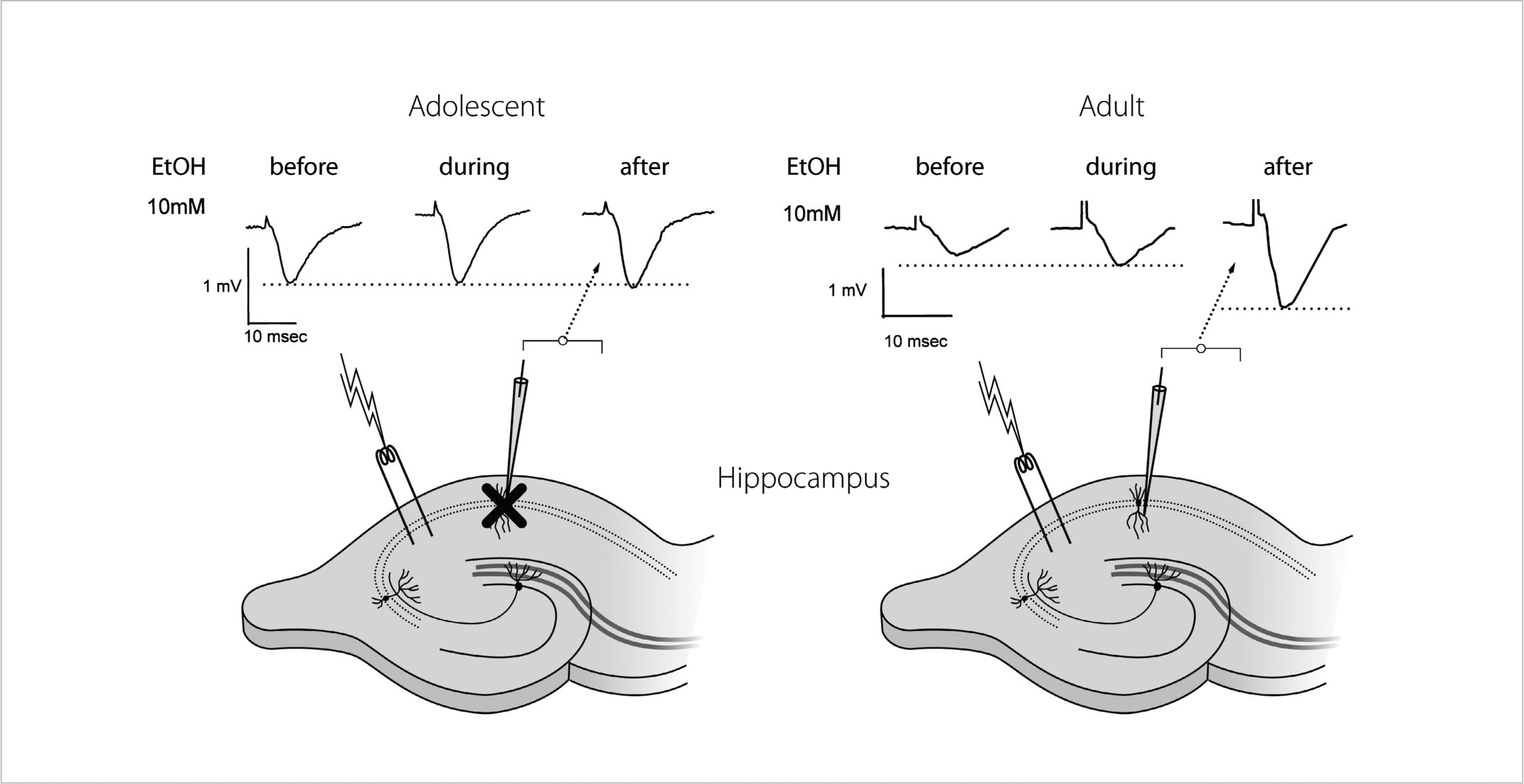
FIGURE 20. Alcohol Affects LTP in Adolescents More Than in Adults: Hippocampal slices from both adolescent and adult rats were exposed to EtOH before a stimulus burst designed to induce LTP. In both, alcohol prevented LTP, but the adult brains recovered more quickly than those of the adolescents.
Scientists talk about alcohol’s effects on memory as a dose-related continuum. On one end of the continuum, where the drinking is light, the level of impairment is mild. On the other end, with severe intoxication, the deficits and impairment are profound. At any place on the continuum, alcohol affects the ability of the hippocampus to turn short-term memories into long-term memories.
An alarming number of college students say they have experienced alcoholic blackouts. When asked in a 2002 study, “Have you ever awoken after a night of drinking not able to remember things that you did or places that you went?” 51 percent of college students said they had blacked out and forgotten various events and information, including incidents of vandalism, fights, unprotected sex, driving, and spending money. An equal percentage of males and females said they experienced blackouts, but females suffered blackouts as a result of significantly less alcohol consumption. This is related to physiological differences between the sexes, with women normally having smaller overall body weight. Allowing for these differences, however, some studies suggest that given comparable doses of alcohol, women may be more vulnerable to milder forms of alcohol-induced memory impairments.
Students’ drinking is a central concern of university administrations and their health centers. Many kids in college are still teenagers, and the term “in loco parentis” is used to describe the surrogate parenting that colleges attempt to provide students. There are as many ways of handling underage drinking as there are institutions of higher education in this country. Some do a better job than others, and often the ones with the strictest and most punitive policies do more harm than good. Still today at many colleges, the policy is that even if a student is not inebriated, if that student brings someone who is inebriated into his or her dorm room, the uninebriated student may still be cited by campus police for underage drinking.
Human studies of binge-drinking adolescents confirm the heavy toll alcohol takes. Rebelliousness, a tendency to engage in harmful activity, depression, and anxiety are just a few of the behavioral traits and emotional disorders that have been associated with alcohol use in adolescence. Children who begin to drink before the age of twelve also have been shown to share certain personality traits, such as hyperactivity and aggression, that may be indicators of risk for future alcohol problems. The harms caused by binge drinking don’t necessarily go away when the hangover does. What scientists have discovered is that alcohol damages a specific patch of the hippocampus called hippocampal area CA1, which contains pyramidal neurons, so called because of their triangular shape. The pyramidal cells specifically help the hippocampus send autobiographical memories—memories of our experiences—into long-term storage. Alcohol blocks the ability of these hippocampal pyramidal cells to do their job, preventing the brain from forming autobiographical memories. In animal studies, researchers have consistently found that memory impairment is greater in adolescents than in adults.
Sporadic but heavy adolescent drinkers perform worse on tests of verbal and nonverbal memory than adolescents who do not drink, and adolescent girls in particular exhibit poorer visual-spatial functioning. Damaged visual-spatial functioning can cause problems in everything from doing mathematics to driving, playing sports, or remembering how to get somewhere. Adolescent boys who drink show greater deficits in attention, such as being unable to focus on something that might be slightly boring for a sustained period of time. One of the experts in this area, Dr. Susan Tapert, a psychiatrist at the University of California, San Diego, says the magnitude of difference between the adolescents who drink and those who do not is about 10 percent, which she likens to the difference between an A and a B on a school test.
Alcohol damages more than just gray matter. White matter, too, has been shown to get “dinged up” in teens who abuse alcohol. We know that white matter, the myelin sheaths that help increase the speed and efficiency of information passing through the brain, continues to develop throughout adolescence and well into early adulthood. In teens with alcohol-use disorders, the white matter of the corpus callosum, the fibers that connect the brain’s two hemispheres and allow them to communicate with each other, becomes damaged, especially in an area called the splenium. Thick and rounded in shape, the splenium overlaps the midbrain, which is the part of the central nervous system associated with hearing, vision, motor control, and the sleep-wake cycle. In one study of twenty-eight teens, those who reported binge drinking had more abnormalities in their white matter than their nondrinking peers. When asked to solve a simple problem, the adolescents with alcohol-use disorders showed less activity in their prefrontal cortex than a control group and had to rely on other areas, such as the parietal cortex, to figure out the answers to the problems. One conclusion, said researchers, is that alcohol use could inhibit the ability of the adolescent brain to consider multiple sources of information when making a decision, force them to use fewer strategies when learning new information, and impair their emotional functioning. Another study showed that white matter damage increased the longer a teen drank and the more withdrawal symptoms the teen experienced.
Alcohol dependence has two common effects during withdrawal: a sluggish prefrontal cortex and a decrease in dopamine receptors, which leads to tolerance, meaning it takes increasingly larger amounts of alcohol to produce the same high. Moreover, it is likely, say researchers, that the effect of alcohol abuse on a teen’s still-maturing prefrontal cortex will increase the desire for more alcohol. In fact, children and adolescents who begin drinking before the age of fifteen are four times more likely to develop alcohol dependence later in life than those who begin drinking at the legal minimum age of twenty-one.
After about a decade of solid research coming out of clinical as well as basic science studies on the effect of alcohol on teen brains, the American Academy of Pediatrics finally published a policy statement on the topic in 2010. In this statement, these experts said that schools, pediatricians, and the media needed to do a better job making the public aware of the unique vulnerabilities of this age group to alcohol. Actually making this a reality has been a challenge, and is likely to require much investment by private as well as public sources.
One of the biggest contributing risk factors for adolescents who drink is a family history of alcohol abuse. Some seven million youths under the age of eighteen are children of alcoholic parents, and researchers have found that about 50 percent of the risk of developing alcohol dependence is genetically influenced. Environment, however, counts for much of the other 50 percent. Social learning experts have found that children, especially teenagers, model their behavior on the adults who are most important to them and with whom they most frequently interact. Those who are monitored closely by their parents or guardians and who are given clear rules are less likely to abuse alcohol. In a study of three hundred teens and their parents, Caitlin Abar at Penn State found that those parents who heartily disapproved of underage drinking tended to have teenagers who engaged in less binge drinking once they got to college. Conversely, those parents who were less strict and more accepting of adolescent drinking were more likely to have teens who engaged in risky drinking behavior in college. Teens with lax parents were also more likely to surround themselves with friends who abused alcohol.
Parents’ mistake, say researchers, is buying into the belief that allowing their teenagers to drink at home with friends will lead the teens to drink responsibly. Instead, says the Dutch researcher Haske van der Vorst, “the more teenagers drink at home, the more they will drink at other places, and the higher the risk for problematic alcohol use three years later.”
On the flip side, there is positive news from researchers on the influence and effect of parents talking with their teens about drinking. Abar also discovered parents can shape adolescent behavior, at least while teens are still living at home. During my kids’ high school years, there were so many instances of underage drinking that occurred when parents were out of the house. Once again, being a single mother, and also very aware of the legal implications, I had a lock installed on the liquor cabinet in the house. The peace of mind this gave me was priceless, especially when I left my kids alone with their visiting teenage friends or went to bed hours earlier than the sleepover gang in the basement. I only wished I could count on that being the case at the homes my kids visited. The best you can do is be that annoying parent who calls up and asks the host parents whether they will be home during the party, etc. I tried to do this behind the scenes and keep this dialogue parent to parent. I have to say, I was always grateful to have parents call me up and ask the very same question: I certainly did not take it personally, and no one should.
Alcohol and the risks and rewards of drinking should be introduced to kids slowly. They’re impressionable and hungry for information of all kinds, so if we give them the necessary information about the pros and cons of drinking so they can make good decisions about alcohol, then that learning should take hold.
Every weekend, thousands of teenagers across the country will consume alcohol. Many of them will drink way too much; some may even pass out. All are likely to suffer some form of damage to their brains that may well be permanent. Many of those teens will also get into cars that are driven by other alcohol-impaired teens. Almost all of them will make it home again. A few, like seventeen-year-old Taylor Meyer, who drowned in a muddy puddle at the edge of an abandoned airfield, will not. A month after the Massachusetts teen’s death in 2009, police arrested a dozen intoxicated adolescents at a party not far from the airfield where they had once gathered to drink with Taylor Meyer and where the young girl had died. Many of them were wearing pink bracelets in honor of their dead friend—and drinking to her memory.