6
Taking Risks
After I was a guest on National Public Radio in March 2010 talking about the teenage brain, I received an avalanche of letters and e-mail. One woman wrote to me about her grandson, with whom she’d always been close. During high school he had become a heavy user of marijuana and alcohol. He was fined for speeding on one occasion, cited for reckless driving on another, and finally arrested and charged with DUI. Like many of the other e-mails and letters I have received over the course of the last few years, mostly from women and men I’ve never met, her message ended with a plea: “This is breaking my heart. He is a bright, handsome, beautiful young man and he is killing himself.”
Parents and teachers know that adolescents are impulsive and more prone than either children or adults to taking risks. Novelty and sensation-seeking seem to motivate every act. And if it’s not about risk-taking, then it’s about rebellion—against parents, against teachers, against anyone in authority. Evolutionarily, this kind of behavior makes sense. Adolescence is the time of life when the young separate from the comfort and safety of their parents in order to explore the world and find independence. Experimental behavior is actually important for adolescents to engage in because it helps them establish their autonomy. The problem for teens is that their underdeveloped frontal cortex means they have trouble seeing ahead, or understanding the consequences of their independent acts, and are therefore ill equipped to weigh the relative harms of risky behavior. No matter how evolutionarily adaptive risk-taking and adventure-seeking are in the long run, in the short run there are outsize dangers.
While risky behavior has been a hallmark of adolescence for millennia, today’s world poses special challenges, possibly greater than at any other point in human history. Increased access to “risk” via media, the Internet, and travel is commonplace and part of every teenager’s life. In centuries past most teens were neatly tucked away on farms. Their range of movement and access to information were limited. And the environments in which they did roam were usually overseen or controlled by adults—parents, teachers, and other authority figures. That meant the potential for bad consequences of risky acts was also limited. It’s important for us as parents to remember that just as there are many more bad choices available for teens today, there are many more good ones as well, and we should encourage positive information and experiences for our children.
Left to their own devices, adolescents frequently access stressful, inappropriate, even dangerous information on the Internet. It is likely that information has led to copycat self-harm behaviors such as cutting and even suicide in depressed kids. Teens are very vulnerable to the power of suggestion, and there are a lot more suggestions now at their fingertips via the computer. Similarly, statistics show that substances of abuse are much more readily available than they have been in the past, and unlike other generations, today’s teens only have to send a text on a smartphone to gain instant access to a source of illicit drugs.
Scientists have a term for risk-taking, “suboptimal choice behavior,” and for the most part adults chalk up the suboptimal choices of teenagers to their impulsivity, irrationality, youthful egocentricity, or pervasive sense of invulnerability. Even Aristotle weighed in on “crazy” Greek teenagers more than two thousand years ago when he wrote that young people thought and behaved differently from adults because they were “passionate, irascible, and apt to be carried away by their impulses.” He also wrote that young people were slaves to their passions because “their ambition prevents their ever brooking a slight and renders them indignant at the mere idea of enduring an injury.” In other words, he concluded that teenagers are so self-focused, so unreasoning, and so prone to feeling invincible that they never consider the possibility that they might hurt themselves doing something that adults would never do. Yet “irrationality,” “self-absorption,” and “invincibility” are labels for an adult who would do these risky things. It is hard to use these terms in the same way with a teenager.
No matter the evidence of their peculiar, sometimes infuriating behavior, teenagers are not irrational. Contrary to that popular misconception, a person’s reasoning abilities are more or less fully developed by the age of fifteen. In fact, adolescents appear to be just as adept as adults in their ability to logically assess whether a certain activity is dangerous or not. This is why teens can, in fact, get very high scores on aptitude tests, such as the SAT, which relies wholly on logic and rational deduction.
So why do teens do some of the crazy things they do? In general, teen brains get more of a sense of reward than adult brains, and as we learned earlier, the release of, and response to, dopamine is enhanced in the teen brain. This is why sensation-seeking is correlated with puberty, a time when the neural systems that control arousal and reward are particularly sensitive. But because the frontal lobes are still only loosely connected to other parts of the teen brain, adolescents have a harder time exerting cognitive control over potentially dangerous situations. Adults also are better able to access a network of frontal brain areas than adolescents, whose brain regions engage in more “connectivity” to assess risks, rewards, and consequences.
In a study of 245 people, ages eight to thirty, University of Pittsburgh researchers monitored the ability of subjects to inhibit their eye movements. Instructed to look at a light on a screen in a dark room, the volunteers were told to look away from a second, flickering light when it appeared. The natural tendency of the brain is to be curious and to follow the novel information—especially if it is forbidden. This response inhibition, as it is called by psychologists, is poor in children and much better in adolescents. In fact, by the age of fifteen, if teenagers are sufficiently motivated, they can score nearly as well as adults. What fascinated the Pittsburgh scientists was the difference in brain scans between adolescents and adults. Although adolescents scored similarly to adults, adults used far fewer brain regions but could engage their frontal lobes, and this made them better able to resist temptation. Hence, adolescents had to put much more effort into staying away from what was forbidden.
In another unusual brain-scanning experiment, scientists at Dartmouth College showed that adolescents use a more limited brain region and take more time than adults—about a sixth of a second more—to respond to questions about whether certain activities, like “swimming with sharks,” “setting your hair on fire,” and “jumping off a roof,” were “good” ideas or not. Adults in the experiment appeared to rely on nearly automatic mental images and a visceral response to answer the questions. Adolescents, on the other hand, relied more on their ability to “reason” an answer. The ability to quickly grasp the general contours of a situation and make a good judgment about costs versus benefits arises from activity in the frontal cortex, the same areas that we keep coming back to, the parts of the brain that are still under construction during adolescence.
Adults are also better at learning from their mistakes, courtesy of areas in and around the frontal lobes including their developed anterior cingulate cortex, which can act as a kind of behavioral monitor and help detect mistakes. During fMRI experiments, when adult subjects make an error, their cingulate cortex lights up as if to say, “Oh boy, I’d better make sure not to do that again.” This part of the brain is still being wired in teenagers, making it more difficult for them, even when they recognize a mistake, to learn from it.
This is what I tried to explain to one woman who read an article I’d written about the teenage brain and e-mailed me in April 2011 about her eighteen-year-old daughter. “She is a great teen, but never thinks things through,” the woman wrote. “Her friends, coaches, teachers, etc. all love her. She has a big heart and really wants to do all the right things but it does not always work out that way. I have been on her about everything from smoking, drinking, etc. It always seems she needs to learn from her mistakes.”
The chief predictor of adolescent behavior, studies show, is not the perception of the risk, but the anticipation of the reward despite the risk. In other words, gratification is at the heart of an adolescent’s impulsivity, and adolescents who engage in risky behavior and who have never, or rarely, experienced negative consequences are more likely to keep repeating that reckless behavior in search of further gratification. This reward-seeking impulse is located deep in the brain in two areas, the nucleus accumbens and the ventral tegmental area (VTA). These structures belong to the brain’s pleasure center because they are responsible for releasing dopamine when a person contemplates or anticipates a reward (eating food, obtaining money, taking drugs, etc.). In effect, the nucleus accumbens both alerts us to the possibility of pleasure and motivates us when we are in a position to experience that pleasure. It turns out that this area is much more susceptible to the powers of addiction in the adolescent brain compared with the adult brain. Experimental studies in rats show that the dopamine neurons in these areas are more active and more responsive in the adolescent than in the adult. Without a fully myelinated frontal lobe to provide inhibition, this can drive risk-taking behavior higher.
Neurons, in general, fire at much higher rates in adolescent brains, making them “at the ready” to be co-opted to engage in addictive behavior. How does addictive behavior come about? It turns out that addiction is really a specialized form of memory. As we learned in Chapter 4, addiction is a form of synaptic plasticity, or LTP, except that the action is not in the hippocampus but in the nucleus accumbens and the ventral tegmental area—key areas for the reward circuit. Just like LTP and memory, addiction happens because a drug or another pleasurable stimulus strongly activates these synapses. As a result, these very plastic and active synapses respond by strengthening their connections, which causes more dopamine to be released in response to each stimulating experience. Hence the craving builds much faster in the adolescent brain than in the adult brain: neurons are more active to start with and have an exaggerated plasticity in response to exposure to the addictive stimulus. Addiction, therefore, is more strongly “hardwired” into the adolescent brain, and as rehabilitation centers well know, detox is much harder and fails more often in adolescents, too. Indeed statistics show that the under-twenty-five population is the fastest-growing age group at inpatient rehab centers.
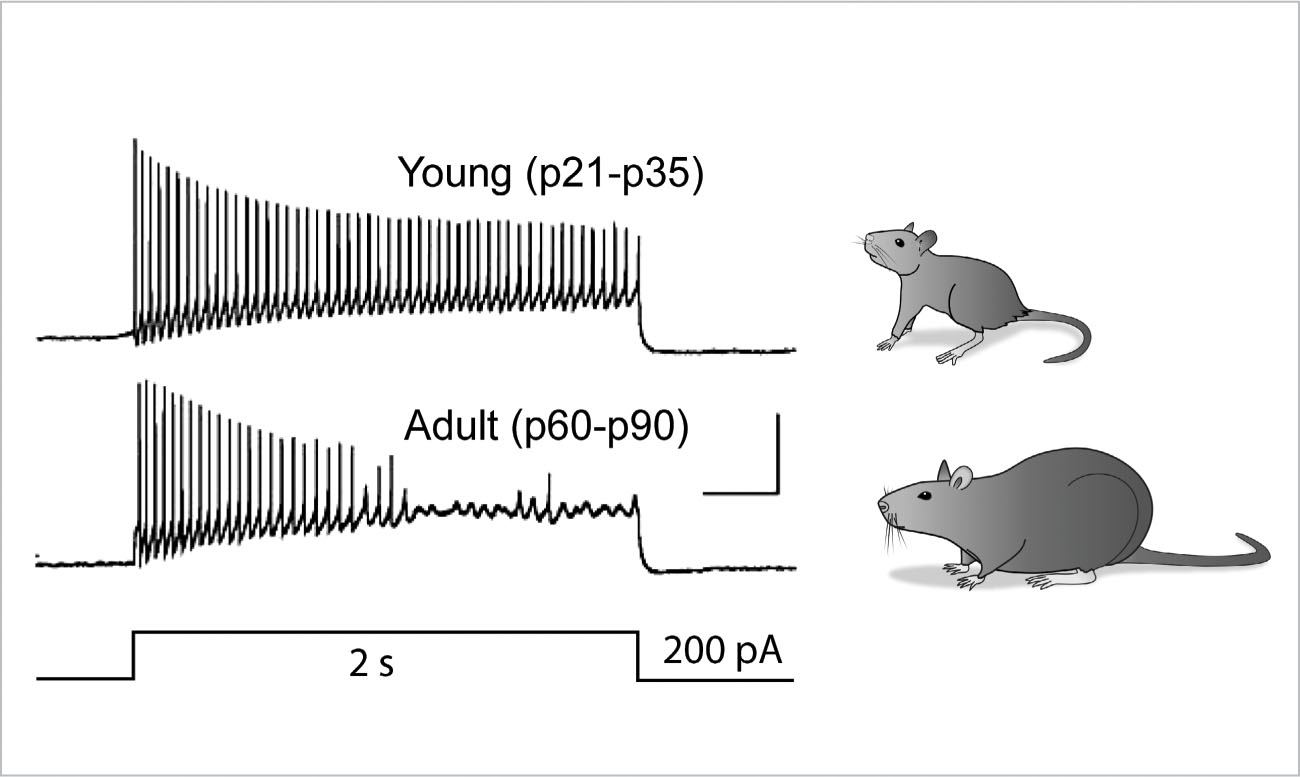
FIGURE 15. Ventral Tegmental Area (VTA) Dopamine Neurons from Young Mice Are Able to Fire More Action Potentials (pA) Than Those from Adult Mice When Stimulated: The VTA is a major part of the reward circuit, and is more active in adolescents’ brains than adults’. As a result, teens have an increased propensity to seek rewards.
Risk and reward are inextricably linked and, not surprisingly, share many brain structures. While the nucleus accumbens and VTA house reward circuits, their activity is also controlled by the frontal lobes. In the adult, fully myelinated brain, the responsivity of these areas can be muted by the frontal lobes in the form of impulse control.
Impulse control can actually be measured in humans. Stanford scientists examined the brain activity of subjects who were asked to make financial decisions by choosing between two fake stocks. When the experimental task was adjusted to elicit risk-taking behavior—that is, to get the subject to choose the riskier, but higher-reward, stock—the subjects’ nucleus accumbens showed heightened activity. The researchers discovered that activity in this brain structure was highest before the subject chose the high-risk/high-reward stock—that is, when the subject was merely in a state of anticipation. It wasn’t the actual monetary reward but simply the expectation of the reward that set the nucleus accumbens buzzing. The researchers concluded that heightened positive emotions or states of arousal are indicators of a likeliness to engage in risk-taking behavior; this may be why in casinos a person who is surrounded by free alcohol and food is more likely to take a spin of the roulette wheel or a pull on a slot machine.
In another clever experiment, BJ Casey and other researchers at the Sackler Institute of the Weill Cornell Medical College showed sixty-two volunteers, ages six to twenty-nine, a series of cards depicting either happy faces or calm faces. They then asked the subjects to resist the happy faces and respond only to the calm ones by pressing the “calm” button. (The sight of a happy face stimulates the reward-seeking response in the brain in the same way the sight of a fifty-dollar bill or a tasty dessert does.) The results revealed that teens, even though they were told not to, were more likely than adults to mistakenly press the button for the happy face. Studies have consistently shown that the adolescent nucleus accumbens releases more dopamine than the adult’s, so it was especially difficult for the teenage subjects to resist the “reward” of that happy face. Another factor, of course, is that they do not have the frontal lobe connectivity to send inhibiting messages to these reward centers.
Not surprisingly, these adolescent subjects reported a “greater intensity of positive feelings” during the “win” conditions. The bigger the potential payoff, the more intense the positive feelings, and the more intense the positive feelings, the greater the release of dopamine in the nucleus accumbens. Because adolescents are hypersensitive to dopamine, even small rewards, if they are immediate, trigger greater nucleus accumbens activity than larger, delayed rewards. Immediacy and emotion, in other words, are linked in the decision to take a risk and in the teen brain’s inability to delay gratification.
One thing you can do as a parent, guardian, or educator to help adolescents avoid giving in to the immediacy and the emotion of rewards is to talk to them about different kinds of risky behavior. Whether it’s drug experimentation or car racing, help them visualize the costs versus benefits through an analogy. Let’s say you want to underscore to your teenage son or daughter that no possible payoff of a risky behavior is worth the chance of death; then ask something like, “Would you pick up a gun and play Russian roulette, even once, just for a million dollars?”
The dual motivation of immediacy and emotion is perhaps nowhere more engaged in adolescent behavior than around sexual activity. This was especially evident in one infamous episode about ten years ago at a New England prep school. The headline in the Boston Globe on Sunday, February 20, 2005, appeared on page one: “Milton Academy Rocked by Expulsions.” The two-hundred-year-old alma mater of T. S. Eliot was the scene of a teenage sex scandal involving a fifteen-year-old girl who, a month earlier, had performed oral sex on five varsity hockey players, ages sixteen to eighteen, in a high school locker room. A three-day investigation was followed by the expulsions of all five boys, a leave of absence and eventual transfer of the girl, and months of media scrutiny for the prestigious old boarding school outside Boston. The school’s spokeswoman, Cathleen Everett, told reporters the boys’ actions were “outside common norms.” At the same time, she also asserted, “Unfortunately, adolescents make big mistakes.”
The Milton Academy incident was hardly the first at an elite private boarding school—it wasn’t even the first at Milton Academy—but it did spawn a bestselling nonfiction book based on the case, Restless Virgins: Love, Sex, and Survival at a New England Prep School, written by two recent Milton Academy graduates. In the book, Abigail Jones and Marissa Miley write how teenagers today no longer regard oral sex as “an intimate act between two established partners” but rather consider it “part of a larger high school culture in which sex and girls’ deference to boys reigned.”
Despite adolescents’ acceptance, even expectation, of sexual activity—close to two-thirds of all high school students report having sex before they graduate, according to the Centers for Disease Control—it remains a high-risk venture precisely because adolescents disregard the risks associated with sex. Although between 80 and 90 percent of teenagers report using contraception, nearly a third of girls between the ages of fifteen and nineteen who rely on oral contraceptives admit they don’t take the pill every day. And among men of the same age, only about half reported they always used a condom.
It should come as no surprise, then, that risks to teens from sexually transmitted diseases are considerable. About three million adolescents every year contract one or more of these diseases. The most common STDs among adolescents and young adults between twenty and twenty-four are human papillomavirus (HPV), trichomoniasis, and chlamydia. Although teens and young adults represent just a quarter of the sexually active populace, they account for nearly half of all new STD cases. In 2004, that number topped nine million for this age group. In their book about the sex scandal at Milton Academy, Jones and Miley write about the obliviousness, or willful denial, of some adolescents of the consequences of risky sexual practices: “Teens like them—privileged, intelligent, going somewhere—didn’t get HPV, herpes, chlamydia, or HIV.”
The role of peers should not be underestimated when it comes to risk-taking behavior in teens. The risk-reward system in the adolescent’s limbic region works closely with nearby brain structures involved in processing not only emotions but also social information. In her 2009 dissertation for a PhD in educational psychology from Temple University, Kathryn Stamoulis studied adolescent online risk-taking. The basis of her research was a survey of 934 American teens conducted by the Pew Internet and American Life Project. Stamoulis found that social isolation for girls and a lack of extracurricular activities for boys increased risk-taking behavior. In other words, socializing with friends or playing team sports appeared to have protective value in keeping teens out of risk-taking trouble. In the past, decision theorists, especially those who deal with models of economic decision-making, have often neglected the role of emotion. But how emotion factors into behavior when it comes to risk-taking is not simply a matter of degree, meaning the more emotion, the more likely it is for someone to take a risk. Mood, physiological arousal, and discrete emotional states like anger, fear, and sadness can be incidental or monumental when it comes to making a decision. What is key is that the brain areas involved in the perception of risk and the evaluation of rewards are closely related to the region that regulates behavior and emotion.
So here’s the paradox: Adolescence is a stage of development in which teens have superb cognitive abilities and high rates of learning and memory because they are still riding on the heightened synaptic plasticity of childhood. These abilities give them a distinct advantage over adults, but because they are so primed to learn, they are also exceedingly vulnerable to learning the wrong things. How does this happen? It all goes back to the brain’s craving for rewards, and the fact that anything that is learned, good or bad, that stimulates the production of dopamine is construed by the brain as a reward. This means a little bit of stimulation to a teenage brain whose synapses are firing all over the place leads to a craving for more stimulation that can, in certain situations, result in a kind of overlearning. The more commonly known name for this overlearning is addiction.