5
Sleep
He’s lazy.”
“She deliberately disobeys me.”
“He just wants to sleep away the day.”
One of the chief complaints I hear from parents of teenagers is their frustration at not being able to get their kids to go to bed at a decent hour every night, and then not being able to coax them out of bed in the morning. I’ve heard stories of parents who have tried cajoling, scolding, threatening. They’ve torn the covers off their teens’ beds and banged on pots and pans, all to no avail. One mother would try to wake her son every fifteen minutes until he finally got out of bed, but no matter how early she started the process, he was still always late for school. She was a nervous wreck every morning because she also had to get to her job. One day her son delayed getting out of bed for the umpteenth time and she had to drive him to school. On the way, he fell asleep in the car and then refused to get out and go to class! Completely worn out, she finally drove to work—she wasn’t going to be late—and left her son in the car, asleep. At lunchtime, she went out to the parking lot. This time he not only was angry at her for waking him up but also said he was hungry!
A boy who sleeps that much needs a physiological workup to find out what’s causing the extreme fatigue. That is an extreme case, of course, and that particular teenager may well have a physiological problem that exacerbates his bodily tiredness. I tell you this story, however, to emphasize that teenagers who refuse to go to bed at night or get out of bed in the morning are not slothful, nor do they lack discipline, and refusing to heed your pleas to wake up is also not a sign of rebelliousness—we’ll get to plenty of those signs later, including the evolutionary explanation for teenage rebellion. I tell you this story because the infuriating behavior of teens when it comes to sleep is actually completely normal.
Let me explain.
Sleep is one of the most important aspects of daily life, and yet it is also one of the least understood. What we do know about sleep is that it is critical to the health of every human being. Sleep patterns, or chronotypes, change across the life cycle and in the same way in all species. Infants and children are “larks”; that is, they wake up early and go to sleep early. Adolescents are “owls,” waking late and staying up until the wee hours of the morning. The technical terms for “larks” and “owls” are early and late sleep chronotypes. Sleep patterns are controlled by a complex web of brain signaling and hormones, both of which are regulated by maturational stages. In most species, this temporary shift to late-night wakefulness during adolescence reverts more to the “early to bed, early to rise” pattern in adulthood.
Teenagers can be, and are, forced to abide by the adult chronotype, with early rising for school. However, this early rising does not result in an early bedtime: the teen brain doesn’t adjust at the other end of the day, and instead has a tendency to hold on to that part of its pattern. The result is a shrunken sleep period. However, on weekends, one sees teenagers immediately slip back into late-morning awakenings, as their internal clock prefers. If they are allowed to sleep as long as they like, teenagers will get around 9 to 10 hours of sleep per night. But if they are made to wake up for school, as shown in Figure 14, they are chronically losing 2.75 hours of sleep daily. This is thought to contribute to a chronic sleep deprivation syndrome.
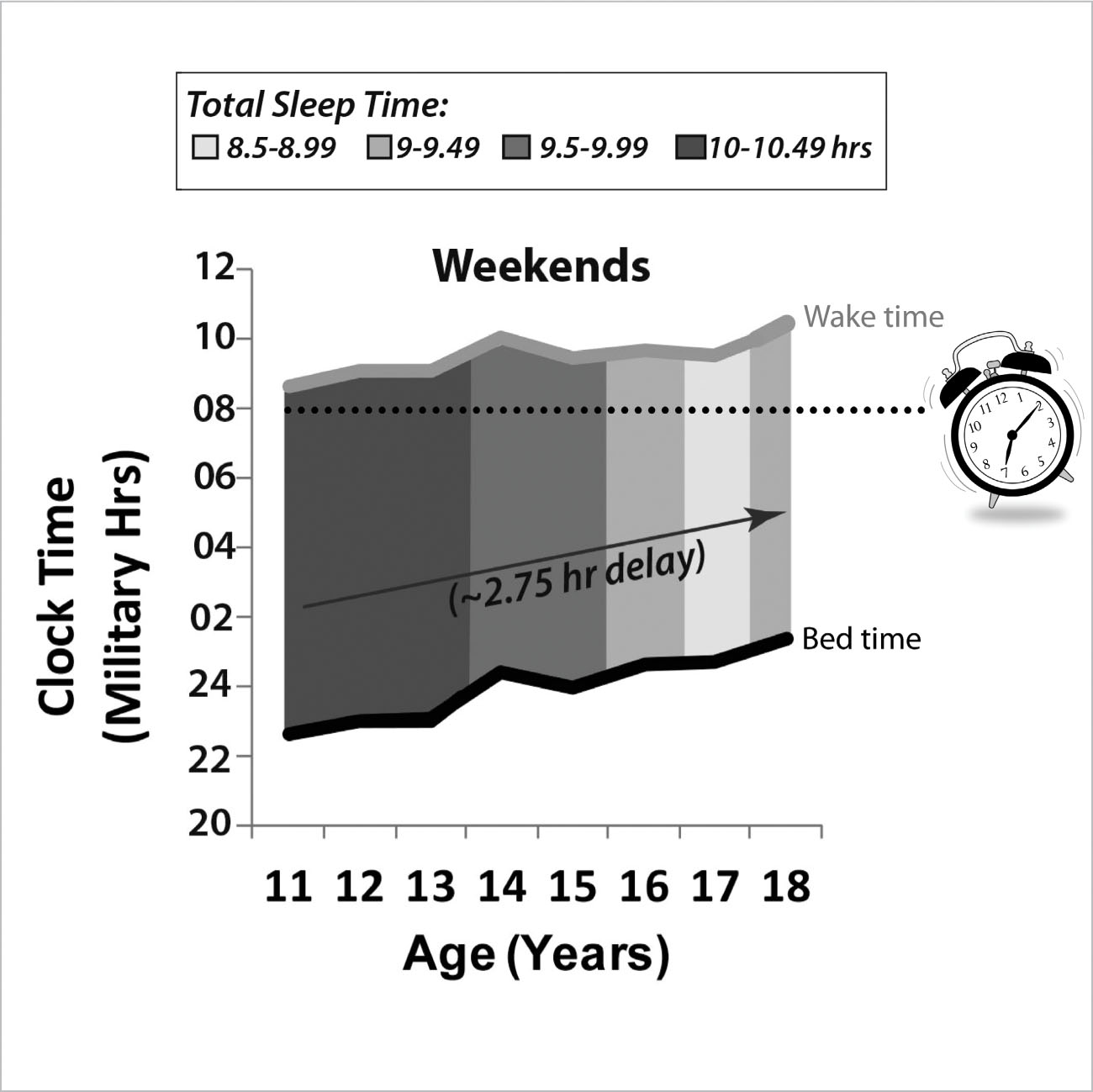
FIGURE 14. The Developmental Control of the Circadian System: Teens have a tendency to stay awake longer and sleep later. This graph compares teens’ sleep hours on the weekends, when study subjects slept for the amount of time their bodies wanted, with those during the week when they were “artificially” woken up for school by an alarm clock.
Because so much is going on in adolescents’ brains, and they are learning so much and at such a fast pace, teenagers need more sleep than either their parents or their much younger siblings. In an earlier chapter I told you about the pruning that takes place in the teenage brain during puberty. When do you think that actually takes place? Yep, that’s right, when they’re asleep. Bedtime isn’t simply a way for the body to relax and recoup after a hard day of working, studying, or playing. It’s the glue that allows us not only to recollect our experiences but also to remember everything we’ve learned that day. Sleep isn’t a luxury. Memory and learning are thought to be consolidated during sleep, so it’s a requirement for adolescents and as vital to their health as the air they breathe and the food they eat. In fact, sleep helps teens eat better. It also allows them to manage stress.
Scientists have calculated that the average adolescent actually requires nine and a quarter hours of sleep. (The Centers for Disease Control and Prevention recommends adolescents get eight and a half hours to nine and a half hours of sleep a night.) Only about 15 percent of all American teenagers actually get that much on a regular basis. Worse, most American teens sleep fewer than six and a half hours a night. How does this happen? Beginning at around ages ten to twelve, young people’s biological clock shifts forward, revving them up by about seven and eight o’clock at night and creating a “no sleep” zone around nine or ten o’clock at night, just when parents are starting to feel drowsy. One reason is that melatonin, a hormone critical to inducing sleep, is released two hours later at night in a teenager’s brain than it is in an adult’s. It also stays in the teenager’s system longer, and this is why it’s so hard to wake your high schooler up in the morning. Adults, on the other hand, have almost no melatonin in their system when they wake up and therefore don’t have the same groggy feeling.
One of the unfortunate consequences of making kids wake early is that it does in fact put the squeeze on their sleep time. There are also so many more distractions at night that can keep a teenager up way past bedtime. In my generation, staying up late meant sneaking a book and a flashlight under the covers. Today’s generation can feed its insomnia in any number of electronic ways, especially texting, making winding down for an already unnaturally early sleep time that much more difficult. This may be why so many of us with teenagers turn in well before our kids do, but always with a sense of worry about what can happen when we close our eyes and are no longer “on watch.”
Awake/rest states, like sleep, have also been shown to strengthen learning. In laboratory studies, when rats are given a maze to explore, their brains show an expected increase in activity. When they are split into two groups, with one group of rats getting a rest after their explorations and the other none, those given the downtime remembered the maze significantly longer. This was shown in a study in Boston where two groups of learners were compared. The first group was given a task to learn early in the day for several days in a row. After each training session, people showed an improvement in the task, called a practice effect. However, when they returned the next morning for another practice/learning session, they showed a slight decay in their skill compared with immediately after the end of their previous session. We all know this phenomenon: a tennis or golf lesson leaves you feeling great, but then if you go out the next day, you are never as good as at the end of the earlier lesson—frustrating! The Boston researchers wanted to know if sleep could help. So they repeated the learning sessions with another group of learners, and instead of doing the practice/learning sessions early in the day, they did them just before the people went to bed at night. They discovered an astonishing effect: when the subjects returned the following evening for their practice session, they did not show any decay whatsoever and were able to start additional learning right where they left off the day before! So there was no “two steps forward, one step backward” effect. These human studies substantiate a large amount of animal data showing how LTP can be affected by sleep deprivation. Brain slices from sleep-deprived rats, even after one day of sleep deprivation, show a diminished capacity for LTP compared with data from well-rested rats, and after two days of sleep there is even more impairment.
More recently, researchers at Brown have been looking at the effect of sleep on motor learning that accompanies piano lessons and comparing brain scans of people who learned finger movements right before sleep versus those who learned these movements but did not go to sleep immediately after their lesson. The Brown scientists were able to show that learners who “slept on it” showed better accuracy than those who did not, and this translated into more measurable activity during slow-wave sleep in the supplementary parts of the motor cortex responsible for coordinating patterned activity. Yuka Sasaki, an author of the study, concluded, “Sleep is not just a waste of time.” Couldn’t have said it better myself.
It is not just sleep that helps learning; even simply being in a restful state helps. At the University of Michigan researchers asked students to perform basic cognitive tests in order to fatigue their brains. They were then assigned to take either a fifty-minute walk in an arboretum or a fifty-minute walk into downtown Ann Arbor. The downtown walk was mostly on a heavily trafficked street. When both groups of students were retested after their walks, the performance of those who took a walk in nature was significantly better than the performance of those who had been assigned to walk into the busiest part of town. A week later the results held, even though the conditions for the two groups were reversed. In other words, those who previously had been told to walk into Ann Arbor now were told to stroll through the arboretum, and vice versa. Again, the group that took a restful walk through the garden outperformed the group assigned to walk into town. What the scientists determined was that the busy urban environment made more demands on the students’ directed, or voluntary, attention, which taxes the brain. The natural setting of the arboretum, however, allowed students to rest their directed attention and let their minds wander. Downtime, whether it is a good night’s sleep, a nap, or simply a few quiet moments of relaxation in the middle of the day, is important for turning learning into long-term memories.
In experiments done on high school students at Harvard Medical School and Trent University in Canada, it was discovered that consolidation of memories happens in two stages during sleep: slow-wave sleep and rapid eye movement (REM) sleep. Early in the sleep cycle of the teenager, the brain enters a slow-wave stage, which is the deepest sleep state. As a child goes through puberty, this deep slow-wave sleep decreases by as much as 40 percent. During REM sleep, which happens later in the sleep cycle, the brain puts on a kind of show, reenacting through dreams the information learned and further solidifying the information for storage in the brain’s memory areas. This is why it is so important for teens to get more than just a good night’s sleep before an exam. They need to get that good night’s sleep right after studying for the exam.
My son Will, who has always been prone to asking “Why?” about everything I tell him or ask him to do, now finally agrees. When he was in high school, he was tempted to pull an all-nighter before a test. I informed him it would be better to study for a little while and then get a good night’s sleep. When he asked why, I told him about the sleep-wake cycle and how it differs in teenagers. He took my advice, studied for a bit, and then went to bed. He may have woken up early to do some last-minute reviewing as well. The next day, when he came home from school, he happily announced I was right. He said he not only felt confident he’d done well on the exam, but also seemed to know the material better in the morning than the night before—all because he’d given his brain time to convert what he’d learned into memories while he was sleeping.
Sleep, however, doesn’t just strengthen learning and memories. Researchers at the University of Notre Dame and Boston College collaborated recently on a memory study and found that sleep not only consolidates memories but also prioritizes them by stripping them down into their components and then organizing those components according to their emotional importance. So, for instance, when subjects were shown a photograph of a tiger in a wooded landscape before they went to sleep, they remembered the tiger better than the trees in the background. Evolutionarily, the ability to remember the most emotional part of a real event makes sense, especially when that emotion is fear and it’s the adrenaline rush that gets you out of harm’s way as fast and as far as your legs can take you.
When I’ve given talks to teenagers and I tell them about what an exciting time this is for their brains and how easy it is for them to learn new things—especially if they sleep on that knowledge—there are always a few smart alecks who say, “Cool, that means I don’t have to start studying until right before I go to bed.” I have to tell them, “No, just before you go to bed shouldn’t be the first time you see the information. Your brain isn’t that responsive. This is just a good time to review.”
Research over the past decade has confirmed the relationship between sleep and learning in adolescents. In one study, moving the start time for school back just seventy minutes, from 7:30 to 8:40 in the morning, had a statistically significant effect on the grades of seven thousand high school students in Minneapolis and Edina, Minnesota. Compared with students in schools that maintained the earlier start time for the school day, the students in the districts whose schools started later reported they got more sleep, earned better grades, and experienced fewer episodes of depression. When high schools in Jessamine County, Kentucky, pushed back the first bell by an hour, attendance rose along with standardized test scores, and when high schools in Fayette County, Kentucky, did the same thing, the number of students involved in car crashes dramatically decreased—while rising in the rest of the state! At Concord Academy, where my older son attended high school, my “Teen Brain 101” lecture helped convince administrators to at least switch its exam schedule, so that instead of being given at 8 a.m., tests were given at 10 a.m. The students, I’m told, scored better with the later start, and the school has maintained its later exam schedule. For once I had managed to be a hero for my son rather than an embarrassment!
Starting the school day later seems a natural next step, but even with the new scientific findings the large majority of schools across the country have not adjusted their start times. The reason given by most boards of education is that starting the school day later in the morning would cause disruption to after-school activities and inconvenience both teachers and parents. However, according to the University of Minnesota’s Center for Applied Research and Educational Improvement, when those Edina and Minneapolis high schools adjusted the start time of their day, after-school jobs and activities were not severely affected. Scheduling was slightly more complicated but not disruptive, and participation, for the most part, remained about the same. Some schools even reported that the more rested athletes performed better on the playing fields.
A few years ago, scientists at Washington University in St. Louis studied the sleep-learning connection from the opposite direction. That is, how does learning affect the need for sleep? In fruit fly experiments—fruit flies actually have sleep-wake cycles similar to those of humans—the researchers looked at how young fruit flies responded to being raised in an enhanced social environment. After flying around in a large, well-lit chamber with other young fruit flies, they all grew more branches on their neurons with many more synapses. They also required two to three more hours of sleep than fruit flies raised in isolation. But what also surprised the researchers was that after sleep, the synapses in these social fruit flies that had been given space in which to roam returned to normal size. Of the twenty thousand cells in a single fruit fly’s brain, only sixteen neurons were needed to consolidate the day’s learning into memories. The brains of those flies that were denied sleep after being exposed to the enriched environment continued to have synapses that were larger and denser. In other words, learning appeared to be related to the pruning of synapses during sleep, leaving space for new ones to grow. Sleep, it seems, provides time—and preserves energy—for the brain to pick out the most salient information from the day’s activities and consolidate that information into memories, discarding the rest. Like almost everything else about human life, the brain is a finite organ, with a finite amount of space. It makes sense that if the brain simply kept adding synapses, it would soon reach a limit and all learning would cease. The more you learn, the more you need to sleep, it would seem.
So what happens when teenagers don’t get enough sleep? Nothing good, that’s for sure. Sleep deprivation inhibits the necessary synaptic pruning or prioritizing of information. And a lack of good sleep habits results in much more than a tired body and mind. It can have profound and lasting effects on teenagers and could contribute to everything from juvenile delinquency to depression, obesity, high blood pressure, and cardiovascular disease. Studies have shown that teenagers who report sleep disturbances have more often consumed soft drinks, fried food, sweets, and caffeine. They also report less physical activity and more time in front of TV and computers. Another study found that teenagers who had trouble sleeping at ages twelve to fourteen were two and a half times more likely to report suicidal thoughts at ages fifteen to seventeen than adolescents with good sleep habits.
Japanese researchers have found that teens who used their cell phones after “lights out” not only had reduced time asleep but also were at increased risk of mental health disorders, including self-harm and suicide. Colleen Carney at the National Institute of Mental Health (NIMH) has been showing that insomnia can worsen depression, and that behavioral therapy (not sleep medications) aimed at better sleep habits can help lower depression rates. Scientists don’t yet fully understand the connection between shortened sleep time and poor mental health in teenagers, but the fact that teens spend more time on their phones than most adults seems indisputable. Talking, of course, is only one use of a cell phone. More than five billion text messages are sent every day in the United States. Not surprisingly, a large portion of the texting population is teenagers. According to one recent study, each teen sends an average of 3,300 texts every month. (Girls average more: 4,050 texts a month.) Researchers at a sleep disorders clinic at JFK Medical Center in New Jersey estimate that one in five teenagers actually interrupts his or her sleep in order to text. The participants in their study, all of whom had come to the clinic for sleep issues, reported sending and receiving an average of thirty-four texts every night—after going to bed! The texts were sent and received from ten minutes to four hours after these teens went to bed, and the adolescents were awakened by a text message at least once a night. There was a slight gender gap in the research. Girls were more likely to text after going to bed, whereas boys were more likely to be awake, playing games on their cell phones. (Excessive or obsessive texting is also now being treated like an addiction.)
Poor sleep habits may even have a role in juvenile delinquency. The Journal of Youth and Adolescence reported in 2012 that teens who slept seven hours or fewer a night had a significantly higher rate of property crimes such as shoplifting, vandalism, and breaking and entering than peers who had eight to ten hours of sleep a night. Those teens who slept five or fewer hours a night had significantly higher rates of violent crimes, including physical fights and threatened violence using a weapon, compared with teens who slept eight to ten hours a night. The relationship is not yet fully clear since stressful environments have an effect all their own on behavior and can also affect sleep. In 2011 a large study undertaken by the Centers for Disease Control and Prevention found a correlation between poor sleep habits in teens and increased risk of unhealthy habits, including use of cigarettes, alcohol, and marijuana. Researchers in Italy have reported similar findings. There is not a single part of a teenager’s life that is not adversely affected by a lack of sleep.
Physiologically, poor sleep can result in:
• Skin conditions that worsen with stress, like acne or psoriasis
• Eating too much or eating the wrong foods
• Injuries during sports activities
• Rise in blood pressure
• Susceptibility to serious illnesses
Emotionally, bad sleep can make teenagers:
• Aggressive
• Impatient
• Impulsive and inappropriate
• Prone to low self-esteem
• Liable to mood swings
Cognitively, poor sleep can cause:
• Impairment of the ability to learn
• Inhibition of creativity
• Slowing of problem-solving skills
• Increasing forgetfulness
One unfortunate consequence of sleep deprivation in everyone, but especially in teenagers, is that increasingly insomniacs are turning to artificial stimulants to keep themselves awake during the day. Some of those stimulants, such as Ritalin and Adderall, which are normally given for attention deficit hyperactivity disorder, are illicit, but the most popular and completely legal ones are energy drinks. Just the names of these drinks can give a parent pause, and it’s no wonder they appeal to the thrill-seeking adolescent: Red Bull, Full Throttle, CHARGE!, NeuroGasm, Hardcore Energize Bullet, Eruption, Crave, Crunk, DynaPep, Rage Inferno, SLAP, and my personal favorite (the name, not the drink!): Venom Death Adder. While the US Food and Drug Administration restricts the amount of caffeine in soft drinks to a maximum of seventy-one milligrams of caffeine per twelve-ounce can, it does not restrict the amount of caffeine in energy drinks, because they are classified as dietary supplements. The amount of caffeine in an energy drink varies from eighty milligrams to as much as five hundred milligrams. Teens and twenty-somethings also sometimes mix the high-caffeine energy drinks with alcohol so that they don’t feel inebriated as long as they’re wired on caffeine. The problem with mixing the Red Bull–type energy drinks of the world with booze is that instead of passing out, a seriously inebriated person is still up and around and likely to be operating under the false assumption of being able to perform complex tasks, such as driving a car, when he or she is not.
Some surveys suggest that anywhere between 30 and 50 percent of all adolescents and young adults consume energy drinks; this figure perhaps explains the exponential rise in caffeine overdoses being seen in hospital emergency rooms. In 2013 the US government’s Substance Abuse and Mental Health Services Administration reported energy-drink-related ER visits increased tenfold between 2005 and 2011, from fewer than two thousand to more than twenty thousand. Some studies report that the average high school student drinks as many as five cans of energy drinks a day to compensate for a lack of sleep.
As critical a role as sleep plays in the learning process of teenagers, so do parents and guardians, and there are things you can do to encourage your teenage sons and daughters to get enough sleep, beginning with taking the TV and computer out of the bedroom. Because they’re in a chronic state of sleep deprivation, you have to help them get their homework done and get them to bed early. When they come home from school, ask them how much homework they have, try to get an inventory of what they have to do, and help them prioritize. If an assignment includes something creative, suggest it be done first because it involves more complex cognitive skills and more focus. Check on them over the course of the evening, but try not to do it judgmentally. The worst thing to do at 9:30 at night when you find out the English lit essay still hasn’t been written is to shout or scold. The second worst thing is to show them you’re panicked. Don’t add more stress to the mix, because stress will impair learning, too!
Another obstacle to sleep that you should be aware of is the bright LED light of a computer screen, which should be turned off about an hour before bedtime to relax the overstimulated eyes and brain. In 2012 a study released by the Lighting Research Center at Rensselaer Polytechnic Institute in Troy, New York, found that just a two-hour exposure to the self-luminous backlit displays of smartphones, computers, and other LED devices suppressed melatonin by about 22 percent. Stimulating the human circadian rhythm like this before bedtime, said the researchers, could definitely affect sleep, especially in teenagers. Not all artificial light is the same, though. Some artificial light, like natural light, can drive the circadian clock. A blue light in LEDs, for instance, is healthy and can trigger circadian rhythm, something both NASA and Russian scientists are tinkering with in experiments simulating a multiyearlong mission to Mars when astronauts’ circadian rhythms would be thrown into disarray.
As a parent, you have your own problems with fatigue at night, and maybe even your own work to get done for the next day. You have a low threshold, and it’s easy to get angry at your kids, so you have to be mindful of that and try to regulate your emotions. As a single parent, I couldn’t just throw up my hands and stomp off and tell my spouse, “You handle this.” When you have no other person to turn to and you’re it, you have to approach things from a different angle with your teenager. I remember not wanting to transfer my panic to my sons when I realized they were clearly unprepared or unable to figure out how to get their work done when there was a hard-stop deadline the morning ahead. You try to tell them that next time they can’t wait till the last minute, or come home without the necessary books or papers to complete the assignment. But you also can’t learn for your child. There’s only so much you can do. You can offer to help in preparing an outline or doing some of the research, but you also don’t want to create learned helplessness or dependence in your child.
As for your teenagers, suggest they do nontech activities before bed and do the same activities at the same time every night, not only to avoid melatonin suppression from the artificial light of computers, iPads, and smartphone screens but also to habituate the body to winding down at the same time every night. Making out a to-do list upon arrival home highlights the “planning ahead” part of the evening, and can ease anxiety and therefore sleeplessness. The bed itself should also be just for sleeping; avoid associations with eating or watching television—or even homework! Finally, try to avoid arguing with your teenagers before bed. They won’t sleep well, and chances are neither will you. Remember the old adage: “Never let the sun set on an argument.”