Flows of Information within PARA
Most approaches to organizing are static: they assume that there is one correct place for a given piece of information. You may recall the Dewey decimal system from your local library, with a precise call number telling you exactly where on the shelf each book goes.
But when it comes to personal organization of digital information, there is no such “correct” place. PARA is a dynamic system: any given file or document can go in any number of places—what matters is your relationship to it. And that relationship is changing all the time.
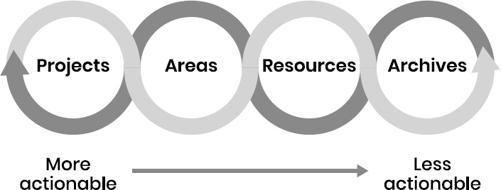
To illustrate this, imagine you read an article about effective coaching techniques one evening and save a few of the best excerpts to your notetaking app. Perhaps at that moment in your career, you are an individual contributor and don’t have an immediate need for advice on how to coach other people in a professional setting. You file away this note in a resource folder called “coaching” for future reference.
The next year, you get promoted to a management position in your company and now have a handful of direct reports to manage. In the blink of an eye, that whole category of knowledge has suddenly become actionable.
You might take several decisive steps in your PARA system to reflect your new role. Those notes about coaching techniques might get moved from a resource folder on “coaching” to a new area folder called “Direct Reports.” You’ve now promoted that knowledge so that it receives more of your attention on a more frequent basis.
Now imagine a couple more years pass, and you’re promoted once again to a senior executive role. Once again, the landscape of your knowledge gets remapped. You might now be responsible for creating management training to teach all the new managers in the company what you’ve learned.
The contents of your “Direct Reports” area folder might now flow into a new project folder called “Management training workshop,” as the knowledge it contains is now most relevant to the near-term goal of delivering your first workshop. The insights and ideas you collected years ago during an evening of casual reading have now bubbled up to the surface and become relevant to your most pressing challenge.
Finally, imagine a couple more years pass, and you’ve decided to quit your day job and start a business of your own. The notes you’ve saved in your “Management training workshop” project folder are now no longer actionable, as you don’t expect to have employees to manage for a while.
There’s no need to delete anything—just move it to the Archives. When the day eventually arrives that you start hiring your own staff, that knowledge will be ready and waiting like a dormant volcano, ready to spew forth a career’s worth of wisdom.
Can you see how all it takes is one event in our lives to completely reshape the landscape of our priorities? At that point, we don’t have time to “do more research”—we need to already have done that research through our reading and notetaking.