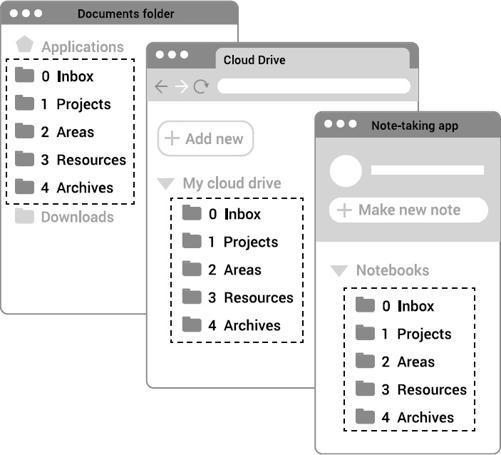
Here’s why this is important: you will always need to use multiple platforms to do your work and live your life. Most projects you take on and areas you manage will involve different kinds of content, each of which needs to be stored on a platform that’s suited to it.
For example, if you are publishing a research report on an emerging industry, you’ll likely have data you’re drawing on (which might be saved in a spreadsheet application), photos of popular products (which would be stored in a dedicated photo application), notes from your conversations with knowledgeable experts (saved in a notetaking app), PDFs of industry publications (in your Documents folder), and a list of next steps you’re contemplating (in a to-do list app).
Technology is advancing too quickly on too many fronts for any one app to fulfill every need. Instead of fighting the tide and looking for “one app to rule them all,” use as many apps as you like, while replicating the same structure across every single one. I recommend doing so down to the exact same spelling, punctuation, and capitalization so that you can mentally transition between platforms as seamlessly as possible. This way you can take advantage of the unique capabilities of each platform you might want to use, without sacrificing coherence and consistency in the way you relate to information.
PARA perfectly mirrors the structure of your life across every platform you use. Rather than forcing your life to fit intothe opinions and preferences of whatever tool you happen to be using, I advise you to do the opposite: decide how you want to order your life and work, and then ask how your tools can support that.