Chapter 9  The Essential Habits of Digital Organizers
Habits reduce cognitive load and free up mental capacity, so you can allocate your attention to other tasks… It’s only by making the fundamentals of life easier that you can create the mental space needed for free thinking and creativity.
—James Clear, author of Atomic Habits
Your Second Brain is a practical system for enhancing your productivity and your creativity.
While these domains are often seen as mutually exclusive opposites—one concrete and defined; the other abstract and open-ended—instead I see them as complementary. When we are organized and efficient, that creates space for creativity to arise. When we have confidence in our creative process, we don’t have to think about it as much, significantly reducing the background stress of constantly worrying whether we’re going in the right direction.
This balance between order and creativity is something that we can build into our Second Brain intentionally. Like every system, a Second Brain needs regular maintenance. There is a certain level of organization that you want to maintain in your digital world, so that when you go there to get things done, your virtual workspaces support your productivity instead of interfering with it.
“Being organized” isn’t a personality trait you’re born with, nor is it merely a matter of finding the right apps or tools. Being organized is a habit—a repeated set of actions you take as you encounter, work with, and put information to use. If we’re constantly scrambling to find our notes, drafts, brainstorms, and sources, not only do we waste precious time, but we also sabotage our momentum. At each step of CODE, there are habits that can help us be more organized so that our creativity has space to arise.
The Mise-en-Place Way to Sustainable Productivity
Consider how chefs work in a commercial kitchen. They have incredibly high demands on both the quality and quantity of their output. Every ingredient in every dish must be nearly perfect—one cold side or undercooked filet and the whole dish can be sent back, and the kitchen might have to produce hundreds of dishes on a busy night.
This fundamental tension—between quality and quantity—is a tension we share as knowledge workers. We also must produce work to an extremely high standard, and we must do it fast, continuously, all year long. We are like sprinters who are also trying to run a marathon.
Chefs have a particular system for accomplishing this daunting feat. It’s called mise en place, a culinary philosophy used in restaurants around the world. Developed in France starting in the late 1800s, mise en place is a step-by-step process for producing high-quality food efficiently. Chefs can never afford to stop the whole kitchen just so they can clean up. They learn to keep their workspace clean and organized in the flow of the meals they are preparing.
In the kitchen, this means small habits like always putting the mixing spoon in the same place so they know where to find it next time; immediately wiping a knife clean after using it so it’s ready for the next cut; or laying out the ingredients in the order they’ll be used so that they serve as placeholders.
Chefs use mise en place—a philosophy and mindset embodied in a set of practical techniques—as their “external brain.”1 It gives them a way to externalize their thinking into their environment and automate the repetitive parts of cooking so they can focus completely on the creative parts.
We have a lot to learn as knowledge workers from the system of mise en place. We likewise have to contend with a deluge of tasks, under uncertain conditions, with tight deadlines. We also receive a constant stream of inputs and requests, have too little time to process them, and face many demands requiring simultaneous attention. For us as well, the only time we have available to maintain our systems is during the execution of our regular work.
There’s no time that’s magically going to become available for you to stop everything and completely reorganize your digital world. It’s not likely that your manager is going to look kindly on you blocking off a whole day to “get caught up.” Your business won’t last long if you turn customers away because you’re “maintaining your systems.” It’s difficult to find the time to put the world on hold and catch your breath. We tend to notice our systems need maintenance only when they break down, which we then blame on our lack of self-discipline or our failure to be sufficiently productive.
Building a Second Brain is not just about downloading a new piece of software to get organized at one point in time; it is about adopting a dynamic, flexible system and set of habits to continually access what we need without throwing our environment (and mind) into chaos.
It’s not enough to have inner discipline. We also need to follow an outer discipline—a system of principles and behaviors—to channel our energies, thoughts, and emotions productively. A system that adds some structure to the constantly changing flux of information that we interact with every day.
In this chapter, I will introduce you to three kinds of habits that can be integrated into your routine to ensure your Second Brain remains functional and relevant. Each of these habits creates boundaries—of time, space, and intention—around the states of mind that you want to protect and promote in your life. These boundaries tell you what you should be focusing on, and just as importantly, what you should ignore. The three habits most important to your Second Brain include:
- Project Checklists: Ensure you start and finish your projects in a consistent way, making use of past work.
- Weekly and Monthly Reviews: Periodically review your work and life and decide if you want to change anything.
- Noticing Habits: Notice small opportunities to edit, highlight, or move notes to make them more discoverable for your future self.
You can think of these habits as the “maintenance schedule” of your Second Brain. Just like you have a maintenance schedule for your car, which advises you to regularly change the oil, rotate the tires, and change the air filters, your Second Brain occasionally needs a tune-up to ensure it’s in good working order.
Let’s explore these habits one at a time.
The Project Checklist Habit: The Key to Starting Your Knowledge Flywheel
At the most basic level, knowledge work is about taking in information and then turning it into results. All day, every day we are consuming and then producing. You don’t need special training to perform these activities, and you certainly don’t need a Second Brain.
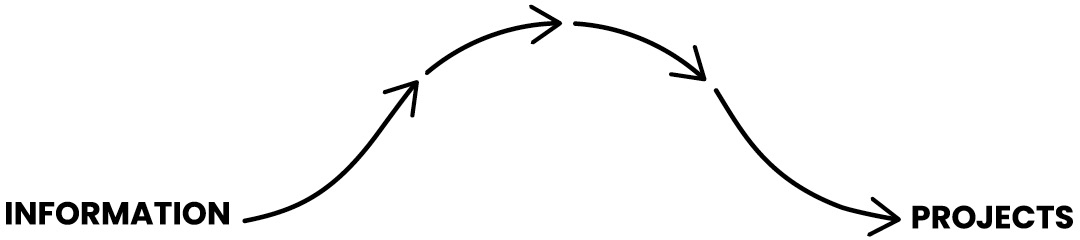
What most people are missing, however, is a feedback loop—a way to “recycle” the knowledge that was created as part of past efforts so it can be used in future ones as well. This is how investors think about money: they don’t get the profits from one investment and immediately spend it all. They reinvest it back into other investments, creating a flywheel so their money builds on itself over time.
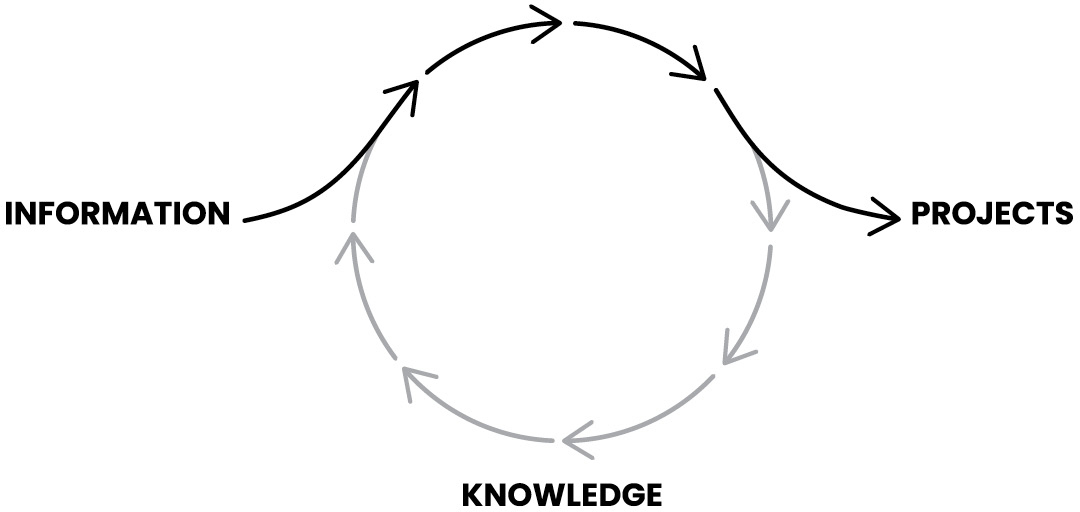
This is exactly how I want you to treat your attention—as an asset that gets invested and produces a return, which in turn can be reinvested back into other ventures. This is how you can ensure your knowledge grows and compounds over time like a high-yield asset. Like investing a small amount in the stock market every month, your investments of attention can likewise compound as your knowledge grows and your ideas connect and build on each other.
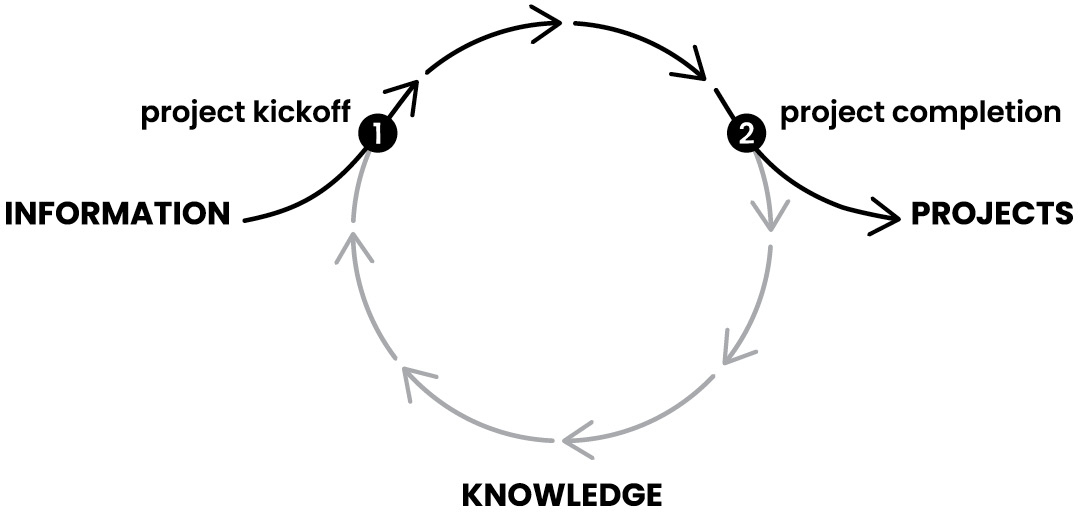
If you look closely, there are two key moments in this process of recycling knowledge. Two places where the paths diverge, and you have the chance to do something different than you’ve done before.
Those two moments are when a project starts, and when it finishes. For the former, I’ll introduce you to the Project Kickoff Checklist, and for the latter, the Project Completion Checklist.
Checklist #1: Project Kickoff
Before they taxi onto the runway and take off, airline pilots run through a “preflight checklist” that tells them everything they need to check or do. It ensures they complete all the necessary steps without having to rely on their unreliable brains.
The way most people launch projects, in contrast, can be described as “haphazardly.” They might look through their existing notes and files for any information that might be relevant, or they might not. They might talk to their colleagues about any lessons from past experience, or they might not. They might create a plan to guide their progress, or they might not. The successful start of the project is more or less left to chance.
In Chapter 5 we saw how work is becoming ever more project-centric. Every goal, collaboration, or assignment we take on can be defined as a project, which gives it shape, focus, and a sense of direction. If we consider that these projects are our biggest investments of attention, it’s worth adding a little bit of structure to how we start them. This is where the Project Kickoff Checklist comes in.
Here’s my own checklist:
- Capture my current thinking on the project.
- Review folders (or tags) that might contain relevant notes.
- Search for related terms across all folders.
- Move (or tag) relevant notes to the project folder.
- Create an outline of collected notes and plan the project.
1. Capture my current thinking on the project. I often find that the moment a project begins to form in my mind, I start to have ideas and opinions about it. I like to start by creating a blank note and doing a brainstorm of any thoughts that come to mind. This first note is then placed inside a new project folder dedicated to storing all the notes I’ll be creating related to it.
This step can and should be messy: I pour out all my random musings, potential approaches, links to other ideas or topics, or reminders of people to talk to.
Here are some questions I use to prompt this initial brainstorm:
- What do I already know about this project?
- What don’t I know that I need to find out?
- What is my goal or intention?
- Who can I talk to who might provide insights?
- What can I read or listen to for relevant ideas?
Anything that comes to mind from these questions I write down in my starting note. I prefer using bullet points so the information is compact and can easily be moved around.
2. Review folders (or tags) that might contain relevant notes. Second, I look through any existing folders that might contain information relevant to the new project I’m starting, including related templates, outlines, and outtakes from previous projects. PARA and Progressive Summarization really come in handy here: I already have a variety of folders, each containing a curated set of notes, highlighted and summarized so I can rapidly recall what they’re about. I choose a handful of folders that seem most relevant to what I’m starting, including in projects, areas, resources, and archives. Then I quickly scan any notes inside that look interesting, taking care to keep the momentum going so I don’t get bogged down anywhere. Now is not the time to go on tangents that will only distract me from moving forward.
3. Search for related terms across all folders. The third step is to perform searches for any notes I might have missed. Sometimes there are valuable ideas buried in unexpected places, which I may not find through browsing alone.
This is where the Curator’s Perspective I used when I first captured the content really pays off—because each and every note in my Second Brain was deliberately chosen, I am able to search through a collection of exclusively high-quality notes free of fluff and filler. This is in stark contrast to searching the open Internet, which is full of distracting ads, misleading headlines, superficial content, and pointless controversy, all of which can throw me off track.
I run a series of searches for terms related to the new project, scanning the results and quickly jumping into any note that seems relevant. Progressive Summarization helps here too, enabling me to zoom into and out of notes without having to absorb their full contents.
4. Move (or tag) relevant notes to the project folder. Fourth, any notes found in the previous two steps I move to the project folder, titled after the name of the new project I’m starting. Alternatively, depending on the capabilities of your notes app, you can also tag or link any relevant notes with the project, so you don’t have to move them from their original location. The important thing isn’t where a note is located, but whether you can reference it quickly while staying focused on the project at hand.
5. Create an outline of collected notes and plan the project. Finally, it’s time to pull together the material I’ve gathered and create an outline (an Archipelago of Ideas) for the project. My goal is to end up not just with a loose collection of ideas. It is to formulate a logical progression of steps that make it clear what I should do next.
The form this outline takes depends on the nature of the project. If it is a piece of writing such as an essay or report, the outline might be the main points or headings I want to include in the final piece. If it is a document outlining a collaborative project with colleagues or outside contractors, the outline might include the objectives we’re working toward and tentative responsibilities for each person. If it is a trip I’m planning to take, it might be a packing list and itinerary.
The important thing to remember as you move through this checklist is that you are making a plan for how to tackle the project, not executing the project itself. You should think of this five-step checklist as a first pass, taking no more than twenty to thirty minutes. You’re only trying to get a sense of what kind of material you already have in your Second Brain. Once you do, you’ll have a much better sense of how much time it will take, which knowledge or resources you’ll need access to, and what your challenges will likely be.
I encourage you to use my kickoff checklist as a starting point and customize it over time as you understand how it fits into your own context. Depending on your profession or industry, you might need more or less formality, more or less time for a first pass, and more or fewer people involved. Here are some other options for actions you might want to include in your own version:
- Answer premortemI questions: What do you want to learn? What is the greatest source of uncertainty or most important question you want to answer? What is most likely to fail?
- Communicate with stakeholders: Explain to your manager, colleagues, clients, customers, shareholders, contractors, etc., what the project is about and why it matters.
- Define success criteria: What needs to happen for this project to be considered successful? What are the minimum results you need to achieve, or the “stretch goals” you’re striving for?
- Have an official kickoff: Schedule check-in calls, make a budget and timeline, and write out the goals and objectives to make sure everyone is informed, aligned, and clear on what is expected of them. I find that doing an official kickoff is useful even if it’s a solo project!
Checklist #2: Project Completion
Now let’s take a look at the Project Completion Checklist, the other side of the equation.
The completion of a project is a very special time in a knowledge worker’s life because it’s one of the rare moments when something actually ends. Part of what makes modern work so challenging is that nothing ever seems to finish. It’s exhausting, isn’t it? Calls and meetings seem to stretch on forever, which means we rarely get to celebrate a clear-cut victory and start fresh. This is one of the best reasons to keep our projects small: so that we get to feel a fulfilling sense of completion as often as possible.
We don’t want to limit ourselves to merely celebrating the end of a project. We want to learn from the experience and document any thinking that could add value in the future. This is where the Project Completion Checklist is essential. It’s a series of steps you can take to decide if there are any reusable knowledge assets worth keeping, before archiving the rest. The only way that the Kickoff Checklist we just looked at will be feasible is if you’ve previously taken the time to save and preserve material from past projects.
Here’s my checklist:
- Mark project as complete in task manager or project management app.
- Cross out the associated project goal and move to “Completed” section.
- Review Intermediate Packets and move them to other folders.
- Move project to archives across all platforms.
- If project is becoming inactive: add a current status note to the project folder before archiving.
1. Mark project as complete in task manager or project management app. This is the first step is making sure the project is in fact finished. Often there are a few lingering tasks needed to completely wrap it up—such as getting final approvals, filing paperwork, or disseminating the project deliverables—which is why I start by looking at my task manager. A task manager is a dedicated app for keeping track of pending actions, like a digital to-do list.II
If all the tasks I find there are done, I can mark it as complete and move on to the following steps.
2. Cross out the associated project goal and move to “Completed” section. Each project I work on usually has a corresponding goal. I keep all my goals in a single digital note, sorted from short-term goals for the next year to long-term goals for years to come.
I like to take a moment and reflect on whether the goal I initially set for this project panned out. If I successfully achieved it, what factors led to that success? How can I repeat or double down on those strengths? If I fell short, what happened? What can I learn or change to avoid making the same mistakes next time? The amount of time you spend thinking about these questions depends on the size of the project. A massive team endeavor might justify hours of in-depth analysis, while a small personal side project might deserve only a few minutes of reflection.
I also like to cross out the goal and move it to a different section called “Completed.” Any time I need some motivation, I can look through this list and be reminded of all the meaningful goals I’ve achieved in the past. It doesn’t matter if the goal is big or small—keeping an inventory of your victories and successes is a wonderful use for your Second Brain.
3. Review Intermediate Packets and move them to other folders. Third, I’ll look through the folder for the completed project to identify any Intermediate Packets I created that could be repurposed in the future. This could include a web-page design to be used as a template for future sites, an agenda for a one-on-one performance review, or a series of interview questions that might come in handy for future hires.
It takes a certain lens to see each of these documents and files not as disposable, but as tangible by-products of quality thinking. Much of our work gets repeated over time with slight variations. If you can start your thinking where you left off last time, you’ll be far ahead compared to starting from zero every time.
Any IPs I decide could be relevant to another project, I move to that project’s folder. The same goes for notes relevant to areas or resources. This is a forgiving decision, and it’s okay if you don’t catch every single one. The full contents of everything you archive away will always show up in future searches, so you don’t have to worry that anything will be lost.
4. Move project to archives across all platforms. Fourth, it’s time to move the project folder to the archives in my notes app, as well as any other platforms I used during the project. For me, this usually includes my computer’s documents folder and my cloud storage drive.
This move ensures that your list of active projects doesn’t get cluttered with old, obsolete stuff from the past while also preserving every bit of material just in case it unexpectedly becomes relevant in the future.
5. If project is becoming inactive: add a current status note to the project folder before archiving. The fifth step applies only if the project is getting canceled, postponed, or put on hold instead of completed. I still want to archive it so it’s out of sight, but in this special case, there’s one final action I take.
I add a new note to the project folder titled “Current status,” and jot down a few comments so I can pick it back up in the future. For example, in a few bullet points I might describe the last actions I took, details on why it was postponed or canceled, who was working on it and what role they played, and any lessons or best practices learned. This Hemingway Bridge gives me the confidence to put the project on ice knowing I can bring it back to life anytime.
I’ve been amazed that by being honest with myself about when a project has stalled and taking these few minutes to download my current thinking on it, I can often pick it back up months or even years later with minimal effort. It’s very empowering to realize you can put a project in “cold storage” and let go of the mental toll of having to keep it in mind. It’s tremendously comforting to know that I don’t need to make constant progress on everything all the time.
Here are some other items you can include on your Project Completion Checklist. I encourage you to personalize it for your own needs:
- Answer postmortem questions: What did you learn? What did you do well? What could you have done better? What can you improve for next time?
- Communicate with stakeholders: Notify your manager, colleagues, clients, customers, shareholders, contractors, etc., that the project is complete and what the outcomes were.
- Evaluate success criteria: Were the objectives of the project achieved? Why or why not? What was the return on investment?
- Officially close out the project and celebrate: Send any last emails, invoices, receipts, feedback forms, or documents, and celebrate your accomplishments with your team or collaborators so you receive the feeling of fulfillment for all the effort you put in.
The first pass on your Project Completion Checklist should be completed in even less time than the Project Kickoff Checklist—no more than ten or fifteen minutes to grab any stand-alone materials and insights. Since you don’t know for sure that any of this material will ever be useful again, you should minimize how much extra time and attention you invest in it. Put in just enough effort that your future self will be able to decide if the material is relevant to their needs. If it is, then they can decide in that moment whether to invest the effort to further organize and distill it.
The purpose of using project checklists isn’t to make the way you work rigid and formulaic. It is to help you start and finish projects cleanly and decisively, so you don’t have “orphaned” commitments that linger on with no end in sight. Think of these checklists as scaffolding—a supporting structure that ensures what you’re building can stand on its own. Just as scaffolding eventually gets taken down, these habits will get absorbed into the way you think and become completely second nature. You won’t even consider starting something new without querying your Second Brain to see if there is any material you can reuse.
The Review Habit: Why You Should Batch Process Your Notes (and How Often)
Next let’s talk about Weekly and Monthly Reviews.
The practice of conducting a “Weekly Review” was pioneered by executive coach and author David Allen in his influential book Getting Things Done.III He described a Weekly Review as a regular check-in, performed once a week, in which you intentionally reset and review your work and life. Allen recommends using a Weekly Review to write down any new to-dos, review your active projects, and decide on priorities for the upcoming week.
I suggest adding one more step: review the notes you’ve created over the past week, give them succinct titles that tell you what’s inside, and sort them into the appropriate PARA folders. Most notes apps have an “inbox” of some kind where new notes collect until they’re ready to be reviewed. This “batch processing” takes only seconds per note, and you can complete it within a few minutes.
Let’s dive into the details and see how Weekly and Monthly Reviews can help you maintain your Second Brain in a state of readiness for whatever arrives at your doorstep.
A Weekly Review Template: Reset to Avoid Overwhelm
Here is my own Weekly Review Checklist, which I usually complete every three to seven days depending on how busy a given week is. The point isn’t to follow a rigid schedule, but to make it a habit to empty my inboxes and clear my digital workspaces on a regular basis to keep them from getting overwhelmed. I keep this checklist on a digital sticky note on my computer, so I can easily refer to it.
- Clear my email inbox.
- Check my calendar.
- Clear my computer desktop.
- Clear my notes inbox.
- Choose my tasks for the week.
1. Clear my email inbox. I start by clearing my email inbox of any emails lingering from the past week. I don’t usually have time to do this during the week in the rush of my other priorities, but I’ve found that if I let messages accumulate from one week to the next, it makes it hard to figure out what’s new and requires action and what’s left over from the past.
Any action items I find get saved in my task manager, and any notes I capture get saved in my notes app.
2. Check my calendar. Next, I check my calendar. This is the landscape of my week, showing me the meetings and appointments I need to make room for. I typically look at the last couple of weeks in case there’s anything I need to follow up on, and the upcoming couple of weeks in case there’s anything I need to prepare for.
Once again, anything I need to act on gets saved in my task manager, and any notes get captured in my notes app.
3. Clear my computer desktop. Next, I clear the files that have accumulated on my computer desktop. I’ve found that if I let them accumulate week after week, eventually my digital environment gets so cluttered that I can’t think straight.
Any files potentially relevant to my projects, areas, or resources get moved to the appropriate PARA folders in my computer’s file system.
4. Clear my notes inbox. By the time I get to the fourth step, the inbox in my notes app is chock-full of interesting tidbits from the previous three steps—from my email, calendar, and computer desktop. Plus all the other notes I’ve collected over the course of the preceding week, which usually totals between five and fifteen new notes in an average week.
At this point I’ll batch process them all at once, making quick, intuitive decisions about which of the PARA folders each note might be relevant to, and creating new folders as needed. There is no “correct” location for a given note, and search is incredibly effective, so I put it in the first place that occurs to me.
You’ll notice that this is the only step in my Weekly Review that is directly related to my digital notes. It is a simple and practical process of going through my notes inbox, giving each note an informative title, and moving them into the appropriate PARA folders. I don’t highlight or summarize them. I don’t try to understand or absorb their contents. I don’t worry about all the topics they could potentially relate to.
I want to save all that thinking for the future—for a time and place when I know what I’m trying to accomplish and am seeking a knowledge building block to help me get there faster. This weekly sorting process serves as a light reminder of the knowledge I’ve accumulated over the past week, and ensures I have a healthy flow of new ideas and insights flowing into my Second Brain.
5. Choose my tasks for the week. There’s one final step in my Weekly Review. It’s time to clear the inbox in my task manager app. By this point, there are likewise a number of tasks that I’ve captured from my email, calendar, desktop, and notes, and I take a few minutes to sort them into the appropriate projects and areas.
The final step of my Weekly Review is to select the tasks I’m committing to for the upcoming week. Because I’ve just completed a sweep of my entire digital world and taken into account every piece of potentially relevant information, I can make this decision decisively and begin my week with total confidence that I’m working on the right things.
A Monthly Review Template: Reflect for Clarity and Control
While the Weekly Review is grounded and practical, I recommend doing a Monthly Review that is a bit more reflective and holistic. It’s a chance to evaluate the big picture and consider more fundamental changes to your goals, priorities, and systems that you might not have the chance to think about in the busyness of the day-to-day.
Here’s mine:
- Review and update my goals.
- Review and update my project list.
- Review my areas of responsibility.
- Review someday/maybe tasks.
- Reprioritize tasks.
1. Review and update my goals. I start by reviewing my goals for the quarter and the year. I ask myself questions like “What successes or accomplishments did I have?” and “What went unexpectedly and what can I learn from it?” I’ll take some time to cross off any completed goals, add any new ones that have emerged, or change the scope of goals that no longer make sense.
2. Review and update my project list. Next, I’ll review and update my project list. This includes archiving any completed or canceled projects, adding any new ones, or updating active projects to reflect how they’ve changed. I will also update the folders in my notes app to reflect these changes.
It’s important that the project list remains a current, timely, and accurate reflection of your real-life goals and priorities. Especially since projects are the central organizing principle of your Second Brain. When you have a project folder ready and waiting, your mind is primed to notice and capture the best ideas to move it forward.
3. Review my areas of responsibility. Now it’s time to do the same for my areas of responsibility. I’ll think about the major areas of my life, such as my health, finances, relationships, and home life, and decide if there’s anything I want to change or take action on. This reflection often generates new action items (which go into my task manager) and new notes (which get captured in my notes app).
Area notebooks often contain notes that become the seeds of future projects. For example, I used an area folder called “Home” to collect photos for the home studio remodel I mentioned previously. Even before it was an active project, that broader area gave me a place to collect ideas and inspiration so it was ready and waiting the moment we decided to get started.
4. Review someday/maybe tasks. “Someday/maybe” is a special category for things I’d like to get to someday, but not in the near future. Things like “Learn Mandarin” and “Plant an orchard.” These kinds of future dreams are important to keep track of, but you don’t want them cluttering your priorities today. I’ll take a few minutes to go through my “someday/maybe” tasks just in case any of them have become actionable. For example, when my wife and I settled down and became homeowners, our dream of getting a dog, which was impossible while moving from one apartment to another, suddenly came within reach. I had already saved a few notes on the kinds of dogs we should consider (athletic, hypoallergenic, good with kids, etc.), and this step in my Monthly Review reminded me to bring them to the surface.
5. Reprioritize tasks. Finally, once I’ve completed all the previous steps and have a holistic picture of my goals and projects in mind, it’s time to reprioritize my tasks. I’m often surprised just how much can change in a month. To-dos that seemed critical last month might become irrelevant this month, and vice versa.
The Noticing Habits: Using Your Second Brain to Engineer Luck
There’s a third category of habits that will come in handy as you start putting your Second Brain into action in the real world. It is in some ways the most important category, but also the least predictable.
I call them “noticing” habits—taking advantage of small opportunities you notice to capture something you might otherwise skip over or to make a note more actionable or discoverable. Here are some examples:
- Noticing that an idea you have in mind could potentially be valuable and capturing it instead of thinking, “Oh, it’s nothing.”
- Noticing when an idea you’re reading about resonates with you and taking those extra few seconds to highlight it.
- Noticing that a note could use a better title—and changing it so it’s easier for your future self to find it.
- Noticing you could move or link a note to another project or area where it will be more useful.
- Noticing opportunities to combine two or more Intermediate Packets into a new, larger work so you don’t have to start it from scratch.
- Noticing a chance to merge similar content from different notes into the same note so it’s not spread around too many places.
- Noticing when an IP that you already have could help someone else solve a problem, and sharing it with them, even if it’s not perfect.
The nice thing about notes, unlike to-dos, is that they aren’t urgent. If one important to-do gets overlooked, the results could be catastrophic. Notes, on the other hand, can easily be put on hold any time you get busy, without any negative impact. If you have the time to organize your notes each week, that’s great. If you don’t, it’s no problem. I often will wait weeks or even a month or longer before I find the time to clear my notes inbox. They remain ready and waiting there for as long as I need.
The most common misconception about organizing I see when I’m working with clients is the belief that organizing requires a heavy lift. They seem to believe that if they could just block off their calendar and get a few days free of pressing commitments, then they’d finally be able to curb the clutter and clear their head.
Even on the rare occasions I’ve seen people somehow manage to clear such a big block of time, it never seems to go very well. They tend to get bogged down in minutiae and barely make a dent in the mountain of accumulated stuff they wanted to tackle. Then they’re saddled with a feeling of guilt that they weren’t able to make progress even with so much time at their disposal. It’s not natural for humans to completely reorganize their entire world all at once. There are too many layers, too many facets of a human life, to perfectly square every little detail.
It’s crucial to stay organized, but it needs to be done a little at a time in the flow of our normal lives. It needs to be done in the in-between moments of moving your projects forward as you notice small opportunities for improvement.
Here are more specific examples of what those opportunities might look like:
- You decide to visit Costa Rica on your next vacation, so you move a note with useful Spanish phrases from your “Languages” resource folder to a “Costa Rica” project folder to aid in your trip.
- Your director of engineering leaves for another job and you need to hire a new one, so you move the folder you created last time for “Engineering hire” from archives to projects to guide your search.
- You schedule the next in a series of workshops you are facilitating and move a PDF with workshop exercises from an area folder called “Workshops” to a new project folder for the specific workshop you’re planning.
- You notice that you need to buy a new computer because your current one is getting too slow, so you move some articles you’ve saved from the “Computer research” resource folder to a new project folder called “Buy a new computer.”
All these actions take mere moments, and are made in response to changes in your priorities and goals. We should avoid doing a lot of heavy lifting up front, not only because it takes up precious time and energy, but because it locks us into a course of action that might not end up being right.
When you make your digital notes a working environment, not just a storage environment, you end up spending a lot more time there. When you spend more time there, you’ll inevitably notice many more small opportunities for change than you expect. Over time, this will gradually produce an environment far more suited to your real needs than anything you could have planned up front. Just like professional chefs keep their environment organized with small nudges and adjustments, you can use noticing habits to “organize as you go.”
Your Turn: A Perfect System You Don’t Use Isn’t Perfect
Each of the three kinds of habits I’ve introduced you to—Project Kickoff and Completion Checklists, Weekly and Monthly Reviews, and Noticing Habits—are all meant to be performed quickly in the in-between spaces of your day.
They are designed to build on activities you are probably already doing in some form, adding perhaps a little bit more structure. These shouldn’t be massive feats, requiring you to set aside huge chunks of time in total Zen-like isolation. That’s not realistic, and if you wait until those perfect conditions arrive, you’ll never take even the first step.
The checklists I’ve provided are a starting point to help you add some predictability in an environment that is often chaotic and unpredictable. They provide a regular cadence of actions for taking in, processing, and making use of digital information, without requiring you to stop everything and reorganize everything all at once.
I want to remind you that the maintenance of your Second Brain is very forgiving. Unlike a car engine, nothing will explode, break down, or burst into flames if you let things slide for days, weeks, or even months. The entire point of building a Second Brain and pouring your thoughts into it is to make those thoughts less vulnerable to the passage of time. They will be ready to pick up right where you left off when you have more time or motivation.
To make this concrete:
- There’s no need to capture every idea; the best ones will always come back around eventually.
- There’s no need to clear your inbox frequently; unlike your to-do list, there’s no negative consequence if you miss a given note.
- There’s no need to review or summarize notes on a strict timeline; we’re not trying to memorize their contents or keep them top of mind.
- When organizing notes or files within PARA, it’s a very forgiving decision of where to put something, since search is so effective as a backup option.
The truth is, any system that must be perfect to be reliable is deeply flawed. A perfect system you don’t use because it’s too complicated and error prone isn’t a perfect system—it’s a fragile system that will fall apart as soon as you turn your attention elsewhere.
We have to remember that we are not building an encyclopedia of immaculately organized knowledge. We are building a working system. Both in the sense that it must work, and in the sense that it is a regular part of our everyday lives. For that reason, you should prefer a system that is imperfect, but that continues to be useful in the real conditions of your life.
- I. A premortem is a useful practice, similar to a postmortem used to analyze how a project went wrong, except performed before the project starts. By asking what is likely to go wrong, you can take action to prevent it from happening in the first place.
- II. Although outside the scope of this book, I’ve included my recommendations for task managers on multiple operating systems in the Second Brain Resource Guide at Buildingasecondbrain.com/resources.
- III. The book Getting Things Done, known as GTD, is a helpful counterpart to personal knowledge management, applying the same lens of “getting things off your mind” that we are using for notes to “actionable” information such as to-dos.