Chapter 8  The Art of Creative Execution
Creative products are always shiny and new; the creative process is ancient and unchanging.
—Silvano Arieti, psychiatrist and author of Creativity: The Magic Synthesis
I was fortunate to grow up in a multicultural household full of art and music.
My mother is a singer and guitarist from Brazil, and some of my earliest memories are of her soprano voice singing beautiful Portuguese lyrics to the tune of a classical guitar. My father is a professional painter born in the Philippines. His canvases bursting with colorful fruits, verdant landscapes, and monumental figures covered every wall of our house, giving our home the ambience of an art gallery.
I’ve never recognized the common stereotypes of the “tortured artist”—mercurial, unpredictable, brooding, and unreliable. My father is one of the most orderly, responsible people I’ve ever met. Yet this regularity didn’t take away from his fantastically creative artwork—it contributed to it. I saw how rigorous his routines had to be to allow him to pursue his creative calling while raising a family.
He had a series of what he called his “strategies.” These were habits and tricks that he used to integrate creativity into every aspect of his life and quickly get into a creative state of mind whenever he had time to paint.
During sermons at our local church, my father would practice sketching biblical stories in a small paper notebook as he listened. Those sketches would often become the starting point for larger, full-scale works measuring eight or ten feet high. While browsing the supermarket he would buy vegetables with unusual shapes to take home and incorporate into his still lifes. Our groceries doubled as models before we ate them. Often in the evening when we were watching TV together as a family, I’d catch him looking off to the side, at the wall of our living room, where he had hung a painting he was working on. He said he could have insights about what was missing by looking at it in a new light and out of the corner of his eye.
My father planned for creativity. He strategized his creativity. When it was time to make progress on a painting, he gave it his full focus, but that wasn’t the only time he exercised his imagination. Much of the rest of the time he was collecting, sifting through, reflecting on, and recombining raw material from his daily life so that when it came time to create, he had more than enough raw material to work with. This attention to organizing his creative influences fueled a prolific body of work made up of thousands of paintings created over decades, while still allowing him plenty of time to attend our soccer games, cook delicious meals, and travel widely as a family.
What I learned from my father is that by the time you sit down to make progress on something, all the work to gather and organize the source material needs to already be done. We can’t expect ourselves to instantly come up with brilliant ideas on demand. I learned that innovation and problem-solving depend on a routine that systematically brings interesting ideas to the surface of our awareness.I
All the steps of the CODE Method are designed to do one thing: to help you put your digital tools to work for you so that your human, fallible, endlessly creative first brain can do what it does best. Imagine. Invent. Innovate. Create.
Building a Second Brain is really about standardizing the way we work, because we only really improve when we standardize the way we do something. To get stronger, you need to lift weights using the correct form. A musician relies on standardized notes and time signatures so they don’t have to reinvent the basics from scratch every time. To improve your writing, you need to follow the conventions of spelling and grammar (even if you decide to break those rules for special effect down the road).
Through the simple acts of capturing ideas, organizing them into groups, distilling the best parts, and assembling them together to create value for others, we are practicing the basic moves of knowledge work in such a way that we can improve on them over time.
This standardized routine is known as the creative process, and it operates according to timeless principles that can be found throughout history. By identifying the principles that stand the test of time despite huge changes in the underlying technology, we can better understand the essential nature of creativity.
The products of creativity are constantly changing and there is always a new “hot” trend to run after. One year it’s Instagram photos, the next it’s Snapchat stories, the next it’s TikTok videos, and so on forever. Even the long tradition of the novel has evolved for each era.
But if you go one level deeper, to the process of creativity, it is a very different story. The creative process is ancient and unchanging. It was the same thousands of years ago as it is today. There are lessons we can learn on that deeper level that transcend any particular medium and any particular set of tools.
One of the most important patterns that underlies the creative process is called “divergence and convergence.”II
Divergence and Convergence: A Creative Balancing Act
If you look at the process of creating anything, it follows the same simple pattern, alternating back and forth between divergence and convergence.
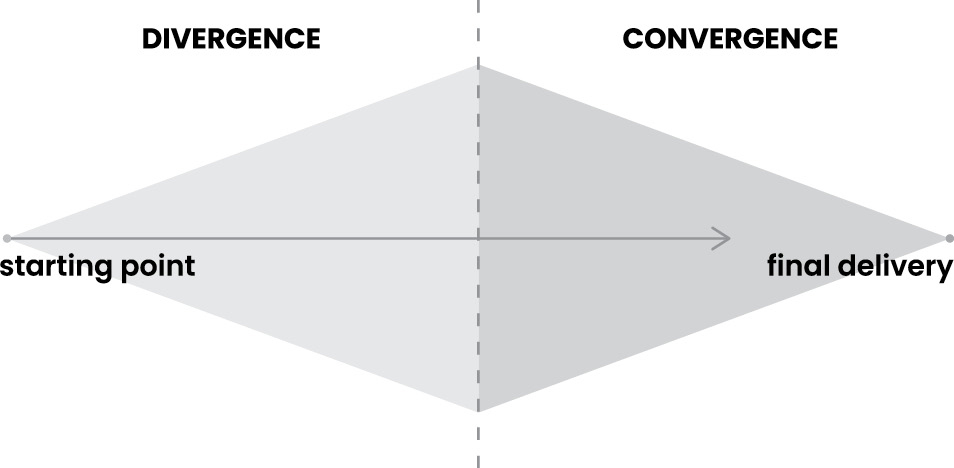
A creative endeavor begins with an act of divergence. You open the space of possibilities and consider as many options as possible. Like Taylor Swift’s notes, Twyla Tharp’s box, Francis Ford Coppola’s prompt book, or Octavia Butler’s commonplace notebooks, you begin to gather different kinds of outside inspiration, expose yourself to new influences, explore new paths, and talk to others about what you’re thinking. The number of things you are looking at and considering is increasing—you are diverging from your starting point.
The activity of divergence is familiar to all of us: it is the classic whiteboard covered in sketches, the writer’s wastepaper basket filled with crumpled-up drafts, and the photographer with hundreds of photos laid out across the floor. The purpose of divergence is to generate new ideas, so the process is necessarily spontaneous, chaotic, and messy. You can’t fully plan or organize what you’re doing in divergence mode, and you shouldn’t try. This is the time to wander.
As powerful and necessary as divergence is, if all we ever do is diverge, then we never arrive anywhere. Like Francis Ford Coppola highlighting certain passages and crossing out others in The Godfather novel, at some point you must start discarding possibilities and converging toward a solution. Otherwise, you will never get the rewarding sense of completion that comes with hitting “send” or “publish” and stepping back from the canvas or screen knowing you got the job done.
Convergence forces us to eliminate options, make trade-offs, and decide what is truly essential. It is about narrowing the range of possibilities so that you can make forward progress and end up with a final result you are proud of. Convergence allows our work to take on a life of its own and become something separate from ourselves.
The model of divergence and convergence is so fundamental to all creative work, we can see it present in any creative field.
Writers diverge by collecting raw material for the story they want to tell, sketching out potential characters, and researching historical facts. They converge by making outlines, laying out plot points, and writing a first draft.
Engineers diverge by researching all the possible solutions, testing the boundaries of the problem, or tinkering with new tools. They converge by deciding on a particular approach, designing the implementation details, and bringing their blueprints to life.
Designers diverge by collecting samples and patterns, talking to users to understand their needs, or sketching possible solutions. They converge by deciding on a problem to solve, building wireframes, or translating their designs into graphics files.
Photographers diverge by taking photos of things they find interesting, juxtaposing different kinds of photos together, or experimenting with new lighting or framing techniques. They converge by choosing the shots for a collection, archiving unused images, and printing their favorites.
If we overlay the four steps of CODE onto the model of divergence and convergence, we arrive at a powerful template for the creative process in our time.
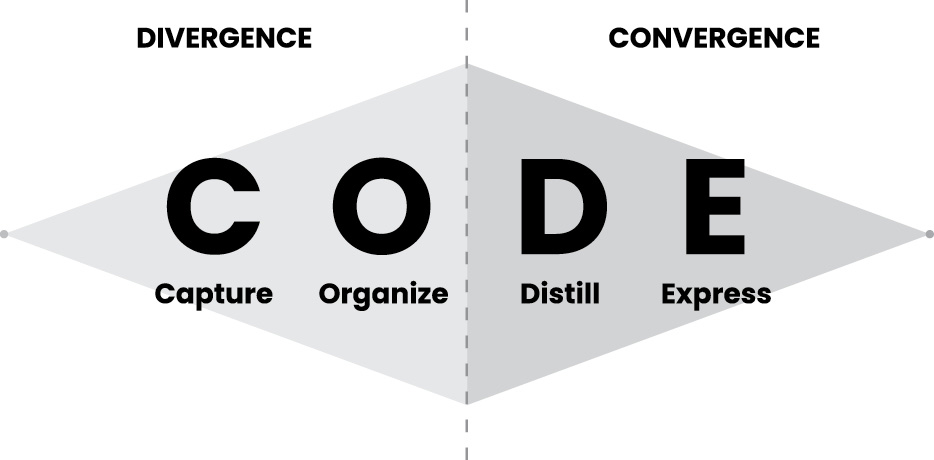
The first two steps of CODE, Capture and Organize, make up divergence. They are about gathering seeds of imagination carried on the wind and storing them in a secure place. This is where you research, explore, and add ideas. The final two steps, Distill and Express, are about convergence. They help us shut the door to new ideas and begin constructing something new out of the knowledge building blocks we’ve assembled.
The Three Strategies I Use to Bring Creative Work Together
Your Second Brain is a powerful ally in overcoming the universal challenge of creative work—sitting down to make progress and having no idea where to start.
Should you do more research, or start organizing the research you’ve already done?
Should you widen your horizons, or narrow your focus?
Should you start something new, or finish something you’ve already started?
When you distinguish between the two modes of divergence and convergence, you can decide each time you begin to work which mode you want to be in, which gives you the answers to the questions above. In divergence mode, you want to open up your horizons and explore every possible option. Open the windows and doors, click every link, jump from one source to another, and let your curiosity be your guide for what to do next. If you decide to enter convergence mode, do the opposite: close the door, put on noise-canceling headphones, ignore every new input, and ferociously chase the sweet reward of completion. Trust that you have enough ideas and enough sources, and it’s time to turn inward and sprint toward your goal.
Of the two stages of this process, convergence is where most people struggle.
The more imaginative and curious you are, the more diverse your interests, and the higher your standards and commitment to perfection, the more difficult you will likely find it to switch from divergence mode into convergence mode. It’s painful to cut off options and choose one path over another. There is a kind of creative grief in watching an idea that you know is full of potential get axed from a script or a story. This is what makes creative work challenging.
When you sit down to finish something—whether it’s an explanatory email, a new product design, a research report, or a fundraising strategy—it can be so tempting to do more research. It’s so easy to open up dozens of browser tabs, order more books, or go off in completely new directions. Those actions are tempting because they feel like productivity. They feel like forward progress, when in fact they are divergent acts that postpone the moment of completion.
There are three powerful strategies for completing creative projects I recommend to help you through the pitfalls of convergence. Each of them depends on having a Second Brain where you can manipulate and shape information without worrying it will disappear. Think of them as the tools in your Second Brain tool belt, which you can turn to anytime you need to get unstuck, find your way around obstacles, or decide what to do next.
1. The Archipelago of Ideas: Give Yourself Stepping-Stones
The Archipelago of Ideas technique is valuable any time you are starting a new piece of work—whether it’s a how-to guide, a training workshop, a brief for a new project, or an essay you’re publishing on your blog. It gives you a way to plan your progress even when performing tasks that are inherently unpredictable. The technique is named after a quote by Steven Johnson, the author of a series of fascinating books on creativity, innovation, and the history of ideas.1 As Johnson wrote:
Instead of confronting a terrifying blank page, I’m looking at a document filled with quotes: from letters, from primary sources, from scholarly papers, sometimes even my own notes. It’s a great technique for warding off the siren song of procrastination. Before I hit on this approach, I used to lose weeks stalling before each new chapter, because it was just a big empty sea of nothingness. Now each chapter starts life as a kind of archipelago of inspiring quotes, which makes it seem far less daunting. All I have to do is build bridges between the islands.
An archipelago is a chain of islands in the ocean, usually formed by volcanic activity over long spans of time. The Hawaiian Islands, for example, are an archipelago of eight major islands extending over about 1,500 miles of the Pacific Ocean.
To create an Archipelago of Ideas, you divergently gather a group of ideas, sources, or points that will form the backbone of your essay, presentation, or deliverable. Once you have a critical mass of ideas to work with, you switch decisively into convergence mode and link them together in an order that makes sense.
Here’s an example of an Archipelago of Ideas note I created to help me write an in-depth article on commonplace books:
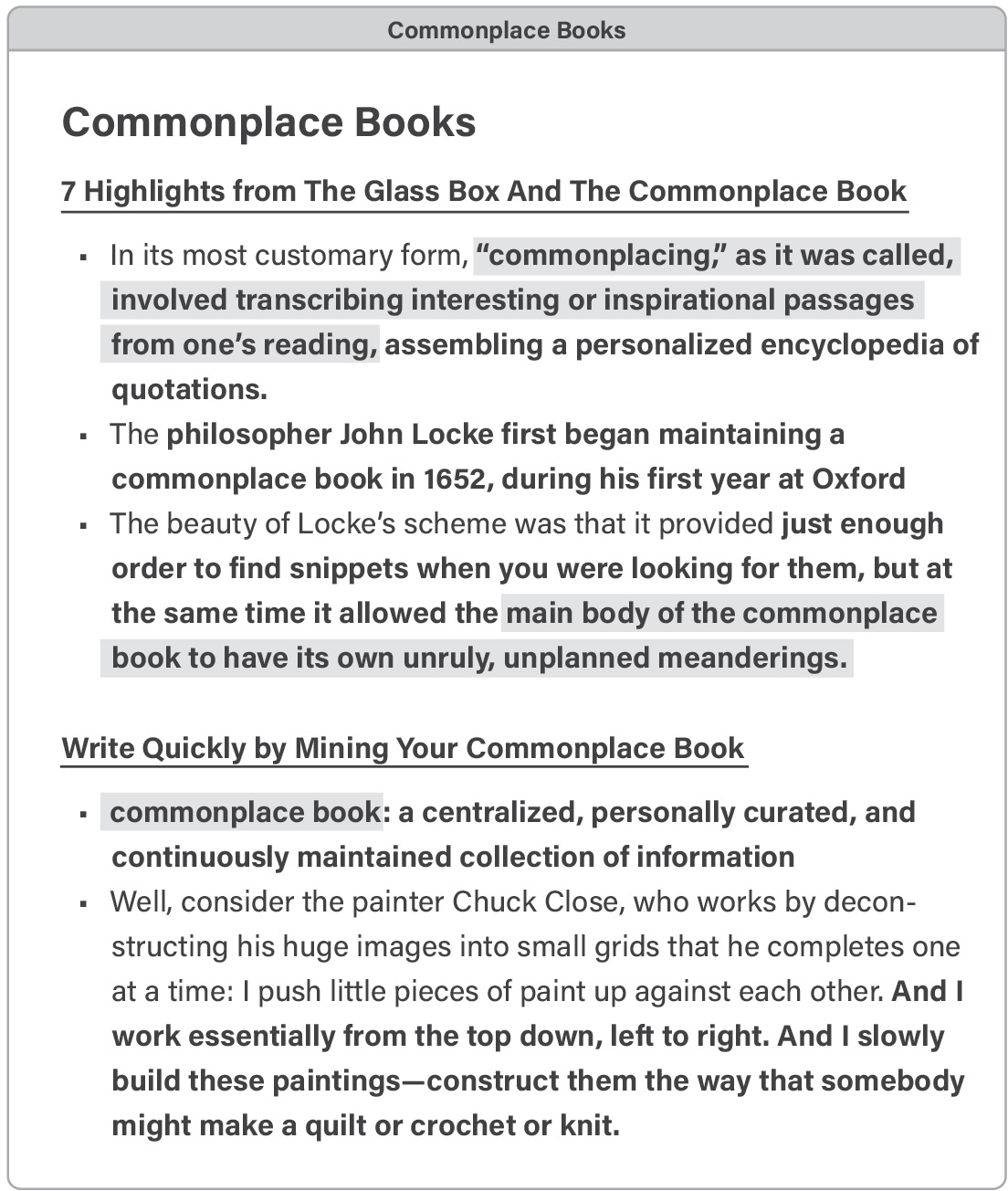
The underlined links (which appear in green in my notes) are the sources I’m drawing on as research. Clicking a link will lead me not to the public web, where I can easily get distracted, but to another note within my Second Brain containing my full notes on that source.III There I will find all the details I might need, as well as a link back to the original work for my citations.
Below each source, I’ve copied and pasted only the points I specifically want to use in this particular piece of writing. This Archipelago of Ideas includes external sources as in my example above, but also notes I’ve taken based on my own thoughts and experiences. This gives me the best of both worlds: I can focus only on the relevant points right in front of me, but all the other details I might need are just a click away. The bolds and highlights of Progressive Summarization help me quickly determine which parts are most interesting and important at a glance.
The Archipelago of Ideas technique is a contemporary reinvention of the age-old practice of outlining—laying out the points you want to include up front, so that when it comes time to execute all you have to do is string them together. The note you see above is exactly what I will want in front of me when I sit down in convergence mode to finish the first draft of my article.
Creating outlines digitally instead of on paper offers multiple major advantages:
- A digital outline is far more malleable and flexible—you can add bullet points and cross them off, rearrange and expand on them, add bolding and highlights, and edit them after the fact as your thinking changes.
- The outline can link to more detailed content—instead of trying to cram every last point onto the same page, you can link to both your own private notes and public resources on the web, which helps avoid overloading the outline with too much detail.
- The outline is interactive and multimedia—you can add not only text, but images, GIFs, videos, attachments, diagrams, checkboxes, and more.
- The outline is searchable—even if it gets long, you have a powerful search feature to instantly call up any term you’re looking for.
- The outline can be accessed and edited from anywhere—unlike a piece of paper in a notebook, your outline is instantaneously synced to every one of your devices, and it can be viewed, edited, and added to from anywhere.
An Archipelago of Ideas separates the two activities your brain has the most difficulty performing at the same time: choosing ideas (known as selection) and arranging them into a logical flow (known as sequencing).
The reason it is so difficult to perform these activities simultaneously is they require different modes: selection is divergent, requiring an open state of mind that is willing to consider any possibility. Sequencing is convergent, requiring a more closed state of mind focused only on the material you already have in front of you.
The goal of an archipelago is that instead of sitting down to a blank page or screen and stressing out about where to begin, you start with a series of small stepping-stones to guide your efforts. First you select the points and ideas you want to include in your outline, and then in a separate step, you rearrange and sequence them into an order that flows logically. This makes both of those steps far more efficient, less taxing, and less vulnerable to interruption.
Instead of starting with scarcity, start with abundance—the abundance of interesting insights you’ve collected in your Second Brain.
2. The Hemingway Bridge: Use Yesterday’s Momentum Today
Ernest Hemingway was one of the most recognized and influential novelists of the twentieth century. He wrote in an economical, understated style that profoundly influenced a generation of writers and led to his winning the Nobel Prize in Literature in 1954.
Besides his prolific works, Hemingway was known for a particular writing strategy, which I call the “Hemingway Bridge.” He would always end a writing session only when he knew what came next in the story. Instead of exhausting every last idea and bit of energy, he would stop when the next plot point became clear. This meant that the next time he sat down to work on his story, he knew exactly where to start. He built himself a bridge to the next day, using today’s energy and momentum to fuel tomorrow’s writing.IV
You can think of a Hemingway Bridge as a bridge between the islands in your Archipelago of Ideas. You may have the islands, but that is just the first step. The much more challenging work is linking them together into something that makes sense, whether it is a piece of writing, the design of an event, or a business pitch. The Hemingway Bridge is a way of making each creative leap from one island to the next less dramatic and risky: you keep some energy and imagination in reserve and use it as a launchpad for the next step in your progress.
How do you create a Hemingway Bridge? Instead of burning through every last ounce of energy at the end of a work session, reserve the last few minutes to write down some of the following kinds of things in your digital notes:
- Write down ideas for next steps: At the end of a work session, write down what you think the next steps could be for the next one.
- Write down the current status: This could include your current biggest challenge, most important open question, or future roadblocks you expect.
- Write down any details you have in mind that are likely to be forgotten once you step away: Such as details about the characters in your story, the pitfalls of the event you’re planning, or the subtle considerations of the product you’re designing.
- Write out your intention for the next work session: Set an intention for what you plan on tackling next, the problem you intend to solve, or a certain milestone you want to reach.
The next time you resume this endeavor, whether that’s the next day or months later, you’ll have a rich set of jumping-off points and next steps waiting for you. I often find that my subconscious mind keeps working in the background to help me improve on those thoughts. When I return to the project, I can combine the results of my past thinking with the power of a good night’s sleep and put them together into a creative breakthrough.
To take this strategy a step further, there is one more thing you can do as you wrap up the day’s work: send off your draft or beta or proposal for feedback. Share this Intermediate Packet with a friend, family member, colleague, or collaborator; tell them that it’s still a work-in-process and ask them to send you their thoughts on it. The next time you sit down to work on it again, you’ll have their input and suggestions to add to the mix of material you’re working with.
3. Dial Down the Scope: Ship Something Small and Concrete
A third technique I recommend for convergence I call “Dial Down the Scope.”
“Scope” is a term from project management that has been adopted by software developers, from whom I learned it while working in Silicon Valley. The scope refers to the full set of features a software program might include.
Let’s say you’re designing a fitness app. You sketch out a beautiful vision: it will have workout tracking, calorie counts, a gym finder, progress charts, and even connect you with others via a social network. It’s going to be amazing! It will transform people’s lives!
As with so many ambitious goals, once you get into the details it dawns on you just how complex these features are to build. You have to design the user interface, but also build the backend system to make it work. You have to hire customer support representatives and train them how to troubleshoot problems. You need a whole finance operation to keep track of payments and comply with regulations. Not to mention all the responsibilities of managing employees, dealing with investors, and developing a long-term strategy.
The solution that software teams landed on to deal with this kind of ballooning complexity is to “dial down the scope.” Instead of postponing the release of the app, which might prove disastrous in the face of looming competition and only delays the learning they need, the development team starts “dialing down” features as the release date approaches. The social network gets postponed to a future version. The progress charts lose their interactive features. The gym finder gets canceled completely. The first parts to be dialed down are the ones that are most difficult or expensive to build, that have the most uncertainty or risk, or that aren’t central to the purpose of the app. Like a hot-air balloon trying to take off, more and more features get thrown overboard to lighten the load and get the product off the ground. Any features that don’t make it into this version can always be released as part of future software updates.
How does this relate to our careers as knowledge workers?
We also deliver complex pieces of work under strict deadlines. We also have limited time, money, attention, and support—there are always constraints we must work within.
When the full complexity of a project starts to reveal itself, most people choose to delay it. This is true of projects at work, and even more true of side projects we take on in our spare time. We tell ourselves we just need more time, but the delay ends up creating more problems than it solves. We start to lose motivation as the time horizon stretches out longer and longer. Things get lost or go out of date. Collaborators move on, technology becomes obsolete and needs to be upgraded, and random life events never fail to interfere. Postponing our goals and desires to “later” often ends up depriving us of the very experiences we need to grow.
The problem isn’t a lack of time. It is that we forget that we have control over the scope of the project. We can “dial it down” to a more manageable size, and we must if we ever want to see it finished.
Waiting until you have everything ready before getting started is like sitting in your car and waiting to leave your driveway until all the traffic lights across town are green at the same time. You can’t wait until everything is perfect. There will always be something missing, or something else you think you need. Dialing Down the Scope recognizes that not all the parts of a given project are equally important. By dropping or reducing or postponing the least important parts, we can unblock ourselves and move forward even when time is scarce.
Your Second Brain is a crucial part of this strategy, because you need a place to save the parts that get postponed or removed.
You might cut sentences or entire pages from an article you’re writing, or delete scenes from a video you’re making, or drop parts of a speech when you’re trying to keep within your allotted time. This is a completely normal and necessary part of any creative process.
That doesn’t mean you have to throw away those parts. One of the best uses for a Second Brain is to collect and save the scraps on the cutting-room floor in case they can be used elsewhere. A slide cut from a presentation could become a social media post. An observation cut from a report could become the basis for a conference presentation. An agenda item cut from a meeting could become the starting point for the next meeting. You never know when the rejected scraps from one project might become the perfect missing piece in another. The possibilities are endless.
Knowing that nothing I write or create truly gets lost—only saved for later use—gives me the confidence to aggressively cut my creative works down to size without fearing that I’ve wasted effort or that I’ll lose the results of my thinking forever. Knowing that I can always release a fix, update, or follow up on anything I’ve made in the past gives me the courage to share my ideas before they’re perfectly ready and before I have them all figured out. And sharing before I feel ready has completely altered the trajectory of my career.
Whatever you are building, there is a smaller, simpler version of it that would deliver much of the value in a fraction of the time. Here are some examples:
- If you want to write a book, you could dial down the scope and write a series of online articles outlining your main ideas. If you don’t have time for that, you could dial it down even further and start with a social media post explaining the essence of your message.
- If you want to deliver a workshop for paying clients, you could dial it down to a free workshop at a local meetup, or dial it down even further and start with a group exercise or book club for a handful of colleagues or friends.
- If you’d like to make a short film, start with a YouTube video, or if that’s too intimidating, a livestream. If it’s still too much, record a rough cut on your phone and send it to a friend.
- If you want to design a brand identity for a company, start with a mock-up of a single web page. Even easier, start with a few hand-drawn sketches with your ideas for a logo.
How can you know which direction to take your thinking without feedback from customers, colleagues, collaborators, or friends? And how can you collect that feedback without showing them something concrete? This is the chicken-and-egg problem of creativity: you don’t know what you should create, but you can’t discover what people want until you create something. Dialing Down the Scope is a way of short-circuiting that paradox and testing the waters with something small and concrete, while still protecting the fragile and tentative edges of your work.
Divergence and convergence are not a linear path, but a loop: once you complete one round of convergence, you can take what you’ve learned right back into a new cycle of divergence. Keep alternating back and forth, making iterations each time until it’s something you can consider “done” or “complete” and share more widely.
Divergence and Convergence in the Wild: Behind the Scenes of a Home Project
Let me share an example of one of my own projects in which I used all three of these techniques: remodeling our garage into a home office.
When we moved into our home, my wife and I soon realized we needed a better workspace. We both work from home, and the tiny extra bedroom wasn’t cutting it, especially once our son was born. We excitedly made plans to turn our garage into a home studio. The moment I created a dedicated project folder, I knew it was on.
I started by creating an Archipelago of Ideas—an outline of the main questions, considerations, desired features, and constraints I thought our project would entail. Here is the outline I came up with after fifteen minutes:
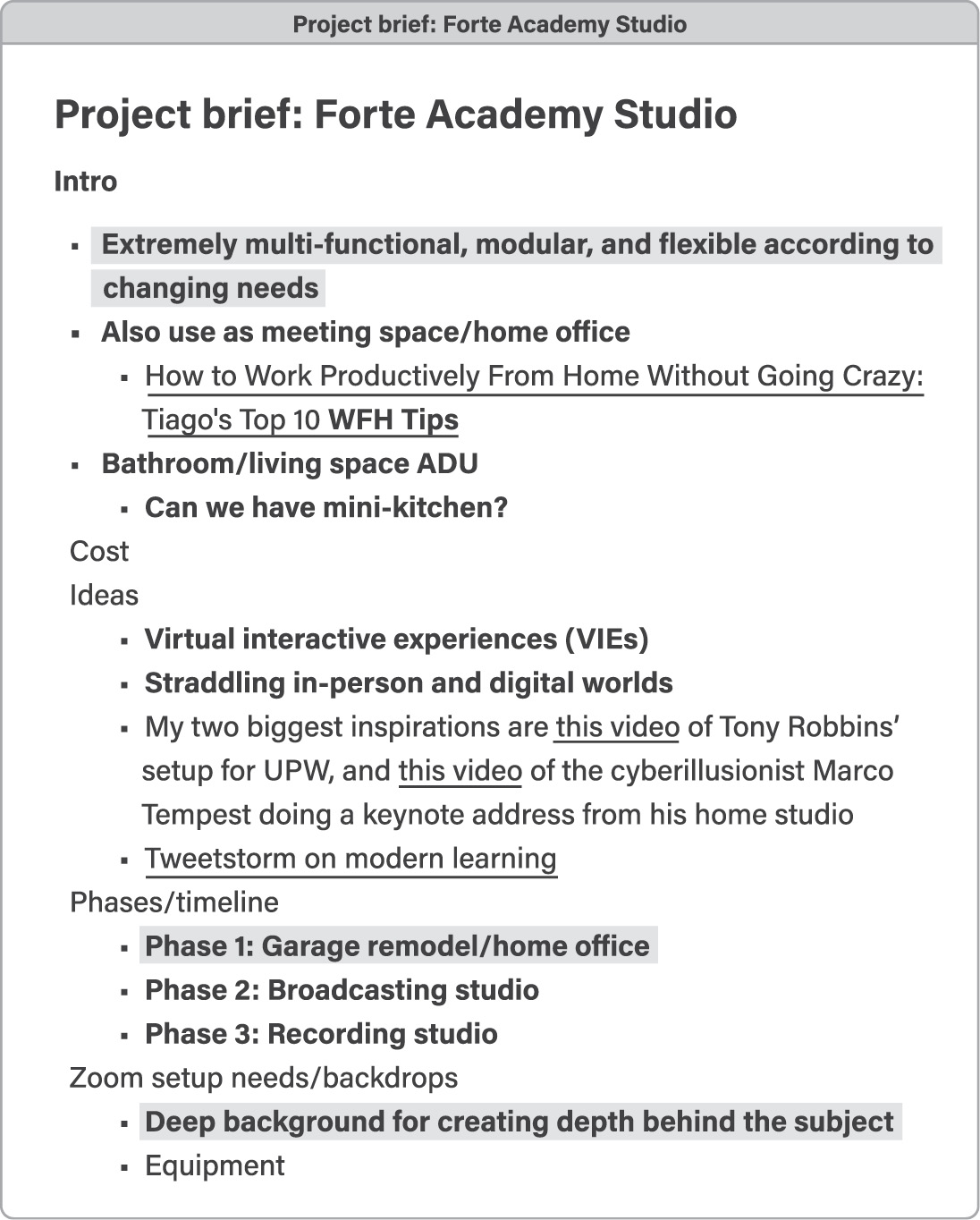
I didn’t know up front what the main headings of this document would include, but as I wrote out my thoughts they soon emerged: Intro, Cost, Ideas, Phases, Aesthetics, Zoom Setup, Equipment, and Open Questions. I did a few searches of my Second Brain for terms like “home office” and “home studio” and found several existing notes that could come in handy as well. For example, I found the notes with recommendations from a friend who had experience designing studios, which I mentioned previously; photos of a beautifully designed café in Mexico City that my wife and I loved visiting and wanted to mimic; and a note with best practices for hosting Zoom calls, such as finding the right lighting and a background that isn’t too distracting. I added links to them at the bottom of my outline as well.
Even with some existing material to work with, there were gaps in our plan. Over the next few weeks, whenever I had a free window of time, I collected and captured tidbits of content to inform our home studio remodel. I saved photos from Pinterest showing examples of home offices that I thought looked neat; notes from a conversation with a musician friend who taught me about soundproofing; and a list of local contractors a neighbor shared with me to reach out to. I even went on a late-night spree watching dozens of videos of YouTubers giving tours of their studios, taking notes on the small details of how they converted empty spaces into functional workspaces.
Between managing the business and our household, my time was incredibly scarce as we began the remodel. Whenever I could, I would highlight and distill the last few notes I’d captured and leave my future self a brief note about where I left off. I used a series of Hemingway Bridges to string together many such windows of time that otherwise wouldn’t have been of much productive use.
Finally, as all these thoughts and ideas and wishes and dreams began to add up, the project became quite a juggernaut. Before I knew it, our ambitions had expanded to knocking down walls, cutting through the roof for a skylight, laying down cable for superfast Internet, and redesigning the layout of the backyard to accommodate it all. We had diverged too far and needed to rein it in a bit.
This is where Dialing Down the Scope was essential: we identified the most outlandish of our plans and decided to save those for a later stage. I moved those ideas to their own “someday/maybe” section of my outline to revisit later. My wife and I also added several constraints to the project, such as the budget we were willing to spend, and a deadline to have the remodel done by a certain date. These constraints helped us reduce the scope of the project to something reasonable and manageable. As soon as we did, the next steps of finding a contractor and finalizing the floorplan became crystal clear.
Your Turn: Move Fast and Make Things
If you’d like to give this approach to executing projects a try, now is the perfect time.
Start by picking one project you want to move forward on. It could be one you identified in Chapter 5, when I asked you to make folders for each active project. It could alternatively be something you know you want to (or have to) get started on. The more uncertain, new, or challenging the project, the better.
Make an outline with your goals, intentions, questions, and considerations for the project. Start by writing out anything already on your mind, and then peruse your PARA categories for related notes and Intermediate Packets. These could include points or takeaways from previously created notes, inspiration from models or examples you want to borrow from, or templates you can use to follow best practices.
Here are some useful questions to ask as you conduct your search:
- Is there a book or article you could extract some excerpts from as inspiration?
- Are there websites that might have resources you could build upon?
- Are there podcasts by experts you could subscribe to and listen to while commuting or doing household chores?
- Are there relevant IPs buried in other projects you’ve worked on in the past?
Some material you find will be very succinct and highly polished, while some might be quite rough. It doesn’t matter—your only goal is to get all the potentially usable material in one place. Move all the notes and IPs you might want to use into a new project folder.
Set a timer for a fixed period of time, such as fifteen or twenty minutes, and in one sitting see if you can complete a first pass on your project using only the notes you’ve gathered in front of you. No searching online, no browsing social media, and no opening multiple browser tabs that you swear you’re going to get to eventually. Only work with what you already have. This first pass could be a plan, an agenda, a proposal, a diagram, or some other format that turns your ideas into a tangible artifact.
You might experience some FOMO—that inner Fear of Missing Out—that pushes you to seek out yet another morsel of information somewhere out there. You will probably be tempted to go off and “do more research,” but you are not completing the entire project in one sitting. You are only creating the first iteration—a draft of your essay, a sketch of your app, a plan for your campaign. Ask yourself, “What is the smallest version of this I can produce to get useful feedback from others?”
If you find that you can’t complete the first iteration in one sitting, start by building a Hemingway Bridge to the next time you can work on it. List open questions, remaining to-dos, new avenues to explore, or people to consult. Share what you’ve produced with someone who can give you feedback while you’re away and save their comments in a new note in the same project folder. You can collect this feedback in a private conversation with a trusted colleague, or publicly on social media at full blast, or anywhere in between. Pick a venue for sharing that you feel comfortable with.
If you feel resistance to continuing with this project later, try Dialing Down the Scope. Drop the least important features, postpone the hardest decisions for later, or find someone to help you with the parts you’re least familiar with.
Throughout every step of this process, be sure to keep notes on anything you learn or discover, or any new Intermediate Packets you might want to seek out. Once your biological brain is primed by this first pass through your notes, you’ll start to notice signs and clues related to it everywhere you look. Save those clues as notes as well! Once you’re finished with your first iteration, have gathered feedback, and collected a new set of notes to work with, you’ll be ready for whatever comes next.
- I. For more insight into what I learned about the creative process from my father, I made a short documentary on his work and life called Wayne Lacson Forte: On My Way To Me.
- II. I first learned about the model of divergence and convergence from Design Thinking, an approach to creative problem-solving that emerged out of the Stanford Design School and was further popularized by the innovation consultancy IDEO starting in the 1980s and 1990s.
- III. If your notes app syncs with your computer, this also means that you can disconnect from the Internet and still make progress, since you have all your notes saved on your hard drive.
- IV. One way to think of this is to “end with the beginning in mind,” a clever rephrasing of author Stephen Covey’s classic advice to “begin with the end in mind.”