Chapter 6  Distill—Find the Essence
To attain knowledge, add things every day. To attain wisdom, remove things every day.
—Lao Tzu, ancient Chinese philosopher
In 1969, studio executives at Paramount Pictures were desperate to find a film director for a new movie they had purchased the rights to, a crime drama based on the New York Mafia.
One after another, all the top directors of the era turned the project down. They all found it too sensationalistic for their tastes. Gangster movies were known as cliché and gimmicky, and there had been several recent duds in the genre.
After exhausting all their top choices, studio executives approached a young film director who had done a few small indie films. The director was a relative novice, with no major commercially successful films to his name. He was an outsider, working out of San Francisco instead of Hollywood, the industry capital. And he was known as an artist who wanted to experiment with new ideas, not a director of big budget movies.
That director’s name was Francis Ford Coppola, and the movie he was asked to make was, of course, The Godfather.
Coppola initially turned down the project. As recounted in the Hollywood Reporter,1 he said, “It was more commercial and salacious than my own taste.” However, his partner and protégé George Lucas (of future Star Wars fame) noted that they were broke. Without a major infusion of cash, they’d soon be evicted.
Mounting financial pressure, plus a second reading of the novel, changed Coppola’s mind, as he realized that it could be framed as “a story that was a metaphor for American capitalism in the tale of a great king with three sons.”
The Godfather would go on to become one of the greatest critical and commercial successes in filmmaking history. In 2007 the American Film Institute named it the third-best American movie of all time.2 It ultimately grossed $245 million, won three Oscars, and spawned a series of sequels and spinoffs eaten up by a rabid fan base obsessed with the story of the fictional Corleone family.
Coppola’s strategy for making the complex, multifaceted film rested on a technique he learned studying theater at Hofstra College, known as a “prompt book.” He started by reading The Godfather novel and capturing the parts that resonated with him in a notebook—his own version of Twyla Tharp’s box. But his prompt book went beyond storage: it was the starting point for a process of revisiting and refining his sources to turn them into something new.
The book was made from a three-ring binder, into which he would cut and paste pages from the novel on which the film was based. It was designed to last, with reinforced grommets to ensure the pages wouldn’t tear even after many turnings. There he could add the notes and directions that would later be used to plan the screenplay and production design of the film.
In a short documentary titled Francis Coppola’s Notebook3 released in 2001, Coppola explained his process. He started with an initial read of the entire novel, noting down anything that stuck out to him: “I think it’s important to put your impressions down on the first reading because those are the initial instincts about what you thought was good or what you didn’t understand or what you thought was bad.”
Coppola then began to add his own interpretations, distilling and reconstituting his own version of the story. He broke down each scene according to five key criteria: a synopsis (or summary) of the scene; the historical context; the imagery and tone for the “look and feel” of a scene; the core intention; and any potential pitfalls to avoid. In his own words, “I endeavored to distill the essence of each scene into a sentence, expressing in a few words what the point of the scene was.”
Coppola described his binder as “a kind of multi-layered road map for me to direct the film… so I was able to review not only Mario Puzo’s original text but all my first notation as to what… was important to me or what I felt was really going on in the book.” His comments in the margins included “Hitchcock” to remind him of how the famed director of thrillers would have framed a shot, or “Frozen time” to remind him to slow down a sequence. He used different kinds of annotations to emphasize to his future self which parts of a scene were most important: “As I was reading the book and making these notes and then putting them on the margins obviously the more pens I was using and the more rulers, and the more squiggly lines, sort of implied the excitement of the book was higher and higher, so that the sheer amount of ink on the page would tell me later on this is one of the most important scenes.”
The Godfather Notebook is a perfect example of the behind-the-scenes process used by successful creative professionals. Coppola considered the prompt book that emerged from this process the most important asset in the production of his now classic film: “the script was really an unnecessary document; I didn’t need a script because I could have made the movie just from this notebook.”
We might imagine a movie as emerging straight out of the mind of a screenplay writer or director, when in fact it depends on collecting and refining source material. Coppola’s story demonstrates that we can systematically gather building blocks from our reading and research that ultimately make the final product richer, more interesting, and more impactful.
If Francis Ford Coppola relied so much on a step-by-step process for notetaking, then so can we. We can also use our notes to drill down to the essence of the stories, research, examples, and metaphors that make up our own source material. This is the third step of CODE, to Distill. This is the moment we begin turning the ideas we’ve captured and organized into our own message. It all begins and ends with notes.
Quantum Notetaking: How to Create Notes for an Unknown Future
I’ve shown you how to capture notes with interesting ideas from the outside world or your own thoughts. You may have started organizing those notes according to their actionability and relevance to your current projects.
Now what?
This is where even the most dedicated notetakers usually stop. They aren’t sure what to do next. They’ve gathered some interesting knowledge, but it hasn’t led anywhere. Our notes are things to use, not just things to collect.
When you initially capture a note, you may have only seconds to get it into your Second Brain before the next meeting, urgent task, or crying child comes calling. Not nearly enough time to fully understand what it means or how it might be used. When you first capture them, your notes are like unfinished pieces of raw material. They require a bit more refinement to turn them into truly valuable knowledge assets, like a chemist distilling only the purest compound. This is why we separate capturing and organizing from the subsequent steps: you need to be able to store something quickly and save any future refinement for later.
In this sense, notetaking is like time travel—you are sending packets of knowledge through time to your future self.
You probably consume a lot of books, articles, videos, and social media posts full of interesting insights, but what are the chances that you’ll be ready to put any given piece of advice into action right at that instant? How likely is it that life will intervene, in the form of a crisis at work, an urgent meeting at your kid’s school, or an unexpected cold? In my experience, life is constantly pushing and pulling us away from our priorities. The more determined we are to focus and get something done, the more aggressively life tends to throw emergencies and delays in our face.
You’re watching a YouTube video on home renovation now, but that knowledge can be put to use only in a few months, when you move into your new place. You’re reading an article about time management techniques now, but they end up being most useful at the end of the year, when your new child is born and you suddenly have much greater demands on your time. You’re talking to a sales prospect about their goals and challenges now, but when you could really use that information is next year, when they start taking bids for a huge new contract.
This holds true for so much of the ideas and inspiration around us. There is a key idea that catches our attention in the moment. We feel enraptured and obsessed with it. It’s difficult to imagine ever forgetting the new idea. It’s changed our lives forever! But after a few hours or days or weeks, it starts to fade from our memory. Soon our recollection of that exciting new idea is nothing but a pale shadow of something we once knew, that once intrigued us. Your job as a notetaker is to preserve the notes you’re taking on the things you discover in such a way that they can survive the journey into the future. That way your excitement and enthusiasm for your knowledge builds over time instead of fading away.
Discoverability—The Missing Link in Making Notes Useful
The most important factor in whether your notes can survive that journey into the future is their discoverability—how easy it is to discover what they contain and access the specific points that are most immediately useful.
Discoverability is an idea from information science that refers to “the degree to which a piece of content or information can be found in a search of a file, database, or other information system.”I Librarians think about discoverability when deciding how to lay out books on the shelves. Web designers think about it when they create menus for the websites you visit every day. Social media platforms work hard to make the best content on their platforms as discoverable as possible.
Discoverability is the element most often missing from people’s notes. It’s easy to save tons and tons of content, but turning it into a form that will be accessible in the future is another matter. To enhance the discoverability of your notes, we can turn to a simple habit you probably remember from school: highlighting the most important points. Highlighting is an activity that everyone understands, takes hardly any additional effort, and works in any app you might use.
Imagine your future self as a demanding customer. They will surely be impatient and very busy. They won’t have time to pore through page after page of details just to find the hidden gems. It’s your job to “sell” them on the value of the notes you are taking now. Your future self might have mere minutes before a meeting starts to quickly search their notes for a reference they need. In that sense, each note is like a product you are creating for the benefit of that future customer. If they don’t buy it—they don’t think it’s worth the effort of revisiting past notes—then all the value of the work you’re doing now will be lost.
This points to a paradox that a lot of people experience as they take notes: the more notes they gather, the more the volume of information grows, the more time and effort it takes to review it all, and the less time they have to do so. Paradoxically, the more notes they collect, the less discoverable they become! This realization tends to either discourage them from taking any notes in the first place, or alternatively, to keep switching from one notetaking tool to another every time the volume gets overwhelming. Thus, they miss out on most of the benefits of their knowledge compounding over time.
What do you do when communicating with a very busy, very impatient, very important person? You distill your message down to the key points and action steps. When you send an email to your boss, you don’t bury your request somewhere near the bottom of a massive wall of text. You identify the most urgent questions that you need them to respond to right at the top of the email. When you’re giving a presentation to the leadership of your organization, you don’t drone on for hours. You leave out unnecessary details and get right to the point.
Distillation is at the very heart of all effective communication. The more important it is that your audience hear and take action on your message, the more distilled that message needs to be. The details and subtleties can come later once you have your audience’s attention.
What if your future self was just as important as these VIPs? How could you communicate with them through time in the most efficient, concise way?
Highlighting 2.0: The Progressive Summarization Technique
Progressive Summarization is the technique I teach to distill notes down to their most important points. It is a simple process of taking the raw notes you’ve captured and organized and distilling them into usable material that can directly inform a current project.
Progressive Summarization takes advantage of a tool and a habit that we are all intimately familiar with—highlighting—while leveraging the unique capabilities of technology to make those highlights far more useful than anything you did in school.
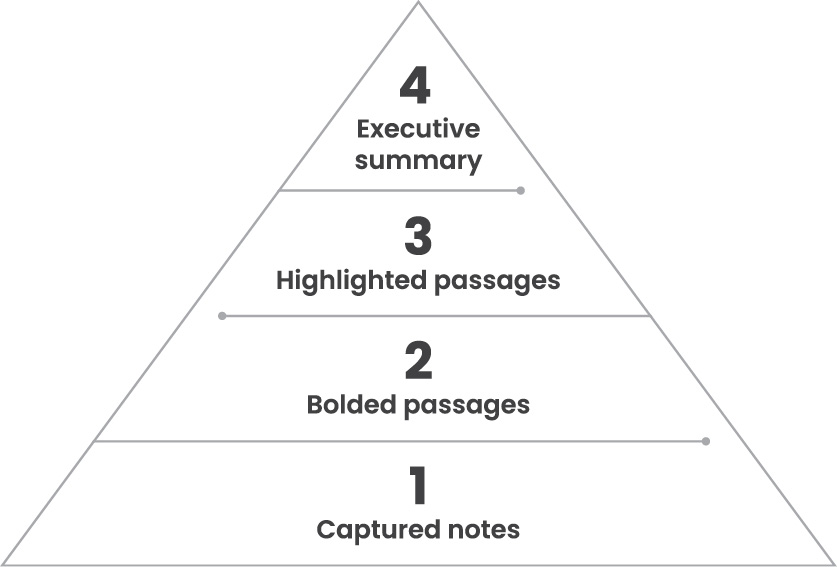
The technique is simple: you highlight the main points of a note, and then highlight the main points of those highlights, and so on, distilling the essence of a note in several “layers.” Each of these layers uses a different kind of formatting so you can easily tell them apart.
Here is a snapshot of the four layers of Progressive Summarization:II
Here’s an example of a note I captured from an article in Psychology Today.4 I came across the link when it was shared on social media and saved it with two clicks to my read later app, where I collect bookmarks of everything I want to read, watch, or listen to. A few evenings later, when I wanted to do some casual reading to wind down for the day, I read the article and highlighted the passages I found most interesting. I have my read later app synced to my digital notes app, so any passage I highlight there automatically gets saved in my notes, including a link to the source.
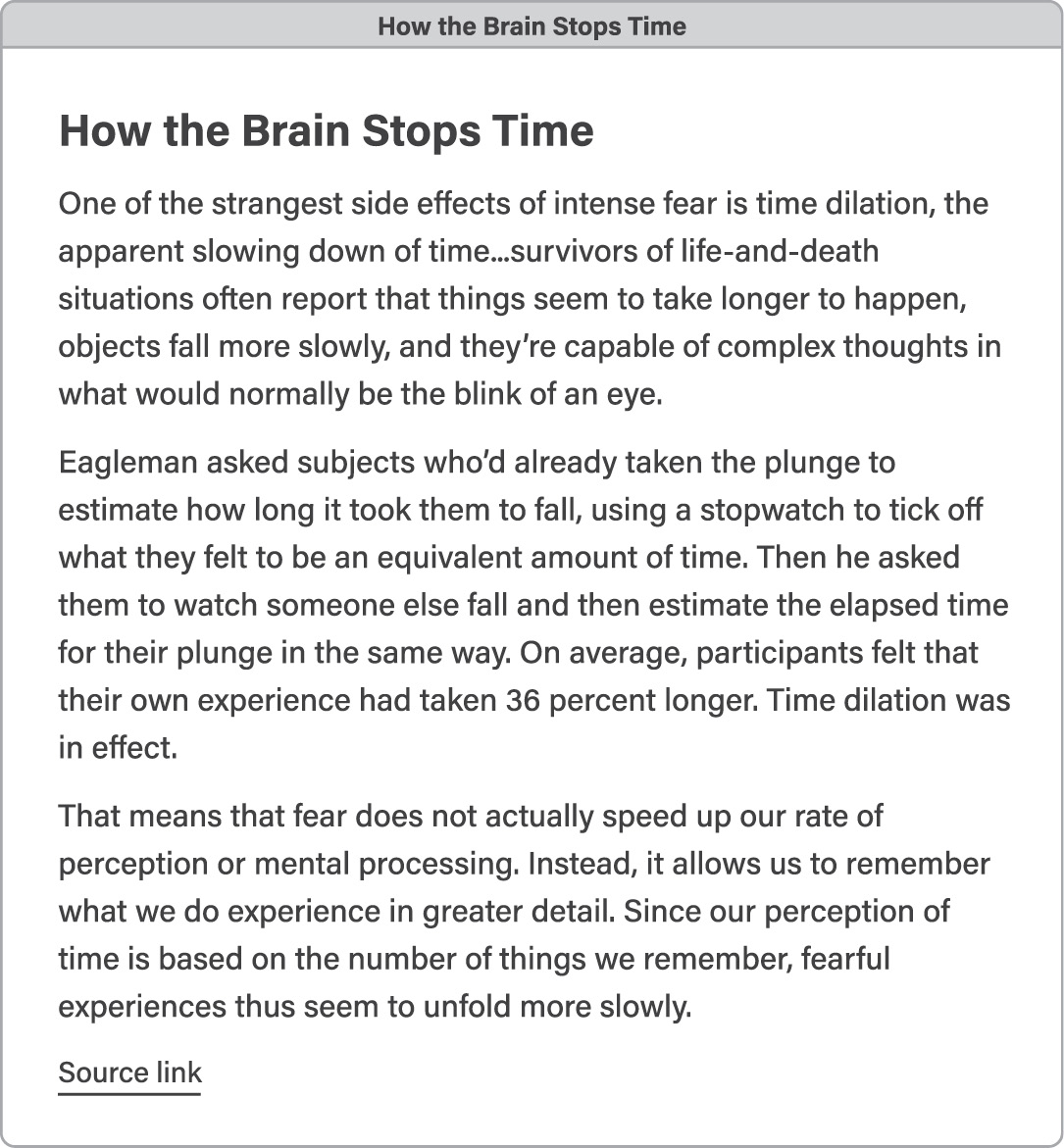
This is what I call “layer one”—the chunks of text initially captured in my notes. Notice that I didn’t save the entire article—only a few key excerpts.III By limiting what I keep to only the best, most important, most relevant parts, I’m making all the subsequent steps of organizing, distilling, and expressing much easier. If I ever need to know the full details, I have the link to the original article right there at the bottom.
As interesting as this content is, it’s not nearly succinct enough. Once again, in the midst of a chaotic workday, I would be hard-pressed to find the time to casually look through multiple paragraphs of text to find the relevant points. Unless I highlight those points in a way that my future self can instantly grasp, I’ll likely never see them again.
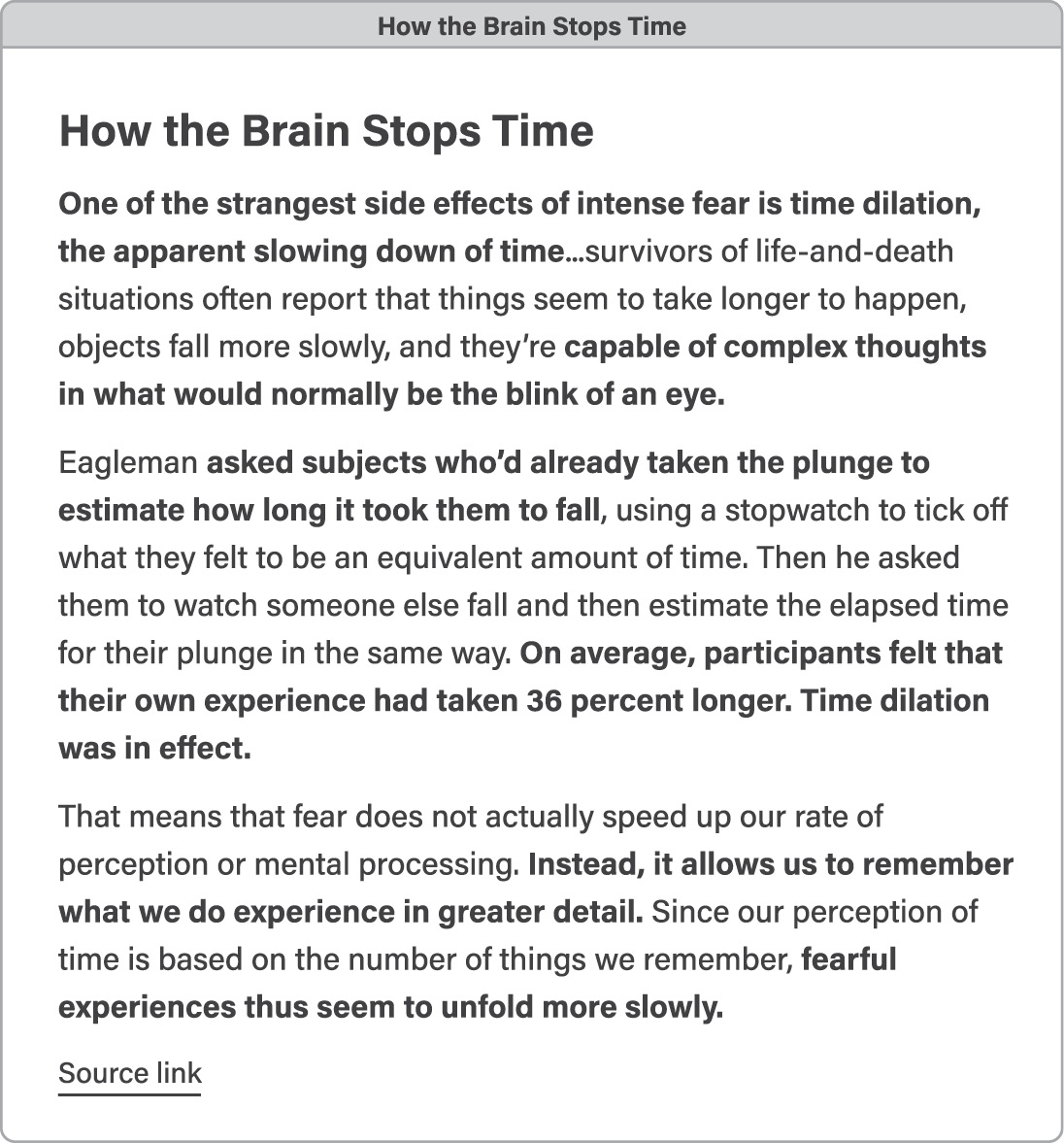
To enhance the discoverability of this note, I need to add a second layer of distillation. I usually do this when I have free time during breaks or on evenings or weekends, when I come across the note while working on other projects, or when I don’t have the energy for more focused work. All I have to do is bold the main points within the note. This could include keywords that provide hints of what this text is about, phrases that capture what the original author was trying to say, or sentences that especially resonated with me even if I can’t explain why. Looking over the bolded parts of the same note below, can you see how much easier it is to quickly grasp the gist of this note by looking only at those parts?
At layer two, this note is already dramatically more discoverable. Imagine the difference between reading the original article, which might take five to ten minutes of focused attention, versus glancing over these bolded points, which would take less than a minute.
We’re not done yet! For those notes that are especially long, interesting, or valuable, it is sometimes worth adding a third layer of highlighting. I advise using the “highlighting” feature offered by most notes apps, which paints passages in bright yellow just like the fluorescent highlighters we used in school (which appear in light gray below). If your notes app doesn’t have a highlighting feature, you can use underlining or another kind of formatting instead. Look only at the bolded passages you identified in layer two and highlight only the most interesting and surprising of those points. This will often amount to just one or two sentences that encapsulate the message of the original source.
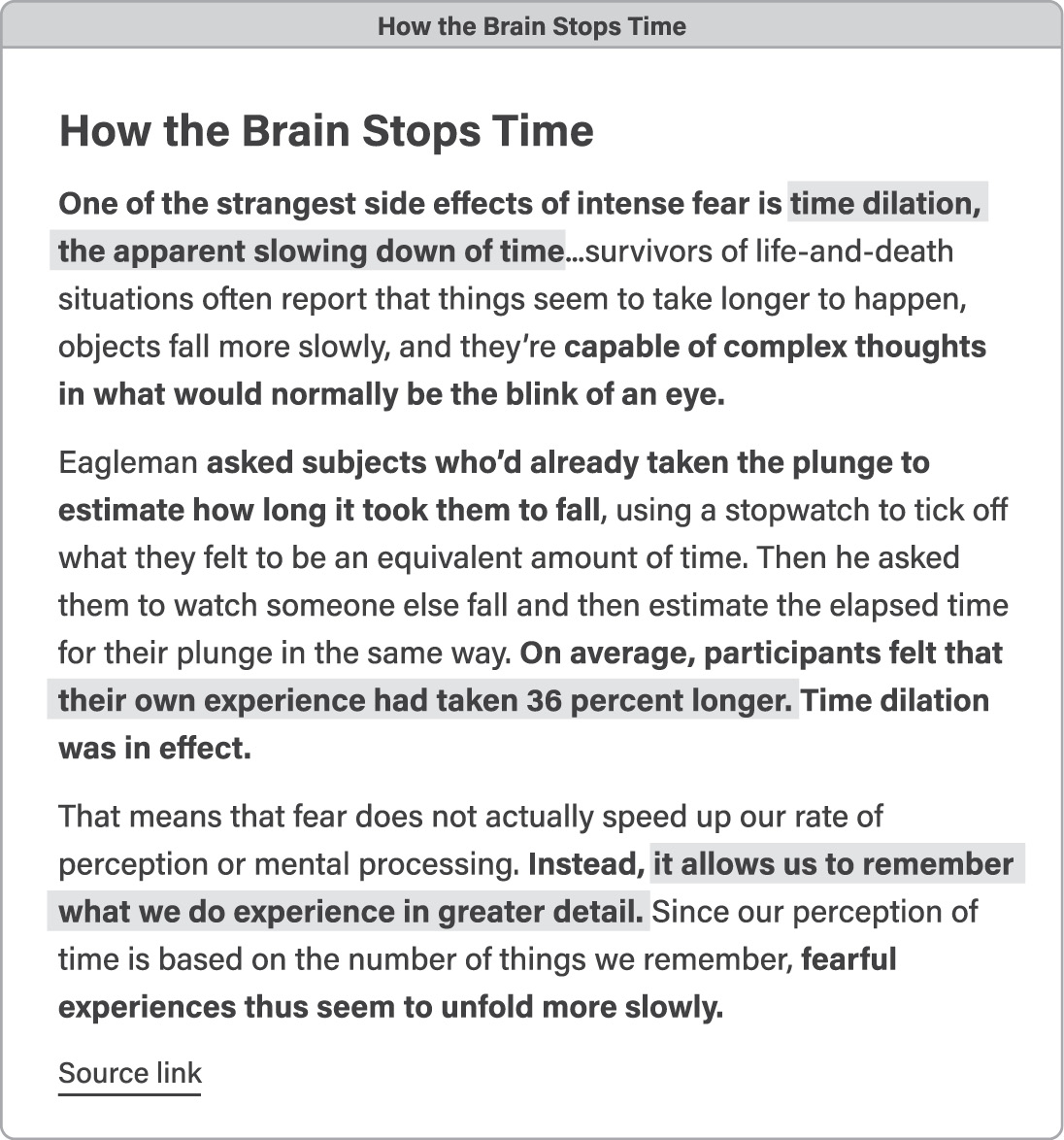
Looking at the note above, can you see how those few highlighted sentences jump out and catch your eye? They convey the main message of this article in a highly distilled form that takes just seconds to grasp. When I come across this note in the future—while doing a search or browsing the notes within a folder—I’ll be able to decide in the blink of an eye whether this source is relevant to my needs. If it is, I’ll have all the additional details and context I need to remember it right in front of me, as well as the link to the original article to check the source.
There is one more layer we can add, though it is quite rarely needed. For only the very few sources that are truly unique and valuable, I’ll add an “executive summary” at the top of the note with a few bullet points summarizing the article in my own words. The best sign that a fourth layer is needed is when I find myself visiting a note again and again, clearly indicating that it is one of the cornerstones of my thinking. Looking only at the points I’ve previously bolded and highlighted in layers two and three makes it far easier to write this summary than if I was trying to summarize the entire article all at once.
I recommend using bullet points to encourage yourself to make this executive summary succinct. Use your own words, define any unusual terms you’re using, and think about how your future self, who may not remember anything about this source, might interpret what you’re writing.
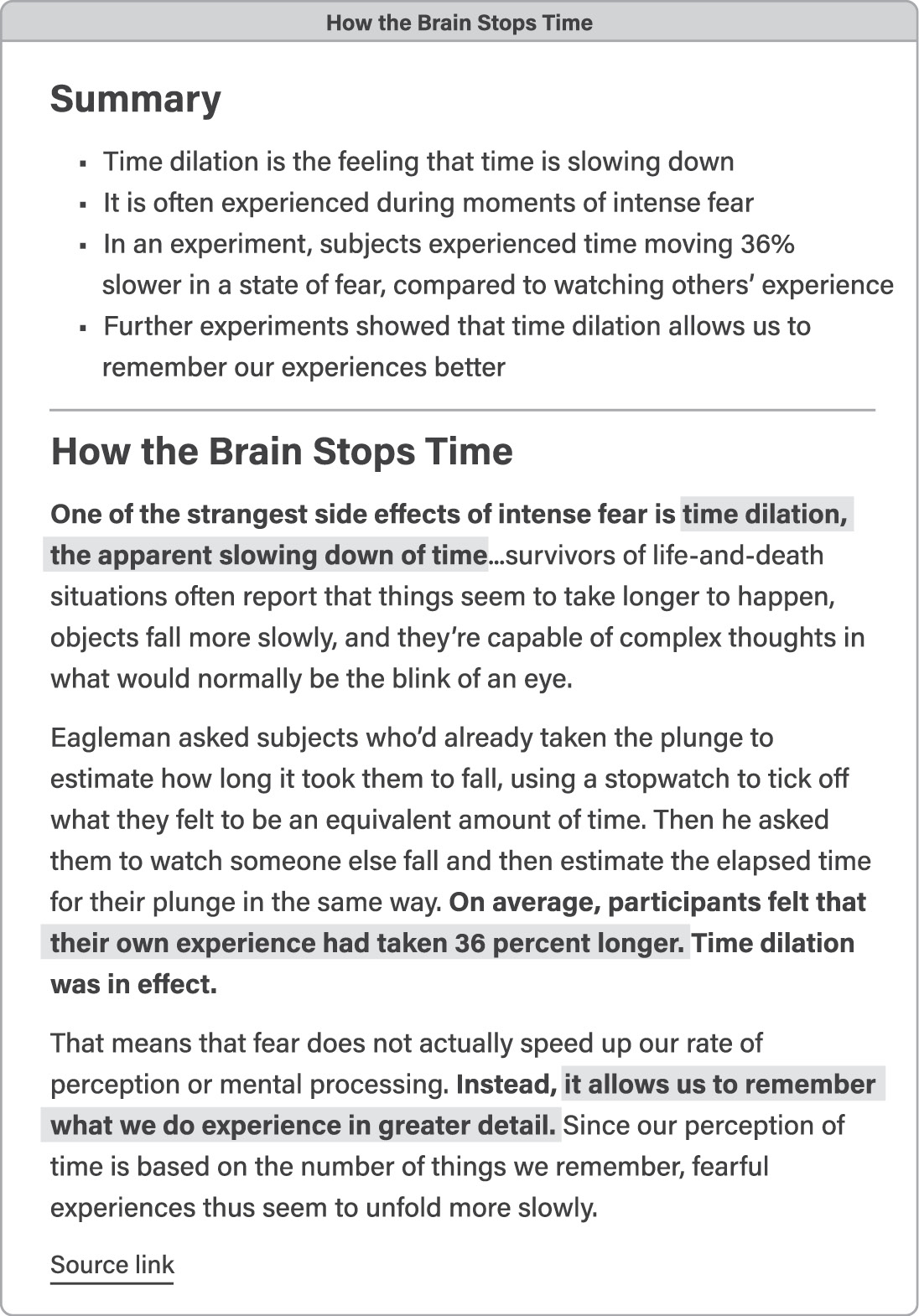
By reviewing this executive summary, I can rapidly recall the main takeaways from this article in a fraction of the time it would take to reread the original. Since the takeaways are already in my own words, they are easy to incorporate into whatever I’m working on. Speed is everything when it comes to recall: you have only a limited amount of time and energy, and the faster you can move through your notes, the more diverse and interesting ideas you can connect together.
Zooming In and Out of Your Map of Knowledge
The layers of Progressive Summarization give you multiple ways of interacting with your notes depending on the needs of the moment. The first time you read about a new idea, you might want to dive into the details and explore every nuance. The next time you revisit that idea, you probably don’t want to repeat all that effort and read the same piece from beginning to end again. You want to pick up where you left off, looking only at the highlights left over from the last time you visited that note. You can review all the details at layer one, or if you’re pressed for time (and when are we ever not pressed for time?), just focus on layers two, three, or four. You can customize how much attention you spend on a note based on your energy level and time available.
It’s like having a digital map of your notes that can be zoomed in or out depending on how many details you want to see, like a maps app on your smartphone. Navigating to a new destination, you might want to zoom in and see exactly which driveway to turn into. On the other hand, if you’re planning a cross-country road trip, you might want to zoom out and see your entire itinerary in one glance. The same is true for your landscape of knowledge—sometimes you want to zoom in and examine one specific research finding, while other times you want to zoom out and see the broad sweep of an argument all at once.
With Progressive Summarization, you are building up a map of the best ideas found in your Second Brain. Your highlights are like signposts and waypoints that help you navigate through the network of ideas you’re exploring. You are building this map without moving anything or deleting anything. Every sentence gets left right where you found it, giving you the freedom to leave things out without worrying that you’ll lose them. With this map in hand, you can actually see what you’ve captured, helping you find what you’re looking for but also what you don’t even know you’re looking for.
Highlighting can sometimes feel risky. You may wonder, “Am I making the right decision about which points are most important, or what this source means?” The multiple layers of Progressive Summarization are like a safety net; if you go in the wrong direction, or make a mistake, you can always just go back to the original version and try again. Nothing gets forgotten or deleted.
Progressive Summarization helps you focus on the content and the presentation of your notes,IV instead of spending too much time on labeling, tagging, linking, or other advanced features offered by many information management tools. It gives you a practical, easy thing to do that adds value even when you don’t have the energy for more challenging tasks. Most importantly, it keeps your attention on the substance of what you’re reading or learning, which is what matters in the long term.
Four Examples of Progressive Summarization
Progressive Summarization can be used across a wide variety of different kinds of content. As long as a source can be turned into text,V you can add layers of highlighting in any information management tool you use.
Let’s look at more examples of progressively summarized notes:
- A Wikipedia article
- A blog post
- A podcast interview
- Meeting notes
Wikipedia Articles
Have you ever found yourself visiting the same Wikipedia article again and again or trying to remember something from that one article you read weeks ago?
By saving the best excerpts from Wikipedia articles you read, you can create your own private encyclopedia with only the parts that are most relevant to you. In the note below, I captured a few key sentences from the article explaining “Baumol’s Cost Disease,” a somewhat esoteric term from economics that I’d seen referenced a few times.
When I first captured the note, I didn’t have time to add tags, highlights, or an executive summary of my own. I saved it to a resource folder for “Economics” to revisit later. A few months later, when it came up in a search for “wages,” I took a few moments to bold a couple of key sentences and highlight the most important one, so I could get the gist of it with a glance.
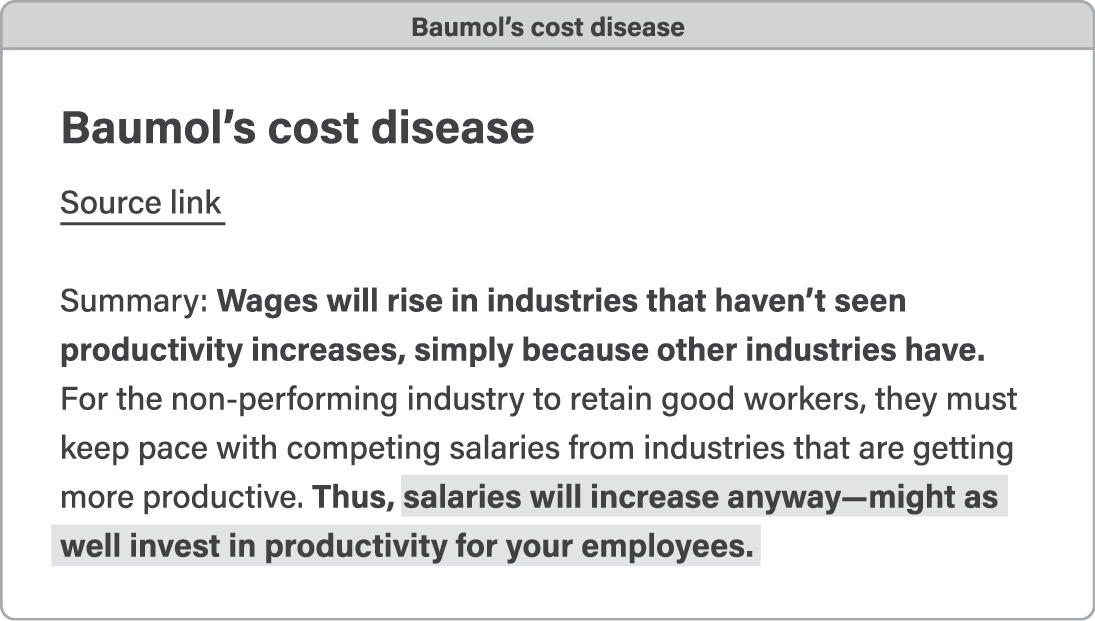
I was once on a panel when one of the speakers mentioned this term. Within the ten seconds before it was my turn to respond, I was able to run a search, look up this note on my tablet (where all my notes are synchronized), and speak confidently on the subject as if I had known it all along.
Online Articles
Much of the time we consume information without a specific purpose in mind. We might peruse the newspaper over breakfast, listen to a podcast while working out, or check out a newsletter to casually learn about a topic. We consume information to stay up to date, pass the time, entertain ourselves, and keep our minds engaged.
These moments are some of the most valuable opportunities to capture tidbits of insight that you probably might not find otherwise. Because this casual reading and listening tends to range over a wide number of topics and interests, you are exposed to more diverse ideas than usual.
One evening I was reading an online article that I saw shared on social media. The article explained how Google used “structured interviews” as part of their hiring process to reduce bias, ensure consistency, and learn from past hires. I was a solo freelancer at the time and had no immediate use for knowledge about hiring practices. I knew that someday I might, so I decided to save the paragraph you see below to my Second Brain.

Almost two years later, I was finally ready to hire my first employee. I remember the feeling of anxiety as I prepared to take on this major financial commitment, not to mention the responsibility of managing a direct report. Luckily, I had a handful of highly actionable notes saved in a resource folder called “Hiring.” To get started, I moved the entire folder from resources to projects. Then I spent about thirty minutes to review the notes it contained and highlight the most relevant takeaways. Those highlights were the starting point for the hiring process I ended up using for my own business, inspired by one of the most innovative and desirable employers in the world.
Podcasts and Audio
Notes can come in handy even when you’re not able to write them down in real time. I was driving with my wife one weekend to a small Airbnb cabin in the Sierra Nevada mountains of California, and we decided to listen to a podcast. It was a casual conversation between the host and a course instructor named Meghan Telpner, who ran an online school called the Academy of Culinary Nutrition.5
I had never heard of her and put on the episode without any particular goal in mind. Over the next hour, as we ascended the steep mountainside roads, we were captivated by the story of the education business she had managed to build. She had faced so many of the same challenges we had. It was a relief to hear that we weren’t alone in our struggles. I was driving and unable to write anything down, but as soon as we arrived I sat in the car for a few minutes and captured the ideas I remembered. This is actually a great way to filter down the volume of notes you’re taking—the best stuff always sticks in your mind for an hour or two.
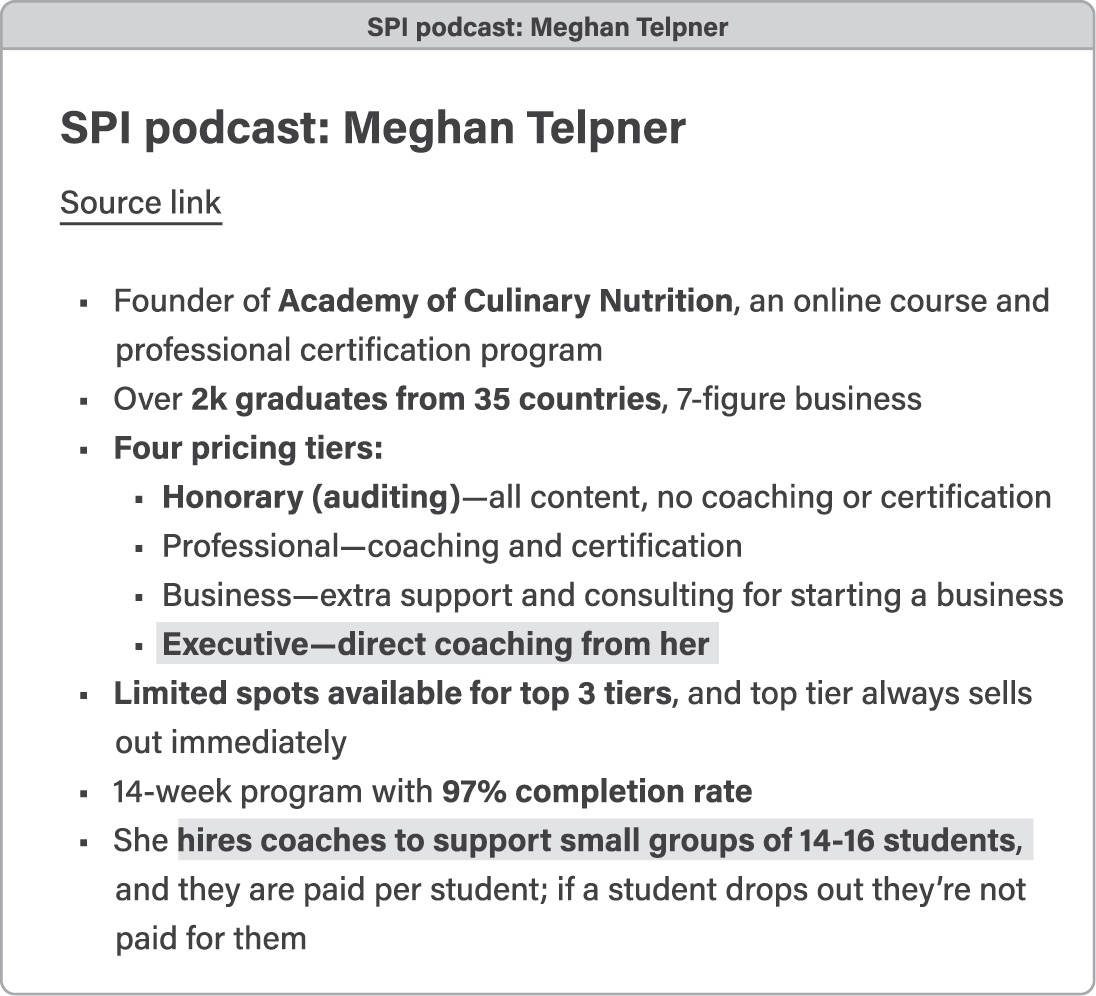
A few months later, we were preparing a launch campaign for a new version of our online course. I had only a couple of weeks to prepare for it—definitely not enough time to do more research. I had to make use of the ideas I’d already collected. As part of my preparation, I went through this note (which I found within an area folder for “Online education”) and bolded the parts that most resonated with me. Then just before our launch kickoff I highlighted the parts I wanted to apply to our own situation. The highlighted passages you see here were the sparks that eventually led to us hiring alumni of the course to coach new students. This freed up my time to implement another idea from Telpner’s interview: adding a new “executive” coaching tier. You truly never know where inspiration will come from and the extraordinary impact it can have.
Meeting Notes
Like many people, I spend a fair percentage of my time on phone calls and in meetings. I want to make the best use of that time, so I take notes during most meetings of new ideas, suggestions, feedback, and action steps that come up.
Taking notes during meetings is a common practice, but it’s often not clear what we should do with those notes. They are often messy, with the action items buried among random comments. I often use Progressive Summarization to summarize my notes after phone calls to make sure I’m extracting every bit of value from them.
I captured this note during a conversation with a friend of mine who has experience designing recording studios. We were remodeling our garage into a home studio and I wanted to get his advice. He was kind enough to come over and walk me through his recommendations, and I wrote down the main points in a notes app on my smartphone as he spoke.

Sometime later, I happened to be driving by the local hardware store on my way home. I realized that I could pop in and get some of the supplies my friend had recommended. I took out my smartphone, did a search for “home studio,” and found this note. I took a few minutes while sitting in the car and bolded the items I would need to purchase at some point, which were buried among other suggestions he had made.
Here’s what it looked like:

I then copied and pasted only the bolded items I was ready to purchase into a separate list below my original notes, and suddenly I had a convenient shopping list I could easily reference while browsing the store.
This example illustrates how even Progressively Summarizing notes from our own conversations can be immensely useful. Often your own thoughts need some distillation before you can take action on them.

Picasso’s Secret: Prune the Good to Surface the Great
We can look at masters of creativity throughout history to see how distilling their ideas shaped their work.
One of Pablo Picasso’s most famous drawings, created in 1945 and known as Picasso’s Bull, offers a master class in how distillation works. It is a sequence of images that he drew to study a bull’s essential form. The process of distillation happens in every art form, but this example is unusual in that Picasso preserved each step of his process.
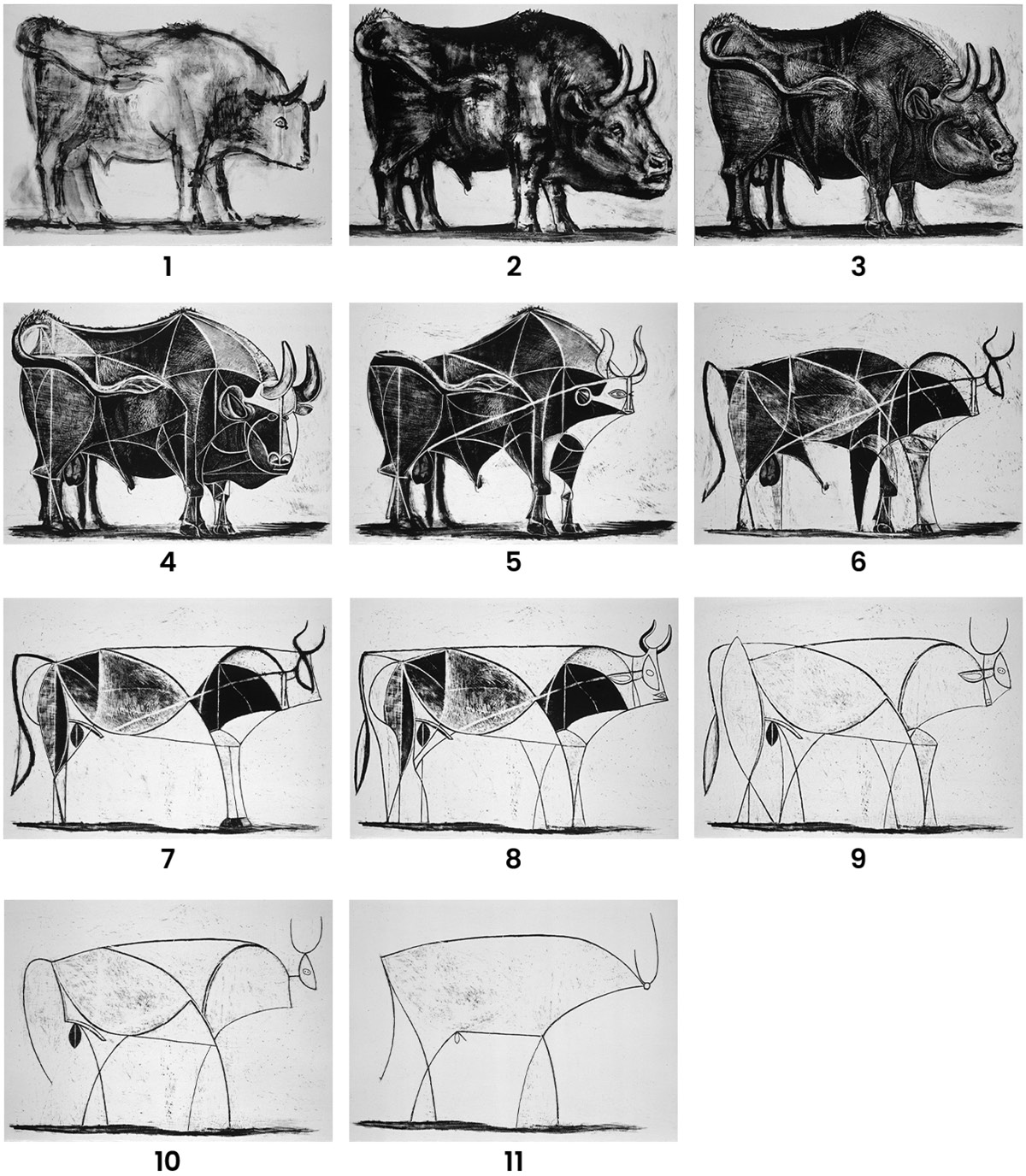
Pablo Picasso, Le Taureau (series of 11 lithographs), 1945–46 (© 2021 Estate of Pablo Picasso / Artists Rights Society (ARS), New York).
Starting with the top left image and moving across and down, Picasso deconstructed the shapes of the bull one step at a time. In the first couple of drawings, he adds more detail. The horns are fuller, the tail becomes three-dimensional, and the hide has more depth and texture. Picasso is starting by building up detail so that he has more options to choose from when it comes time to take some away.
The process of distillation begins with the fourth image. He outlines the main muscles of the animal using sharp white lines. Soft curves become more angular, and the animal as a whole starts to take on a more geometric look. In the fifth and sixth images, the drawing starts to become radically simplified as Picasso drops most of the detail in the bull’s head and further simplifies its horns, tail, and legs. A thick white line representing the bull’s center of gravity is added, cutting across the animal from front to back.
By the last few images, the bull has become nothing more than an interconnected series of simple, black-and-white shapes. The legs have become single lines. Solid blocks of color define the front and back of the animal. In the final drawings, even those details are abstracted away. We end with a drawing that is nothing but a single, continuous stroke, which somehow still manages to capture the very essence of the bull.6
Picasso’s act of distillation involves stripping away the unnecessary so that only the essential remains. Crucially, Picasso couldn’t have started with the single line drawing. He needed to go through each layer of the bull’s form step-by-step to absorb the proportions and shapes into his muscle memory. The result points to a mysterious aspect of the creative process: it can end up with a result that looks so simple, it seems like anyone could have made it. That simplicity masks the effort that was needed to get there.
Another example comes from documentary filmmaking. Ken Burns, the renowned creator of award-winning films like The Civil War, Baseball, and Jazz, has said that only a tiny percentage of the raw footage he captures eventually makes it into the final cut. This ratio can be as high as 40- or 50-to-1, which means that for every forty to fifty hours of footage he captures, only one hour makes it into the final film. Along the way, Burns and his team are performing a radical act of distillation—finding the most interesting, surprising, moving moments hidden amidst hundreds of hours of recordings.VI
Progressive Summarization is not a method for remembering as much as possible—it is a method for forgetting as much as possible. As you distill your ideas, they naturally improve, because when you drop the merely good parts, the great parts can shine more brightly. To be clear, it takes skill and courage to let the details fall away. As Picasso’s bull and Burns’s documentaries illustrate, in making decisions about what to keep, we inevitably have to make decisions about what to throw away. You cannot highlight the main takeaways from an article without leaving some points out. You cannot make a highlight reel of a video without cutting some of the footage. You cannot give an effective presentation without leaving out some slides.
The Three Most Common Mistakes of Novice Notetakers
Here are a few guidelines to help you avoid common pitfalls as you embark on highlighting your own notes.
Mistake #1: Over-Highlighting
The biggest mistake people make when they start to distill their notes is that they highlight way too much. You may have experienced this pitfall in school, highlighting paragraph after paragraph or entire pages of textbooks in the vain hope that you’d automatically be able to remember everything in yellow for the test.
When it comes to notetaking for work, less is more. You can capture entire books, articles with dozens of pages, or social media posts by the hundreds. No one will stop you, but you’ll quickly learn that such volume will only create a lot more work later on when you have to figure out what all that information means. If you’re going to capture everything, you might as well capture nothing.
Remember that notes are not authoritative texts. You don’t need to and shouldn’t include every tiny detail. They are more like bookmarks peeking out from the pages of a book on the shelf, signaling to you, “Hey! There’s something interesting here!” You will always be able to go back and review the full, original source if needed. Your notes only solve the problem of rediscovering those sources when you need them.
A helpful rule of thumb is that each layer of highlighting should include no more than 10–20 percent of the previous layer. If you save a series of excerpts from a book amounting to five hundred words, the bolded second layer should include no more than one hundred words, and highlighted third layer no more than twenty. This isn’t an exact science, but if you find yourself highlighting everything, this rule should give you pause.
Mistake #2: Highlighting Without a Purpose in Mind
The most common question I hear about Progressive Summarization is “When should I be doing this highlighting?” The answer is that you should do it when you’re getting ready to create something.
Unlike Capture and Organize, which take mere seconds, it takes time and effort to distill your notes. If you try to do it with every note up front, you’ll quickly be mired in hours of meticulous highlighting with no clear purpose in mind. You can’t afford such a giant investment of time without knowing whether it will pay off.
Instead, wait until you know how you’ll put the note to use. For example, when I’m preparing to write a blog post or article, I’ll usually start by highlighting the most interesting points from a group of notes that I think will be relevant to the topic at hand. That way I have a predictable, not-too-difficult task to get me warmed up for writing, the same way an athlete might have a warm-up and stretching routine.
When I’m about to get on a call with my lawyer, I’ll often prepare by highlighting my notes from our last call and drawing out decision points and action items into an agenda. He always thinks I’m well prepared, when in fact I just want to finish the call quickly to minimize the time I’m being billed for!
You have to always assume that, until proven otherwise, any given note won’t necessarily ever be useful. You have no idea what your future self will need, want, or be working on. This assumption forces you to be conservative in the time you spend summarizing notes, doing so only when it’s virtually guaranteed that it will be worth it.
The rule of thumb to follow is that every time you “touch” a note, you should make it a little more discoverable for your future selfVII—by adding a highlight, a heading, some bullets, or commentary. This is the “campsite rule” applied to information—leave it better than you found it. This ensures that the notes you interact with most often will naturally become the most discoverable in a virtuous cycle.
Mistake #3: Making Highlighting Difficult
Don’t worry about analyzing, interpreting, or categorizing each point to decide whether to highlight it. That is way too taxing and will break the flow of your concentration. Instead, rely on your intuition to tell you when a passage is interesting, counterintuitive, or relevant to your favorite problems or a current project.
Just as you listened for a feeling of internal resonance in deciding what content to save in the first place, the same rule applies for the insights within the note. Certain passages will move you, pique your attention, make your heart beat faster, or provoke you. Those are clear signals that you’ve found something important, and it’s time to add a highlight. You can apply the same criteria I introduced earlier in Chapter 4, looking out for individual points that are surprising, useful, inspiring, or personal to decide which ones are worth highlighting.
When you learn the art of distillation, you will gain a lifelong skill that will impact every area of your life. Think of a storyteller who captivates you with every word. Their story is well distilled, with unnecessary details stripped away. Think about the last time you were entranced by a drawing or painting. Its ability to grab you immediately is a sign that the concept behind the artwork is compressed into its most compact form, allowing it to travel efficiently from the canvas straight into your brain.
Even in our daily conversations, the ability to be succinct without missing key details is what leads to exciting conversations that leave both people feeling enlivened. Distillation is at the heart of the communication that is so central to our friendships, our working relationships, and our leadership abilities. Notetaking gives you a way to deliberately practice the skill of distilling every day.
Your Turn: Keep Your Future Self in Mind
The effort we put into Progressive Summarization is meant for one purpose: to make it easy to find and work with our notes in the future.
More is not better when it comes to thinking and creating. Distilling makes our ideas small and compact, so we can load them up into our minds with minimal effort. If you can’t locate a piece of information quickly, in a format that’s convenient and ready to be put to use, then you might as well not have it at all. Our most scarce resource is time, which means we need to prioritize our ability to quickly rediscover the ideas that we already have in our Second Brain.
When the opportunity arrives to do our best work, it’s not the time to start reading books and doing research. You need that research to already be done.VIII You can prepare in advance for the future challenges and opportunities you don’t even yet know you’ll face, by taking advantage of the effort you’re already spending reading books, learning new things, and simply being curious about the world around you.
To put what you’ve just learned into practice immediately, find an interesting piece of content you consumed recently, such as an article, audiobook, or YouTube video. This could be content you’ve captured already and organized in one of your PARA folders. Or it could be a new piece of content floating around your email inbox or in a read later app.
Start by saving only the best excerpts from that piece of content in a new note, either using copy-paste or a capture tool. This is layer one, the initial excerpts you save in your Second Brain. Next, read through the excerpts, bolding the main points and most important takeaways. Don’t make it an analytical decision—listen for a feeling of resonance and let that be your guide for what to bold. These bolded passages are layer two.
Now read through only the bolded passages, and highlight (or, if your notes app doesn’t have a highlighting feature, underline) the best of the best passages. The key here is to be very picky: the entire note may have only a few highlighted sentences, or even just one. Not only is that fine, it represents a highly distilled and discoverable note. These highlights are layer three, which is distilled enough for most use cases.
The true test of whether a note you’ve created is discoverable is whether you can get the gist of it at a glance. Put it aside for a few days and set a reminder to revisit it once you’ve forgotten most of the details. When you come back to it, give yourself no more than thirty seconds and see if you can rapidly get up to speed on what it’s about using the highlights you previously made. You’ll quickly be able to tell if you’ve added too many highlights or too few.
Each time you decide to add a highlight, you are developing your judgment: distinguishing the bits that truly matter from those that don’t. This is a skill you can become better at over time. The more you exercise your judgment, the more efficient and enjoyable your notetaking will become because you know that every minute of attention you invest is creating lasting value. There are few things more satisfying than the feeling of making consistent progress.
In the next chapter, we will move on to the final step of CODE, drawing on the material you’ve collected and distilled and using it to express your own point of view.
- I. Discoverability, Wikipedia
- II. I like to think of layer one as the “soil”—an excerpt from a source or my own thinking (whether as words, drawings, images, or audio) I initially capture into my notes. They are like the ground on which my understanding will be built. Layer two is “oil,” as in “I’ve struck oil!,” conveniently represented by black, bolded text. Layer three is “gold,” which is even more valuable, and shines in highlighter yellow in many apps. Layer four is the “gems,” the most rare and illuminating finds that I’ve distilled in my own words as an executive summary.
- III. In his book A New Method of Making Common-Place-Books, John Locke similarly advised that “We extract only those Things which are Choice and Excellent, either for the Matter itself, or else the Elegancy of the Expression, and not what comes next.”
- IV. As humans we are exquisitely sensitive to the way information is presented. In web design, a slight change of color for a button or a slightly reworded headline can easily have a double-digit impact on the number of visitors who click on it. Imagine if we put as much thought into how the information on our own devices is presented to us as we do into the public web. Even something as simple as an informative heading, a paragraph break, or a highlighted phrase can make it dramatically easier to absorb a piece of text.
- V. Distillation also applies to other kinds of media such as images, audio, and video, but looks quite different and is beyond the scope of this book.
- VI. In a class on documentary filmmaking on the educational platform MasterClass, Burns offered his suggestions for keeping track of material related to a film project: “Is there an article in the newspaper that relates to your project? Cut it out and file it. Have you written a draft of narration or dialogue? Print it out and file it. Thought of some great questions to ask your first interview subject? Jot them down on a scrap of paper and file that too.”
- VII. This principle is called stigmergy—to leave “marks” on the environment that make your future efforts easier. It is a strategy used by ant colonies to find food. If an ant finds a food source, it will bring a piece of it back to the colony, while leaving a special pheromone along the trail. Other ants can follow this trail to find the food for themselves, enabling a multitude of ants to quickly find and collect new sources of food.
- VIII. As Sönke Ahrens observes in his book How to Take Smart Notes, this is the fundamental paradox at the heart of writing: you have to do the research before you know what you will write about. In his words: “We have to read with a pen in hand, develop ideas on paper and build up an ever-growing pool of externalised thoughts. We will not be guided by a blindly made-up plan picked from our unreliable brains, but by our interest, curiosity and intuition, which is formed and informed by the actual work of reading, thinking, discussing, writing and developing ideas—and is something that continuously grows and reflects our knowledge and understanding externally.”