Chapter 4  Capture—Keep What Resonates
Everything not saved will be lost.
—Nintendo “Quit Screen” message
Information is food for the brain. It’s no accident that we call new ideas “food for thought.”
It’s clear that we need food and water to survive. What may not be so clear is that we also need information to live: to understand and adapt to our environment; to maintain relationships and cooperate with others; and to make wise decisions that further our interests.
Information isn’t a luxury—it is the very basis of our survival.
Just as with the food we put into our bodies, it is our responsibility and right to choose our information diet. It’s up to us to decide what information is good for us, what we want more of and less of, and ultimately, what we do with it. You are what you consume, and that applies just as much to information as to nutrition.
A Second Brain gives us a way to filter the information stream and curate only the very best ideas we encounter in a private, trusted place. Think of it as planting your own “knowledge garden” where you are free to cultivate your ideas and develop your own thinking away from the deafening noise of other people’s opinions.
A garden is only as good as its seeds, so we want to start by seeding our knowledge garden with only the most interesting, insightful, useful ideas we can find.
You may already consume a lot of content from many different sources, but perhaps never put much thought into what you do with it afterward. Maybe you are already a diligent organizer, but you’ve fallen into a habit of “digital hoarding” that doesn’t end up enriching your life. Or, if this is all completely new to you, you may be starting at square one.
No matter your situation, let’s start at the very beginning—how to use the first step of CODE to begin building your own private collection of knowledge.
Building a Private Collection of Knowledge
Taylor Swift is an icon of modern pop and country music and one of the best-selling music artists in history. Her nine chart-topping albums have sold over two hundred million copies worldwide and earned her a long list of awards, including eleven Grammy Awards. Not only does she appear in lists of the greatest singer-songwriters of all time, her influence has transcended music and placed her on such lists as the Time 100 and Forbes Celebrity 100.1
Over the course of her career, Swift has released five documentary films revealing her creative songwriting process. In all of them, she can be found with her head buried in her phone. As she says: “I disappear into my phone because my phone is where I keep my notes and my phone is where I’m editing.”2 In her notes she can write down (and reread, edit, and riff off) any snippet of lyrics or melodic hook that flickers through her mind. She can take her notes everywhere, access them from anywhere, and send them within seconds to a wide network of producers and collaborators using the same device. Any feedback they send back can go right into her notes as well.
In an interview about how she wrote the smash hit “Blank Space,”3 Swift says, “I’ll be going about my daily life and I’ll think, ‘Wow, so we only have two real options in relationships—it’s going to be forever or it’s going to go down in flames,’ so I’ll jot that down in my notes… I’ll come up with a line that I think is clever like ‘Darling I’m a nightmare dressed like a daydream’ and I just pick them and put them where they fit and construct the bridge out of more lines that come up within the last couple of years… ‘Blank Space’ was the culmination of all my best ones one after the other.”
For Swift, writing songs is not a discrete activity that she can do only at certain times and in certain places. It is a side effect of the way her mind works, spinning off new metaphors and turns of phrase at the most unexpected times: “I’m inspired to write songs at any time of day, when I’m going through something or when the dust has settled and I’m over it. It can be anything. I’ll just be doing dishes or something, or in the middle of an interview, and I could get an idea in my head that just kind of sticks out as, ‘That could be a hook, that could be a pre-chorus, that’s a first line.’ ” She goes on to explain why it’s so important to her to capture those fleeting thoughts right as they appear: “I kind of have to capitalize on the excitement of me getting that idea and see it all the way through or else I’ll leave it behind and assume it wasn’t good enough.”
Even after all her success, even Taylor Swift needs a system to carry her ideas from inception all the way to completion. By integrating her notetaking with her daily life, she’s able to use language and analogies that are rooted in everyday feelings and experiences, forging a powerful connection with her fans who call themselves “Swifties.” Listening to her albums is like following Swift on a journey of self-discovery, each album chronicling what she was experiencing and who she was becoming in each chapter of her life.
This story sheds light on how even the world’s most successful and prolific creatives need support systems to pursue their craft. It’s not a matter of having enough raw talent. Talent needs to be channeled and developed in order to become something more than a momentary spark. Actor and comedian Jerry Seinfeld, arguably the most influential comedian of his generation, wrote in his book Is This Anything?:
Whenever I came up with a funny bit, whether it happened on a stage, in a conversation or working it out on my preferred canvas, the big yellow legal pad, I kept it in one of those old-school accordion folders… A lot of people I’ve talked to seemed surprised that I’ve kept all these notes. I don’t understand why they think that. I don’t understand why I’ve kept anything else. What could possibly be of more value?
Think about your favorite athlete, musician, or actor. Behind the scenes of their public persona, there is a process they follow for regularly turning new ideas into creative output. The same goes for inventors, engineers, and effective leaders. Innovation and impact don’t happen by accident or chance. Creativity depends on a creative process.
Creating a Knowledge Bank: How to Generate Compounding Interest from Your Thoughts
In Chapter 2, we looked at the history of commonplace books, kept by intellectuals and writers in previous centuries. For them, the purpose of information was clear: to inform their writing, speaking, and conversation. Knowing how they were going to be putting ideas to use gave them a powerful lens for seeing which ones were worth the trouble of writing down.
This practice continues among creatives today. Songwriters are known for compiling “hook books” full of lyrics and musical riffs they may want to use in future songs. Software engineers build “code libraries” so useful bits of code are easy to access. Lawyers keep “case files” with details from past cases they might want to refer to in the future. Marketers and advertisers maintain “swipe files” with examples of compelling ads they might want to draw from.
The challenge for the rest of us is how to apply this same lens to the work we do every day. What kinds of information are worth preserving when we don’t know exactly how we’ll be putting it to use? Our world changes much faster than in previous eras, and most of us don’t have a single creative medium we work in. How can we decide what to save when we have no idea what the future holds?
To answer that question, we have to radically expand our definition of “knowledge.”
Knowledge isn’t just wise quotations from long-dead Greek philosophers in white togas. It’s not just the teachings found within thick textbooks written by academics with advanced degrees. In the digital world we live in, knowledge most often shows up as “content”—snippets of text, screenshots, bookmarked articles, podcasts, or other kinds of media. This includes the content you gather from outside sources but also the content you create as you compose emails, draw up project plans, brainstorm ideas, and journal your own thoughts.
These aren’t just random artifacts with no value—they are “knowledge assets” that crystallize what you know in concrete form.I
Knowledge isn’t always something “out there” that you have to go out and find. It’s everywhere, all around you: buried in the emails in your inbox, hidden within files in your documents folder, and waiting on cloud drives. Knowledge capture is about mining the richness of the reading you’re already doing and the life you’re already living.
Sometimes these assets are quite mundane—the agenda from last year’s financial planning off-site repurposed for next year’s meeting. At other times that knowledge is lofty and grand—your in-depth notes from a book on history that could change how you think about the world. Or anything in between. A knowledge asset is anything that can be used in the future to solve a problem, save time, illuminate a concept, or learn from past experience.
Knowledge assets can come from either the external world or your inner thoughts. External knowledge could include:
- Highlights: Insightful passages from books or articles you read.
- Quotes: Memorable passages from podcasts or audiobooks you listen to.
- Bookmarks and favorites: Links to interesting content you find on the web or favorited social media posts.
- Voice memos: Clips recorded on your mobile device as “notes to self.”
- Meeting notes: Notes you take about what was discussed during meetings or phone calls.
- Images: Photos or other images that you find inspiring or interesting.
- Takeaways: Lessons from courses, conferences, or presentations you’ve attended.
Look around you and notice that you already have many of these. It may be disorganized, spread around in different places, and saved in different formats, but it’s there. Just notice that you’ve already spent the effort to create or acquire it. All you need to do is gather it up and plant it as the first seeds in your knowledge garden. Soon I’ll show you how to do that.
As you start collecting this material from the outer world, it often sparks new ideas and realizations in your inner world. You can capture those thoughts too! They could include:
- Stories: Your favorite anecdotes, whether they happened to you or someone else.
- Insights: The small (and big) realizations you have.
- Memories: Experiences from your life that you don’t want to forget.
- Reflections: Personal thoughts and lessons written in a journal or diary.
- Musings: Random “shower ideas” that pop into your head.
The meaning of a thought, insight, or memory often isn’t immediately clear. We need to write them down, revisit them, and view them from a different perspective in order to digest what they mean to us. It is exceedingly difficult to do that within the confines of our heads. We need an external medium in which to see our ideas from another vantage point, and writing things down is the most effective and convenient one ever invented.
Perhaps you have some hesitation about writing down such personal thoughts in a piece of software rather than a private journal. While it’s always up to you what you choose to note down, remember that your Second Brain is private too. You can share certain notes if you want to, but by default everything inside is for your eyes only.
For now, choose the two to three kinds of content from the two lists above that you already have the most of and already value. Some people favor inner sources of knowledge, some people are biased toward the outer world, but most people are somewhere in between. While you can eventually learn to capture from dozens of different sources, it’s important to start small and get your feet wet before diving into the deep end.
What Not to Keep
The examples I’ve shared may seem so expansive that you’re wondering if there is anything you shouldn’t keep in your Second Brain. In my experience, there are four kinds of content that aren’t well suited to notes apps:
- Is this sensitive information you’d like to keep secure? The content you save in your notes is easily accessible from any device, which is great for accessibility but not for security. Information like tax records, government documents, passwords, and health records shouldn’t be saved in your notes.
- Is this a special format or file type better handled by a dedicated app? Although you could save specialized files such as Photoshop files or video footage in your notes, you’ll need a specialized app to open them anyway, so there’s no benefit to keeping them in your notes.
- Is this a very large file? Notes apps are made for short, lightweight bits of text and images, and their performance will often be severely hampered if you try to save large files in them.
- Will it need to be collaboratively edited? Notes apps are perfectly suited for individual, private use, which makes them less than ideal for collaboration. You can share individual notes or even groups of notes with others, but if you need multiple people to be able to collaboratively edit a document in real time, then you’ll need to use a different platform.
Twelve Favorite Problems: A Nobel Prize Winner’s Approach to Capturing
With the abundance of content all around us, it can be hard to know exactly what is worth preserving. I use an insightful exercise to help people make this decision easier. I call it “Twelve Favorite Problems,” inspired by Nobel Prize–winning physicist Richard Feynman.
Feynman was known for his wide-ranging, eclectic tastes. As a child he already showed a talent for engineering, once building a functioning home alarm system out of spare parts while his parents were out running errands. During his colorful lifetime Feynman spent time in Brazil teaching physics, learned to play the bongo and the conga drums well enough to perform with orchestras, and enthusiastically traveled around the world exploring other cultures.
Of course, Feynman is best known for his groundbreaking discoveries in theoretical physics and quantum mechanics, for which he received the Nobel Prize in 1965. In his spare time, he also played a pivotal role on the commission that investigated the Challenger space shuttle disaster and published half a dozen books.
How could one person make so many contributions across so many areas? How did he have the time to lead such a full and interesting life while also becoming one of the most recognized scientists of his generation?
Feynman revealed his strategy in an interview4:
You have to keep a dozen of your favorite problems constantly present in your mind, although by and large they will lay in a dormant state. Every time you hear or read a new trick or a new result, test it against each of your twelve problems to see whether it helps. Every once in a while there will be a hit, and people will say, “How did he do it? He must be a genius!”
In other words, Feynman’s approach was to maintain a list of a dozen open questions. When a new scientific finding came out, he would test it against each of his questions to see if it shed any new light on the problem. This cross-disciplinary approach allowed him to make connections across seemingly unrelated subjects, while continuing to follow his sense of curiosity.
As told in Genius: The Life and Science of Richard Feynman by James Gleick,5 Feynman once took inspiration for his physics from an accident at dinner:
… he was eating in the student cafeteria when someone tossed a dinner plate into the air—a Cornell cafeteria plate with the university seal imprinted on one rim—and in the instant of its flight he experienced what he long afterward considered an epiphany. As the plate spun, it wobbled. Because of the insignia he could see that the spin and the wobble were not quite in synchrony. Yet just in that instant it seemed to him—or was it his physicist’s intuition?—that the two rotations were related.
After working the problem out on paper, Feynman discovered a 2-to-1 ratio between the plate’s wobble and spin, a neat relationship that suggested a deeper underlying principle at work.
When a fellow physicist and mentor asked what the use of such an insight was, Feynman responded: “It doesn’t have any importance… I don’t care whether a thing has importance. Isn’t it fun?” He was following his intuition and curiosity. But it did end up having importance, with his research into the equations underlying rotation informing the work that ultimately led to him receiving the Nobel Prize.
Feynman’s approach encouraged him to follow his interests wherever they might lead. He posed questions and constantly scanned for solutions to long-standing problems in his reading, conversations, and everyday life. When he found one, he could make a connection that looked to others like a flash of unparalleled brilliance.
Ask yourself, “What are the questions I’ve always been interested in?” This could include grand, sweeping questions like “How can we make society fairer and more equitable?” as well as practical ones like “How can I make it a habit to exercise every day?” It might include questions about relationships, such as “How can I have closer relationships with the people I love?” or productivity, like “How can I spend more of my time doing high-value work?”
Here are more examples of favorite problems from my students:
- How do I live less in the past, and more in the present?
- How do I build an investment strategy that is aligned with my mid-term and long-term goals and commitments?
- What does it look like to move from mindless consumption to mindful creation?
- How can I go to bed early instead of watching shows after the kids go to bed?
- How can my industry become more ecologically sustainable while remaining profitable?
- How can I work through the fear I have of taking on more responsibility?
- How can my school provide more resources for students with special needs?
- How do I start reading all the books I already have instead of buying more?
- How can I speed up and relax at the same time?
- How can we make the healthcare system more responsive to people’s needs?
- What can I do to make eating healthy easier?
- How can I make decisions with more confidence?
Notice that some of these questions are abstract, while others are concrete. Some express deep longings, while others are more like spontaneous interests. Many are questions about how to live a better life, while a few are focused on how to succeed professionally. The key to this exercise is to make them open-ended questions that don’t necessarily have a single answer. To find questions that invoke a state of wonder and curiosity about the amazing world we live in.
The power of your favorite problems is that they tend to stay fairly consistent over time. The exact framing of each question may change, but even as we move between projects, jobs, relationships, and careers, our favorite problems tend to follow us across the years. I recommend asking your family or childhood friends what you were obsessed with as a kid. Those very same interests probably still fire your imagination as an adult. Which means any content you collect related to them will likely be relevant far into the future as well.
As a kid, I had a passion for LEGOs, the modular toy blocks beloved by generations of children. My parents noticed that I didn’t play with LEGOs like other kids. Instead I spent my time organizing and reorganizing the pieces. I remember being completely captivated by the problem of how to create order out of the chaos of thousands of pieces of every shape and size. I would invent new organizational schemes—by color, by size, by theme—as I became obsessed with the idea that if I could just find the right system, I would finally be able to build my magnum opus—a LEGO spaceship like the ones I saw in the sci-fi movies I loved.
That very same question—How can creativity emerge out of chaos?—still drives me to this day. Only now, it’s in the form of organizing digital information instead of LEGOs. Pursuing this question has taught me so many things over the years, across many seasons of my life. The goal isn’t to definitively answer the question once and for all, but to use the question as a North Star for my learning.
Take a moment now to write down some of your own favorite problems. Here are my recommendations to guide you:
- Ask people close to you what you were obsessed with as a child (often you’ll continue to be fascinated with the same things as an adult).
- Don’t worry about coming up with exactly twelve (the exact number doesn’t matter, but try to come up with at least a few).
- Don’t worry about getting the list perfect (this is just a first pass, and it will always be evolving).
- Phrase them as open-ended questions that could have multiple answers (in contrast to “yes/no” questions with only one answer).
Use your list of favorite problems to make decisions about what to capture: anything potentially relevant to answering them. Use one of the capture tools I recommend later in this chapter, or in the Second Brain Resource Guide at Buildingasecondbrain.com/resources.
Capture Criteria: How to Avoid Keeping Too Much (or Too Little)
Once you have identified the kinds of questions you want your Second Brain to answer, it’s time to choose specifically which pieces of information will be most useful.
Imagine you come across a blog post during your web browsing that details how a marketing expert you respect runs her campaigns. You’re hooked: this is the kind of material you’ve been looking for! Finally, the master reveals her secrets!
Your first instinct might be to save the article in its entirety. It’s high-quality information, so why not preserve all of it? The problem is, it’s an in-depth how-to article that is thousands of words long. Even if you spend the twenty or thirty minutes it would take to consume it now, in the future you’ll just have to spend all that time reading it again, since you’ll have forgotten most of the details. You also don’t want to just bookmark the link and save it to read later, because then you won’t know what it contains in the first place!
This is where most people get stuck. They either dive straight into the first piece of content they see, read it voraciously, but quickly forget all the details, or they open dozens of tabs in their web browser and feel a pang of guilt at all those interesting resources they haven’t been able to get to.
There is a way out of this situation. It starts with realizing that in any piece of content, the value is not evenly distributed. There are always certain parts that are especially interesting, helpful, or valuable to you. When you realize this, the answer is obvious. You can extract only the most salient, relevant, rich material and save it as a succinct note.
Don’t save entire chapters of a book—save only select passages. Don’t save complete transcripts of interviews—save a few of the best quotes. Don’t save entire websites—save a few screenshots of the sections that are most interesting. The best curators are picky about what they allow into their collections, and you should be too. With a notes app, you can always save links back to the original content if you need to review your sources or want to dive deeper into the details in the future.
The biggest pitfall I see people falling into once they begin capturing digital notes is saving too much. If you try to save every piece of material you come across, you run the risk of inundating your future self with tons of irrelevant information. At that point, your Second Brain will be no better than scrolling through social media.
This is why it’s so important to take on a Curator’s Perspective—that we are the judges, editors, and interpreters of the information we choose to let into our lives. Thinking like a curator means taking charge of your own information stream, instead of just letting it wash over you. The more economical you can be with the material you capture in the first place, the less time and effort your future self will have to spend organizing, distilling, and expressing it.II
Here are four criteria I suggest to help you decide exactly which nuggets of knowledge are worth keeping:
Capture Criteria #1: Does It Inspire Me?
Inspiration is one of the most rare and precious experiences in life. It is the essential fuel for doing your best work, yet it’s impossible to call up inspiration on demand. You can Google the answer to a question, but you can’t Google a feeling.
There is a way to evoke a sense of inspiration more regularly: keep a collection of inspiring quotes, photos, ideas, and stories. Any time you need a break, a new perspective, or a dash of motivation, you can look through it and see what sparks your imagination.
For example, I keep a folder full of customer testimonials I’ve received over the years. Any time I think what I’m doing doesn’t matter or isn’t good enough, all I have to do is open up that folder and my perspective is completely shifted.
Capture Criteria #2: Is It Useful?
Carpenters are known for keeping odds and ends in a corner of their workshop—a variety of nails and washers, scraps of lumber cut off from larger planks, and random bits of metal and wood. It costs nothing to keep these “offcuts” around, and surprisingly often they end up being the crucial missing piece in a future project.
Sometimes you come across a piece of information that isn’t necessarily inspiring, but you know it might come in handy in the future. A statistic, a reference, a research finding, or a helpful diagram—these are the equivalents of the spare parts a carpenter might keep around their workshop.
For example, I keep a folder full of stock photos, graphics, and drawings I find both online and offline. Any time I need an image for a slide deck, or a web page, or to spark new ideas, I have a plentiful supply of imagery I’ve already found compelling ready and waiting.
Capture Criteria #3: Is It Personal?
One of the most valuable kinds of information to keep is personal information—your own thoughts, reflections, memories, and mementos. Like the age-old practice of journaling or keeping a diary, we can use notetaking to document our lives and better understand how we became who we are.
No one else has access to the wisdom you’ve personally gained from a lifetime of conversations, mistakes, victories, and lessons learned. No one else values the small moments of your days quite like you do.
I often save screenshots of text messages sent between my family and friends. The small moments of warmth and humor that take place in these threads are precious to me, since I can’t always be with them in person. It takes mere moments, and I love knowing that I’ll forever have memories from my conversations with the people closest to me.
Capture Criteria #4: Is It Surprising?
I’ve often noticed that many of the notes people take are of ideas they already know, already agree with, or could have guessed. We have a natural bias as humans to seek evidence that confirms what we already believe, a well-studied phenomenon known as “confirmation bias.”6
That isn’t what a Second Brain is for. The renowned information theorist Claude Shannon, whose discoveries paved the way for modern technology, had a simple definition for “information”: that which surprises you.7 If you’re not surprised, then you already knew it at some level, so why take note of it? Surprise is an excellent barometer for information that doesn’t fit neatly into our existing understanding, which means it has the potential to change how we think.
Sometimes you come across an idea that is neither inspiring, personal, nor obviously useful, but there is something surprising about it. You may not be able to put your finger on why, but it conflicts with your existing point of view in a way that makes your brain perk up and pay attention. Those are the ideas you should capture.
Your Second Brain shouldn’t be just another way of confirming what you already know. We are already surrounded by algorithms that feed us only what we already believe and social networks that continually reinforce what we already think.
Our ability to capture ideas from anywhere takes us in a different direction: By saving ideas that may contradict each other and don’t necessarily support what we already believe, we can train ourselves to take in information from different sources instead of immediately jumping to conclusions. By playing with ideas—bending and stretching and remixing them—we become less attached to the way they were originally presented and can borrow certain aspects or elements to use in our own work.
If what you’re capturing doesn’t change your mind, then what’s the point?
Ultimately, Capture What Resonates
I’ve given you specific criteria to help you decide what is worth capturing, but if you take away one thing from this chapter, it should be to keep what resonates.
Here’s why: making decisions analytically, with a checklist, is taxing and stressful. It is the kind of thinking that demands the most energy. When you use up too much energy taking notes, you have little left over for the subsequent steps that add far more value: making connections, imagining possibilities, formulating theories, and creating new ideas of your own. Not to mention, if you make reading and learning into unpleasant experiences, over time you’re going to find yourself doing less and less of them. The secret to making reading a habit is to make it effortless and enjoyable.
As you consume a piece of content, listen for an internal feeling of being moved or surprised by the idea you’re taking in. This special feeling of “resonance”—like an echo in your soul—is your intuition telling you that something is literally “noteworthy.” You don’t need to figure out exactly why it resonates. Just look for the signs: your eyes might widen slightly, your heart may skip a beat, your throat may go slightly dry, and your sense of time might subtly slow down as the world around you fades away. These are clues that it’s time to hit “save.”
We know from neuroscientific research that “emotions organize—rather than disrupt—rational thinking.”8 When something resonates with us, it is our emotion-based, intuitive mind telling us it is interesting before our logical mind can explain why. I often find that a piece of content resonates with me in ways I can’t fully explain in the moment, and its true potential only becomes clear later on.
There’s scientific evidence that our intuition knows what it’s doing. From the book Designing for Behavior Change:9
Participants in a famous study were given four biased decks of cards—some that would win them money, and some that would cause them to lose. When they started the game, they didn’t know that the decks were biased. As they played the game, though, people’s bodies started showing signs of physical “stress” when their conscious minds were about to use a money-losing deck. The stress was an automatic response that occurred because the intuitive mind realized something was wrong—long before the conscious mind realized anything was amiss.
The authors’ conclusion: “Our intuitive mind learns, and responds, even without our conscious awareness.”
If you ignore that inner voice of intuition, over time it will slowly quiet down and fade away. If you practice listening to what it is telling you, the inner voice will grow stronger. You’ll start to hear it in all kinds of situations. It will guide you in what choices to make and which opportunities to pursue. It will warn you away from people and situations that aren’t right for you. It will speak up and take a stand for your convictions even when you’re afraid.
I can’t think of anything more important for your creative life—and your life in general—than learning to listen to the voice of intuition inside. It is the source of your imagination, your confidence, and your spontaneity. You can intentionally train yourself to hear that voice of intuition every day by taking note of what it tells you.
Besides capturing what personally resonates with you, there are a couple other kinds of details that are generally useful to save in your notes. It’s a good idea to capture key information about the source of a note, such as the original web page address, the title of the piece, the author or publisher, and the date it was published.III Many capture tools are even able to identify and save this information automatically. Also, it’s often helpful to capture chapter titles, headings, and bullet-point lists, since they add structure to your notes and represent distillation already performed by the author on your behalf.
Beyond Your Notetaking App: Choosing Capture Tools
Now that you know what kinds of material to save in your Second Brain, it’s time to get into the nitty-gritty: How does capturing work exactly?
Let’s say while reading that in-depth marketing article, you decide a specific piece of advice is highly relevant to your own plans. Most notetaking apps (introduced in Chapter 2 and covered in detail in the Second Brain Resource Guide at Buildingasecondbrain.com/resources) have built-in features that allow you to capture excerpts from outside sources, and you can always simply cut and paste text directly into a new note. There is also an array of more specialized “capture tools” that are designed to make capturing content in digital form easy and even fun.
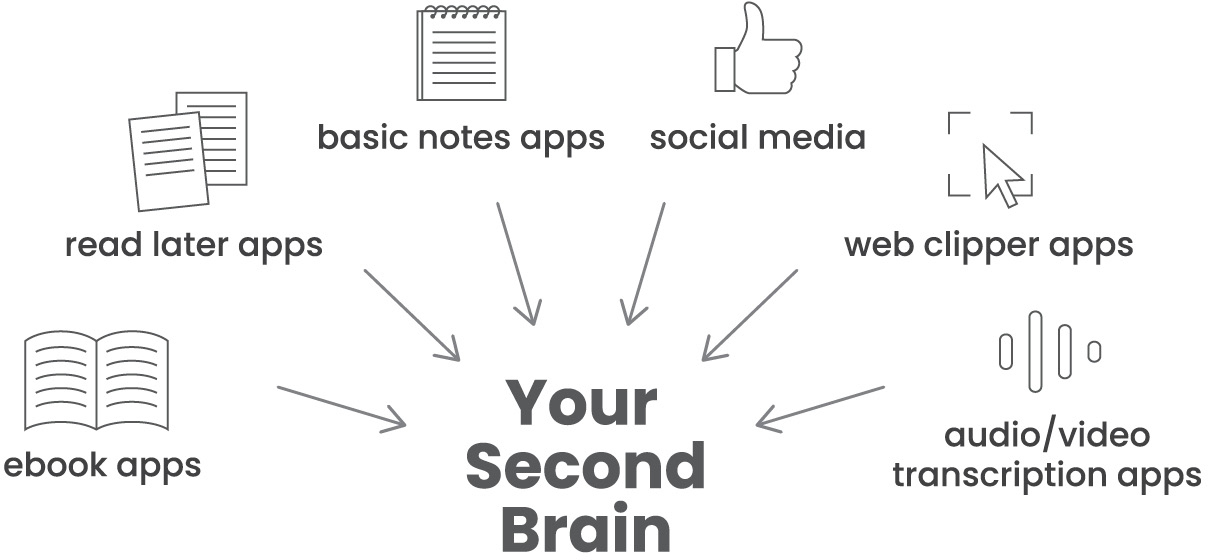
The most common options include:
- Ebook apps, which often allow you to export your highlights or annotations all at once.
- Read later apps that allow you to bookmark content you find online for later reading (or in the case of podcasts or videos, listening or watching).
- Basic notes apps that often come preinstalled on mobile devices and are designed for easily capturing short snippets of text.
- Social media apps, which usually allow you to “favorite” content and export it to a notes app.
- Web clippers, which allow you to save parts of web pages (often included as a built-in feature of notes apps).
- Audio/voice transcription apps that create text transcripts from spoken words.
- Other third-party services, integrations, and plug-ins that automate the process of exporting content from one app to another.
Some of these tools are free, and others charge a small fee. Some are completely automatic, working silently in the background (for example, to automatically sync your ebook highlights with a notes app), while others require a bit of manual effort (such as taking photos of paper notebooks to save them digitally).IV But in any case, the act of capture takes only moments—to hit share, export, or save—and voilà, you’ve preserved the best parts of whatever you’re consuming in your Second Brain.
Make no mistake: you will continue to use many kinds of software to manage information—such as computer folders, cloud storage drives, and various platforms for sharing and collaborating on documents. Think of your capture tools as your extended nervous system, reaching out into the world to allow you to sense your surroundings. No matter how many different kinds of software you use, don’t leave all the knowledge they contain scattered across dozens of places you’ll never think to look. Make sure your best findings get routed back to your notes app where you can put them all together and act on them.
Here are some of the most popular ways of using capture tools to save content you come across:
- Capturing passages from ebooks: Most ebook apps make it very easy to highlight passages as you read. On Amazon Kindle, you can simply drag your finger across a sentence or paragraph you like to add a highlight. Then use the share menu to export all your highlights from the entire book all at once straight to your digital notes. You can also add comments right alongside the text as you read, which will help you remember what you found interesting about a passage.
- Capturing excerpts from online articles or web pages: When you come across an online article or blog post you want to read, save it to a “read later” app, which is like a digital magazine rack of everything you want to read (or watch or listen to) at some point. Whenever you have some free time (such as on breaks or in the evening after work), scroll through the articles you’ve saved and pick one to read. You can make highlights, just as with ebooks, and they can also be automatically exported to your notes app using a third-party platform.
- Capturing quotes from podcasts: Many podcast player apps allow you to bookmark or “clip” segments of episodes as you’re listening to them. Some of them will even transcribe the audio into text, so you can export and search it within your notes.
- Capturing voice memos: Use a voice memo app that allows you to press a button, speak directly into your smartphone, and have every word transcribed into text and exported to your notes.
- Capturing parts of YouTube videos: This is a little-known feature, but almost every YouTube video is accompanied by an automatically generated transcript. Just click the “Open transcript” button and a window will open. From there, you can copy and paste excerpts to your notes.
- Capturing excerpts from emails: Most popular notes apps include a feature that allows you to forward any email to a special address, and the full text of that email (including any attachments) will be added to your notes.
- Capturing content from other apps: You might edit photos in a photos app, or make sketches in a drawing app, or like posts in a social media app. As long as that app has a “share” button or allows for copy-and-paste, you can save whatever you’ve created directly to your notes for safekeeping.
The Surprising Benefits of Externalizing Our Thoughts
Often ideas occur to us at the most random times—during our commute, while watching TV, when we’re playing with our kids, or in the shower.
Your Second Brain gives you a place to corral the jumble of thoughts tumbling through your head and park them in a waiting area for safekeeping. Not only does this allow you to preserve them for the long term; there are multiple other profound benefits that come from the simple act of writing something down.
First, you are much more likely to remember information you’ve written down in your own words. Known as the “Generation Effect,”10 researchers have found that when people actively generate a series of words, such as by speaking or writing, more parts of their brain are activated when compared to simply reading the same words. Writing things down is a way of “rehearsing” those ideas, like practicing a dance routine or shooting hoops, which makes them far more likely to stick.
Enhancing our memory is just the beginning. When you express an idea in writing, it’s not just a matter of transferring the exact contents of your mind into paper or digital form. Writing creates new knowledge that wasn’t there before. Each word you write triggers mental cascades and internal associations, leading to further ideas, all of which can come tumbling out onto the page or screen.V
Thinking doesn’t just produce writing; writing also enriches thinking.
There is even significant evidence that expressing our thoughts in writing can lead to benefits for our health and well-being.11 One of the most cited psychology papers of the 1990s found that “translating emotional events into words leads to profound social, psychological, and neural changes.”
In a wide range of controlled studies, writing about one’s inner experiences led to a drop in visits to the doctor, improved immune systems, and reductions in distress. Students who wrote about emotional topics showed improvements in their grades, professionals who had been laid off found new jobs more quickly, and staff members were absent from work at lower rates. The most amazing thing about these findings is that they didn’t rely on input from others. No one had to read or respond to what these people wrote down—the benefits came just from the act of writing.
Perhaps the most immediate benefit of capturing content outside our heads is that we escape what I call the “reactivity loop”—the hamster wheel of urgency, outrage, and sensationalism that characterizes so much of the Internet. The moment you first encounter an idea is the worst time to decide what it means. You need to set it aside and gain some objectivity.
With a Second Brain as a shield against the media storm, we no longer have to react to each idea immediately, or risk losing it forever. We can set things aside and get to them later when we are calmer and more grounded. We can take our time slowly absorbing new information and integrating it into our thinking, free of the pressing demands of the moment. I’m always amazed that when I revisit the items I’ve previously saved to read later, many of them that seemed so important at the time are clearly trivial and unneeded.
Notetaking is the easiest and simplest way of externalizing our thinking. It requires no special skill, is private by default, and can be performed anytime and anywhere. Once our thoughts are outside our head, we can examine them, play with them, and make them better. It’s like a shortcut to realizing the full potential of the thoughts flowing through our minds.
Your Turn: What Would This Look Like If It Was Easy?
I’ve introduced a lot of ideas in this chapter, and I know it’s a lot to absorb. There are so many ways to capture knowledge, but when you’re just getting started all those options can just feel overwhelming.
I want to give you an open question that will help guide you as you embark on this journey: What would capturing ideas look like if it was easy?
Think about what you would want to capture more of (or less of). How would that feel? What kinds of content are already familiar enough that it would be easy to begin saving them now? What would capturing look like today or this week? On average I capture just two notes per day—what are two ideas, insights, observations, perspectives, or lessons you’ve encountered today that you could write down right now?
It’s important to keep capturing relatively effortless because it is only the first step. You need to do it enough that it becomes second nature, while conserving your time and energy for the later steps when the value of the ideas you’ve found can be fully unleashed.
Capture isn’t about doing more. It’s about taking notes on the experiences you’re already having. It’s about squeezing more juice out of the fruit of life, savoring every moment to the fullest by paying closer attention to the details.
Don’t worry about whether you’re capturing “correctly.” There’s no right way to do this, and therefore, no wrong way. The only way to know whether you’re getting the good stuff is to try putting it to use in real life. We’ll get to that soon, but in the meantime, try out a couple of digital notes apps and capture tools to see which ones fit your style. Don’t forget the resource guide I’ve put together to help you make your choice.
If at any point you feel stuck or overwhelmed, step back and remember that nothing is permanent in the digital world. Digital content is endlessly malleable, so you don’t have to commit to any decision forever. While every step of CODE complements the others, you can also use them one at a time. Start with the parts that resonate with you and expand from there as your confidence grows.
In the next chapter, I’ll tell you what to do with the knowledge assets you’ve gathered in your Second Brain.
- I. MIT economist César Hidalgo in his book Why Information Grows describes how physical products, which he calls “crystals of imagination,” allow us to turn what we know into concrete objects that other people can access: “Crystallizing our thoughts into tangible and digital objects is what allows us to share our thoughts with others.” And elsewhere: “Our ability to crystallize imagination… gives us access to the practical uses of the knowledge and knowhow residing in the nervous systems of other people.”
- II. If you’re looking for a more precise answer of how much content to capture in your notes, I recommend no more than 10 percent of the original source, at most. Any more than that, and it will be too difficult to wade through all the material in the future. Conveniently, 10 percent also happens to be the limit that most ebooks allow you to export as highlights.
- III. Even if the original web page disappears, you can often use this information to locate an archived version using the Wayback Machine, a project of the Internet Archive that preserves a record of websites: https://archive.org/web/.
- IV. The software landscape is constantly changing, so I’ve created a resource guide with my continually updated recommendations of the best capture tools, both free and paid, and for a variety of devices and operating systems. You can find it at buildingasecondbrain.com/resources.
- V. This is called “detachment gain,” as explained in The Detachment Gain: The Advantage of Thinking Out Loud by Daniel Reisberg, and refers to the “functional advantage to putting thoughts into externalized forms” such as speaking or writing, leading to the “possibility of new discoveries that might not have been obtained in any other fashion.” If you’ve ever had to write out a word to remember how it’s spelled, you’ve experienced this.