Chapter 3  How a Second Brain Works
It is in the power of remembering that the self’s ultimate freedom consists. I am free because I remember.
—Abhinavagupta, tenth-century Kashmiri philosopher and mystic
Think of your Second Brain as the world’s best personal assistant.
It is perfectly reliable and totally consistent. It is always ready and waiting to capture any bit of information that might be of value to you. It follows directions, makes helpful suggestions, and reminds you of what’s important to you.
What would the job description for such a personal assistant look like? What “jobs” would you hire them to do for you? The same way you would hold your assistant accountable to a certain standard of performance, the same is true for your Second Brain. You need to know what it should be doing for you so you know if it’s worth keeping around.
In this chapter we’ll see how the four main capabilities of a Second Brain will actively work for you—immediately and over time; the one basic tool you’ll need to get started; how your Second Brain will evolve to serve what is most important to you; and, finally, an introduction to the four steps of the CODE Method that lies at the heart of it all.
The Superpowers of a Second Brain
There are four essential capabilities that we can rely on a Second Brain to perform for us:
- Making our ideas concrete.
- Revealing new associations between ideas.
- Incubating our ideas over time.
- Sharpening our unique perspectives.
Let’s examine each of these.
Second Brain Superpower #1: Make Our Ideas Concrete
Before we do anything with our ideas, we have to “off-load” them from our minds and put them into concrete form. Only when we declutter our brain of complex ideas can we think clearly and start to work with those ideas effectively.
In 1953, American biologist James Watson and English physicist Francis Crick made a profound discovery: the structure of DNA was a double helix. Their discovery was built on the groundwork laid by other pioneers, including advancements in X-ray crystallography by Rosalind Franklin and Maurice Wilkins, and ushered in a golden age in molecular biology and genetics.
Watson and Crick’s breakthrough is well recognized, but there is a part of their story that is much less well known. An important tool of the researchers was building physical models, an approach they borrowed from American biochemist Linus Pauling. They made cardboard cutouts to approximate the shapes of the molecules they knew were part of DNA’s makeup and, like a puzzle, experimented with different ways of putting them together. They would shift around their models on their desktops, trying to find a shape that fit everything they knew about how the molecules were arranged. The double helix structure seemed to fit all known constraints, allowing the complementary base pairs to fit together perfectly while respecting the ratios between elements that had been measured previously.1
This is a remarkable aspect of one of the most famous scientific discoveries of the last century: at the decisive moment, even highly trained scientists deeply familiar with mathematical and abstract thinking turned to the most basic, ancient medium available: physical stuff.
Digital notes aren’t physical, but they are visual. They turn vague concepts into tangible entities that can be observed, rearranged, edited, and combined together. They may exist only in virtual form, but we can still see them with our eyes and move them around with our fingers. As researchers Deborah Chambers and Daniel Reisberg found in their research on the limits of mental visualization, “The skills we have developed for dealing with the external world go beyond those we have for dealing with the internal world.”2
Second Brain Superpower #2: Reveal New Associations Between Ideas
In its most practical form, creativity is about connecting ideas together, especially ideas that don’t seem to be connected.
Neuroscientist Nancy C. Andreasen, in her extensive research on highly creative people including accomplished scientists, mathematicians, artists, and writers, came to the conclusion that “Creative people are better at recognizing relationships, making associations and connections.”3
By keeping diverse kinds of material in one place, we facilitate this connectivity and increase the likelihood that we’ll notice an unusual association.
Quotes from a philosophy book written in ancient times might sit next to the latest clever tweet. Screenshots from an interesting YouTube video can live right by scenes from classic movies. An audio memo might be saved alongside project plans, a link to a helpful website, and a PDF with the latest research findings. All these formats can be combined in a way that would be impossible in the physical world.
If you’ve ever played the word-tile game Scrabble, you know the best way to come up with new words is to mix up the letters in different combinations until a word jumps out at you. In our Second Brain we can do the same: mix up the order of our ideas until something unexpected emerges. The more diverse and unusual the material you put into it in the first place, the more original the connections that will emerge.
Second Brain Superpower #3: Incubate Our Ideas Over Time
Too often when we take on a task—planning an event, designing a product, or leading an initiative—we draw only on the ideas we have access to right in that moment. I call this approach a “heavy lift”—demanding instantaneous results from our brains without the benefit of a support system.
Even when we do a brainstorm, that still relies only on ideas that we can think up right now. What are the chances that the most creative, most innovative approaches will instantly be top of mind? What are the odds that the best way to move forward is one of the first ways we come up with?
This tendency is known as recency bias.4 We tend to favor the ideas, solutions, and influences that occurred to us most recently, regardless of whether they are the best ones. Now imagine if you were able to unshackle yourself from the limits of the present moment, and draw on weeks, months, or even years of accumulated imagination.
I call this approach the “slow burn”—allowing bits of thought matter to slowly simmer like a delicious pot of stew brewing on the stove. It is a calmer, more sustainable approach to creativity that relies on the gradual accumulation of ideas, instead of all-out binges of manic hustle. Having a Second Brain where lots of ideas can be permanently saved for the long term turns the passage of time into your friend, instead of your enemy.
Second Brain Superpower #4: Sharpen Our Unique Perspectives
Until now we’ve talked mostly about gathering the ideas of others, but the ultimate purpose of a Second Brain is to allow your own thinking to shine.
A recent study from Princeton University found that there is a certain kind of job that is least likely to be automated by machines in coming years. Surprisingly, it wasn’t jobs that required advanced skills or years of training that were predicted to fare best. It was jobs that required the ability to convey “not just information but a particular interpretation of information.”5
In other words, the jobs that are most likely to stick around are those that involve promoting or defending a particular perspective. Think of a fundraising organizer sharing stories of the impact their nonprofit has made, a researcher using data to back up their interpretation of an experiment, or a project manager citing a couple of key precedents to support a decision. Our careers and businesses depend more than ever on our ability to advance a particular point of view and persuade others to adopt it as well.6
Advocating for a particular point of view isn’t just a matter of sparkling charisma or irresistible charm. It takes supporting material.
American journalist, author, and filmmaker Sebastian Junger once wrote on the subject of “writer’s block”: “It’s not that I’m blocked. It’s that I don’t have enough research to write with power and knowledge about that topic. It always means, not that I can’t find the right words, [but rather] that I don’t have the ammunition.”7
When you feel stuck in your creative pursuits, it doesn’t mean that there’s something wrong with you. You haven’t lost your touch or run out of creative juice. It just means you don’t yet have enough raw material to work with. If it feels like the well of inspiration has run dry, it’s because you need a deeper well full of examples, illustrations, stories, statistics, diagrams, analogies, metaphors, photos, mindmaps, conversation notes, quotes—anything that will help you argue for your perspective or fight for a cause you believe in.
Choosing a Notetaking App: The Neural Center of Your Second Brain
The same technology that has fueled an explosion in the volume of information coming our way has also provided the tools to help us manage it.
While your Second Brain is made up of all the tools you use to interact with information, including a to-do list, a calendar, email, and reading apps, for example, there is one category of software I recommend as the centerpiece of your Second Brain: a digital notetaking app.I There are plentiful options available, from the free notes app that came preinstalled on your smartphone to third-party software you can download with exactly the features you need.
From Microsoft OneNote, Google Keep, and Apple Notes to Notion and Evernote, digital notes apps have four powerful characteristics that make them ideal for building a Second Brain. They are:
- Multimedia: Just like a paper notebook might contain drawings and sketches, quotes and ideas, and even a pasted photo or Post-it, a notes app can store a wide variety of different kinds of content in one place, so you never need to wonder where to put something.
- Informal: Notes are inherently messy, so there’s no need for perfect spelling or polished presentation. This makes it as easy and frictionless as possible to jot things down as soon as they occur to you, which is essential to allow nascent ideas to grow.
- Open-ended: Taking notes is a continuous process that never really ends, and you don’t always know where it might lead. Unlike more specialized kinds of software that are designed to produce a specific kind of output (such as slide decks, spreadsheets, graphics, or videos), notes are ideal for free-form exploration before you have a goal in mind.
- Action-oriented: Unlike a library or research database, personal notes don’t need to be comprehensive or precise. They are designed to help you quickly capture stray thoughts so you can remain focused on the task at hand.
All four of the above qualities are shared by paper notes, but when we make them digital, we can supercharge these timeless benefits with the incredible capabilities of technology—searching, sharing, backups, editing, linking, syncing between devices, and many others. Digital notes combine the casual artistry of a daily sketchbook with the scientific power of modern software.
Choosing which apps and tools you’ll use is a personal decision, and depends on which mobile device you use, the needs of your job or business, and even your own temperament and taste. The software landscape is dynamic and constantly changing. New apps regularly come out, and existing ones release innovative new features. You can find a free, continually updated guide to choosing your notes app and other Second Brain tools at Buildingasecondbrain.com/resources.
Although you will always use many different software programs to manage information and do your work—from word processors to messaging platforms and project management tools used within your organization—your notes app is uniquely designed to facilitate personal knowledge management.
A good place to start is to look at the apps you already have and perhaps are already using. You can always start now with a basic option and upgrade later as your needs get more sophisticated.II
Most important of all, don’t get caught in the trap of perfectionism: insisting that you have to have the “perfect” app with a precise set of features before you take a single note. It’s not about having the perfect tools—it’s about having a reliable set of tools you can depend on, knowing you can always change them later.
Remembering, Connecting, Creating: The Three Stages of Personal Knowledge Management
As people set out on their Second Brain journey, there are three stages of progress I often observe—and even encourage. Those stages are remembering, connecting, and creating. It takes time to fully unlock the value of using digital tools to enhance and extend what our minds are capable of, but there are also distinct benefits at every step along the way.
The first way that people tend to use their Second Brain is as a memory aid. They use their digital notes to save facts and ideas that they would have trouble recalling otherwise: takeaways from meetings, quotes from interviews, or the details of a project, for example.
Camille is the cofounder and lead designer of a start-up in Quebec, Canada. She uses her Second Brain to save excerpts from the many research reports and studies she reads as part of her work designing electric vehicle charging stations for large residential buildings. Most of these reports are published as PDFs, a notoriously inflexible and difficult-to-use format, but by importing the findings most relevant to her work into her notes, she can add as many annotations and comments as she wants.
The second way that people use their Second Brain is to connect ideas together. Their Second Brain evolves from being primarily a memory tool to becoming a thinking tool. A piece of advice from a mentor comes in handy as they encounter a similar situation on a different team. An illuminating metaphor from a book finds its way into a presentation they’re delivering. The ideas they’ve captured begin gravitating toward each other and cross-pollinating.
Fernando is an oncologist at a world-renowned hospital who uses his Second Brain to organize his patient notes. He summarizes the key points from each patient’s health history with a special focus on how long they’ve had the condition, which treatments they’ve received, and key features of their tumor. Fernando uses his Second Brain to connect what he knows from his training and research to the needs of his patients, to be able to treat them more effectively.
Eventually, the third and final way that people use their Second Brain is for creating new things. They realize that they have a lot of knowledge on a subject and decide to turn it into something concrete and shareable. Seeing so much supporting material ready and waiting gives them the courage to put their own ideas out there and have a positive impact on others.
Terrell is a young father of three working a demanding job at a large tech company in Texas. After taking my course, he used his Second Brain to start a YouTube channel where he shares stories and tips on parenting. For example, he’s made videos on how to travel internationally with kids and how to request paternity leave, and shared clips from weekend trips he’s taken with his family.
Being able to keep track of all the video ideas and production details outside his head has been crucial in allowing Terrell to balance his side gig with his full-time career, while still having enough time with his kids. He is using his Second Brain to express himself and create the content he wants to see in the world.
Each of these individuals has leveraged technology to remember, connect, and create far more effectively than if they had to do it on their own.8 They use their Second Brain in ways that complement the current season of their lives. As those seasons change, they will be able to adapt how they use their notes so that they remain relevant and useful.
Introducing The CODE Method: The Four Steps to Remembering What Matters
To guide you in the process of creating your own Second Brain, I’ve developed a simple, intuitive four-part method called “CODE”—Capture; Organize; Distill; Express.
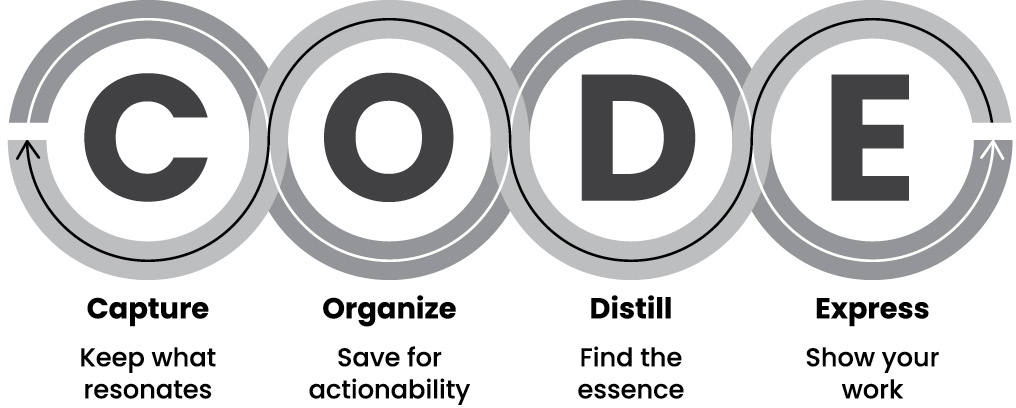
These are the steps not only to build your Second Brain in the first place, but also to work with it going forward. Each of these steps represents a timeless principle found throughout humanity’s history, from the earliest cave paintings to the artisan workshops of the Renaissance to the most cutting-edge modern fields. They are flexible and agnostic for any profession, role, or career and for whatever notetaking methods and platforms you prefer. I’m even willing to bet that you’re doing them already in some form, whether you realize it or not.
CODE is a map for navigating the endless streams of information we are now faced with every day. It is a modern approach to creating a commonplace book, adapted to the needs of the Information Age.
The same way we have a genetic code that determines our height and eye color, we also have a creative code that is hardwired into our imagination. It shapes how we think and how we interact with the world. It is mirrored in the software code that runs the apps we use to handle information. It’s also been a secret code for most of history—now it’s finally time to reveal how it works.III
Let’s preview each of the four steps of the CODE Method—Capture, Organize, Distill, and Express—and then we’ll dive into the details in the following chapters.
Capture: Keep What Resonates
Every time we turn on our smartphone or computer, we are immediately immersed in the flow of juicy content they present. Much of this information is useful and interesting—how-to articles that could make us more productive, podcasts with experts sharing hard-won lessons, or inspiring photos of travel destinations we might want to visit.
Here’s the problem: we can’t consume every bit of this information stream. We will quickly be exhausted and overwhelmed if we try. We need to adopt the perspective of a curator, stepping back from the raging river and starting to make intentional decisions about what information we want to fill our minds.
Like a scientist capturing only the rarest butterflies to take back to the lab, our goal should be to “capture” only the ideas and insights we think are truly noteworthy. Content tends to pile up all around us even without our involvement. There are probably emails filling your inbox, updates popping up in your social media feeds, and notifications proliferating on your smartphone as you’re reading this.
It’s already there, but we tend to capture it haphazardly, at best. You might email yourself a quick note, brainstorm some ideas in a document, or highlight quotes in a book you’re reading, but that information probably remains disconnected and scattered. The insights you uncovered through serious mental effort remain hidden in forgotten folders or drifting in the cloud.
The solution is to keep only what resonates in a trusted place that you control, and to leave the rest aside.
When something resonates, it moves you on an intuitive level. Often, the ideas that resonate are the ones that are most unusual, counterintuitive, interesting, or potentially useful. Don’t make it an analytical decision, and don’t worry about why exactly it resonates—just look inside for a feeling of pleasure, curiosity, wonder, or excitement, and let that be your signal for when it’s time to capture a passage, an image, a quote, or a fact.
By training ourselves to notice when something resonates with us, we can improve not only our ability to take better notes, but also our understanding of ourselves and what makes us tick. It is a way of turning up the volume on our intuition so we can hear the wisdom it offers us.
Adopting the habit of knowledge capture has immediate benefits for our mental health and peace of mind. We can let go of the fear that our memory will fail us at a crucial moment. Instead of jumping at every new headline and notification, we can choose to consume information that adds value to our lives and consciously let go of the rest.
Organize: Save for Actionability
Once you’ve begun capturing notes with the ideas that resonate with you, you’ll eventually feel the need to organize them.
It is tempting to try to create a perfect hierarchy of folders up front to contain every possible note you might ever want to capture. Even if it was possible, that approach would be incredibly time-consuming and require way too much effort, pulling you away from what interests you today.
Most people tend to organize information by subject, like the Dewey decimal system you’ve probably seen at the library. For example, you might find a book under a broad subject category like “Architecture,” “Business,” “History,” or “Geology.”
When it comes to digital notes, we can use much easier and lighter ways of organizing. Because our priorities and goals can change at a moment’s notice, and probably will, we want to avoid organizing methods that are overly rigid and prescriptive. The best way to organize your notes is to organize for action, according to the active projects you are working on right now. Consider new information in terms of its utility, asking, “How is this going to help me move forward one of my current projects?”
Surprisingly, when you focus on taking action, the vast amount of information out there gets radically streamlined and simplified. There are relatively few things that are actionable and relevant at any given time, which means you have a clear filter for ignoring everything else.
Organizing for action gives you a sense of tremendous clarity, because you know that everything you’re keeping actually has a purpose. You know that it aligns with your goals and priorities. Instead of organizing being an obstacle to your productivity, it becomes a contributor to it.
Distill: Find the Essence
Once you start capturing ideas in a central place and organizing them for action, you’ll inevitably begin to notice patterns and connections between them.
An article you read about gardening will give you an insight into growing your customer base. An offhand testimonial from a client will give you the idea to create a web page with all your client testimonials. A business card will remind you of a fascinating conversation you had with someone who you could reach out to for coffee.
The human mind is like a sizzling-hot frying pan of associations—throw a handful of seeds in there and they’ll explode into new ideas like popcorn. Every note is the seed of an idea, reminding you of what you already know and already think about a topic.
There is a powerful way to facilitate and speed up this process of rapid association: distill your notes down to their essence.
Every idea has an “essence”: the heart and soul of what it is trying to communicate. It might take hundreds of pages and thousands of words to fully explain a complex insight, but there is always a way to convey the core message in just a sentence or two.
Einstein famously summarized his revolutionary new theory of physics with the equation E=mc2. If he can distill his thinking into such an elegant equation, you can surely summarize the main points of any article, book, video, or presentation so that the main point is easy to identify.
Why is it so important to be able to easily find the main point of a note? Because in the midst of a busy workday, you won’t have time to review ten pages of notes on a book you read last year—you need to be able to quickly find just the main takeaways.
If you’ve highlighted those takeaways in the flow of the reading you were already doing anyway, you’ll be able to remind yourself of what the book contains without having to spend hours rereading it.
Every time you take a note, ask yourself, “How can I make this as useful as possible for my future self?” That question will lead you to annotate the words and phrases that explain why you saved a note, what you were thinking, and what exactly caught your attention.
Your notes will be useless if you can’t decipher them in the future, or if they’re so long that you don’t even try. Think of yourself not just as a taker of notes, but as a giver of notes—you are giving your future self the gift of knowledge that is easy to find and understand.
Express: Show Your Work
All the previous steps—capturing, organizing, and distilling—are geared toward one ultimate purpose: sharing your own ideas, your own story, and your own knowledge with others.
What is the point of knowledge if it doesn’t help anyone or produce anything?IV Whether your goal is to lose weight, get a promotion at work, start a side business, or strengthen your local community, personal knowledge management exists to support taking action—anything else is a distraction.
A common challenge for people who are curious and love to learn is that we can fall into the habit of continuously force-feeding ourselves more and more information, but never actually take the next step and apply it. We compile tons of research, but never put forward our own proposal. We gather untold business case studies, but never pitch one potential client. We study every piece of relationship advice available, but never ask anyone out on a date.
It’s so easy to endlessly delay and postpone the experiences that would so enrich our lives. We think we’re not ready. We fear we’re not prepared. We cannot stand the thought that there is one little piece of information we’re missing that, if we had it, would make all the difference.
I’m here to tell you that that is no way to live your life. Information becomes knowledge—personal, embodied, verified—only when we put it to use. You gain confidence in what you know only when you know that it works. Until you do, it’s just a theory.
This is why I recommend you shift as much of your time and effort as possible from consuming to creating.V We all naturally have a desire to create—to bring to life something good, true, or beautiful.9 It’s a part of our essential nature. Creating new things is not only one of the most deeply fulfilling things we can do, it can also have a positive impact on others—by inspiring, entertaining, or educating them.
What should you create?
It depends on your skills, interests, and personality. If you are highly analytical, you could evaluate the many options for camping gear and create a list of recommended products to share with your friends. If you like to teach, you could record your favorite dessert recipe and post it on social media or a blog. If you care about a local cause such as public parks, you could create a plan to lobby the city council for more funding.
All these actions—evaluate, share, teach, record, post, and lobbyVI—are synonyms for the act of expression. They all draw on outside sources for raw material, they all involve a practical process of refinement over time, and they all end up making an impact on someone or something that matters to you.
Information is always in flux, and it is always a work in progress. Since nothing is ever truly final, there is no need to wait to get started. You can publish a simple website now, and slowly add additional pages over time. You can send out a draft of a piece of writing now and make revisions later when you have more time. The sooner you begin, the sooner you start on the path of improvement.
I’ve introduced a lot of new concepts and terms, and I know at this point it can seem a little overwhelming. It may feel like you have to learn and do a lot of new things to be able to build a Second Brain.
Here’s the surprising truth: you are already doing most of the work required.
You are already learning new things—you couldn’t stop if you wanted to. You already consume interesting ideas—note the dozens of tabs you likely have open in your browser. You already put in so much effort to keep track of all the information you need for your studies, your job, or your business. All you need is a slightly more intentional, more deliberate way to manage that information, plus a few practical habits to ensure it gets done.
In Part Two, I will show you how to use the CODE steps to radically expand your memory, intelligence, and creativity. For each step, I’ll share a set of practical techniques that you can implement today that will begin to yield benefits tomorrow. Techniques that don’t require any advanced technology—only the everyday devices and apps you have in your pocket and on your desk right now.
- I. Many people who follow the CODE methodology continue to use paper for their notes. Many even find that they take more notes on paper once they have a way of capturing those notes digitally and saving them in a secure place. It’s not black-or-white. It’s about choosing the right tool for the job. This book is focused primarily on the potential of digital notes.
- II. Most notes apps provide ways of exporting your notes in standard formats that can then be imported into other apps. I personally have switched platforms twice (from Microsoft Word to Google Docs, and then later to Evernote) and expect to switch to new platforms regularly in the future as technology advances.
- III. In a wonderful coincidence, recent research by neurophysiologists May-Britt Moser and Edvard Moser at the Norwegian University of Science and Technology indicates that the human brain remembers information using a “grid code”—a part of the brain involved in spatial reasoning. They speculate that “the grid code could therefore be some sort of metric or coordinate system” that can “uniquely and efficiently represent a lot of information.”
- IV. The word “productivity” has the same origin as the Latin verb producere, which means “to produce.” Which means that at the end of the day, if you can’t point to some kind of output or result you’ve produced, it’s questionable whether you’ve been productive at all.
- V. The consumerist attitude toward information—that more is better, that we never have enough, and that what we already have isn’t good enough—is at the heart of many people’s dissatisfaction with how they spend their time online. Instead of trying to find “the best” content, I recommend instead switching your focus to making things, which is far more satisfying.
- VI. Other synonyms for expression include publish, speak, present, perform, produce, write, draw, interpret, critique, or translate.