International Contagion 1618–1930
Allocating the blame for the crisis
That the review of the historical record suggests that crises occur in waves leads to two questions – one concerns when and where each of the shocks begins and the other relates to the mechanism that links the crises in different countries.
The tendency in every country is to believe that the crisis is imported. US President Herbert Hoover insisted that Europe was responsible for the 1930s depression because of its cartels and the ‘European statesmen [who] did not have the courage to face these issues’.1 There was global overproduction of wheat, rubber, coffee, sugar, silver, zinc, and cotton. Hoover accepted some US responsibility for stock market speculation. Friedman and Schwartz asserted that the crisis originated in the United States, although the gold-exchange standard rendered the international financial system vulnerable. The initial climactic event – the stock market crash – was American, and the developments that led to a decline in the stock of money in late 1930 were predominantly domestic.2
The Europeans believe that the recession in 2008 started in the United States. So do many of those in Iceland.
In 1837 President Jackson placed the blame for that year’s crisis on both Britain and the United States:
It would seem impossible for sincere inquiries after the truth to resist the conviction that the causes of the revulsion in both countries have been substantially the same. Two nations, the most commercial in the world, enjoying but recently the highest degree of apparent prosperity, are suddenly, without any great national calamity, arrested in that career, and plunged into embarrassment and distress. In both countries have we witnessed the same redundancy of paper money, and other facilities of credit, the same spirit of speculation, the same partial success, the same difficulties and reverses, and, at length, the same overwhelming catastrophe.3
Although observers in the 1850s called the panics of 1836–37 the ‘American panics’ because they originated in and were confined to the banks that traded with the United States,4 one modern economist concluded that it was ‘futile to try to draw any hard-and-fast line assigning to either country causal primacy in the cycle as a whole or in its individual phases’.5
Friedman and Schwartz relied on the data on the pattern of gold movements to conclude that the United States was responsible for the recession of 1920–21.6 Another observer disagreed:
How was [the early postwar fall in economic activity] brought about? ... I think the answer must be: It was a deliberate policy inaugurated by the two economically dominating countries, the U.K. and the U.S.A. It is impossible to give priority to any of them. The earliest official statement of the policy was undoubtedly made by England. On the other hand, causally U.S.A.’s policy must have the greater weight.7
A few crises are purely national – the gold agio crisis in the United States in 1869, the City of Glasgow Bank in 1878, the Union Générale in France in 1882. In contrast the Canadian financial crises that occurred in 1879, 1887, and 1908 seemed related to major financial currents that bound Western Europe, Scandinavia, and the United States together.8
Some countries may not be affected by international crises that impact their neighbors and for obvious reasons. France was not affected in 1873 because it had undergone severe deflation in 1871 and 1872 as it transferred reparations to Prussia. The United States was insulated from the European potato disease and the tumultuous European wheat situation in 1847 because US railroads had not yet developed to the point where US food markets were closely linked to those in Europe.
For the most part however financial crises ricochet from one country to another. Juglar,9 Mitchell,10 and Morgenstern11 noted that financial crises tend to be international, and either affect a number of countries at the same time or alternatively spread from the centers where they originate to other countries.
One of the several links among countries is that arbitrage connects national commodity and financial markets; the implication of the Law of One Price is that the difference in the prices of identical or similar goods in various countries cannot exceed the costs of transport and trade barriers. The links between commodity markets in different countries may involve only a modest amount of trade. When the price of cotton soared in the 1830s in one country, the price increased in all other countries; similarly the decline in the price of cotton after 1864 was worldwide. A decline in the price of a given commodity – especially a widely traded product like wheat or cotton – may produce bankruptcies and bank failures far from the source of the original change in demand or supply.
Similarly the financial markets in the various countries are also linked, since the prices of internationally traded securities available in different markets must be virtually identical after a conversion of prices in different currencies into the same currency. The prices of internationally traded securities that are listed on the stock exchanges in several different countries increase and decrease together. The prices of domestic securities often move in a synchronous fashion with internationally traded securities as a result of psychological linkages or through impacts on interest rates transmitted through short-term capital movements.
When changes in stock prices are small, the correlations between the stock price movements in different national markets are low. As the changes in stock prices become larger, the correlations become stronger.
In 1929 all stock markets crashed simultaneously and again in October 1987 virtually all of the stock markets declined at the same time. Even though national financial markets generally were believed to be more fully integrated in the 1980s and the 1990s than in earlier periods, share prices in the 1920s in different countries were as strongly correlated as in later decades. Because of the strong correlation of the stock price movements in different countries, many of the investors who sought to reduce risk by diversification through ownership of stocks in different national markets obtained smaller reductions in risk than they had anticipated.
The correlations among changes in stock prices in different countries are somewhat asymmetric in that changes in US stock prices have a much more powerful impact on stock prices in various foreign countries than changes in stock prices in any one of these countries have on US stock prices. Thus US stock prices increased throughout the 1990s while stock prices in Tokyo were on a downward trend – but when US stock prices declined in 2001 stock prices in Tokyo, London, and Frankfurt declined. The Mexican financial crisis of 1994–95 impacted both Brazil and Argentina; US investors became more cautious about buying both Latin American bonds and stocks. The devaluation of the Thai baht in early July 1997 triggered the ‘contagion effect’ and induced depreciations of the currencies in nearby Asian countries in the following six months and then spread to Russia and Brazil and eventually Argentina.
Booms and panics are transmitted from one country to another in several different ways, including arbitrage in commodities or securities and movements of money in various forms (specie, bank deposits, bills of exchange), cooperation among monetary authorities, and investor psychology.12
The security and asset markets in various countries are linked by movements of money. The inflation in the United States in the late 1960s and the early 1970s led to larger money flows from the United States to Germany and Japan and the inflation rates in these countries increased as their monetary bases and their money supplies increased.
Cross-border money movements may respond to real causes, including wars and revolutions, technical innovations and the opening of new markets and of new sources of raw materials, and to changes in the relationship among the growth rates in different countries, as well as to changes in monetary policy and in fiscal policy. The privatization of government-owned firms in a country often induces inflows of money as foreign investors buy shares in these firms.
Consider the connections between the appreciation of a currency and deflation in that country’s goods market (or the connections between the depreciation of a currency and inflation in that country’s goods market); the appreciation of the currency leads to declines in the prices of internationally traded goods and to bankruptcies and the de-capitalization of banks and other financial firms. The appreciation of the Japanese yen in the second half of the 1980s and the 1990s put downward pressure on the prices of internationally traded goods in Japan. The depreciation of the Argentine, Uruguayan, Australian, and New Zealand currencies in the early 1930s contributed to the decline in wheat prices in the United States which in turn led to bankruptcies among farmers and to the failures of banks in Missouri, Indiana, Illinois, Iowa, Arkansas, and North Carolina.13
Booms and busts are connected internationally in several different ways. An economic boom in one country almost always attracts money from abroad. Similarly, a boom in one country may reduce the flow of money to others; thus in 1872 Berlin and Vienna stopped lending to New York, while the US stock market boom in 1928 led to a sharp reduction in US purchases of German, Australian, and Latin American bonds. The collapse of the market in syndicated bank loans to Mexico, Brazil, and Argentina in 1982 led to a sharp decline in the values of their currencies.
Stock prices and real estate prices increased sharply in three of the Nordic countries in the late 1980s; with a three-fold increase in Norway and five-fold increases in Sweden and Finland.14
This financial crisis occurred with metallic money; credit from banks or other lenders was not involved. Princes, abbots, bishops, even the Holy Roman Emperor debased the subsidiary coinage used in daily transactions (but not gold and silver coin of large denominations) by raising the denomination of existing coins, substituting base for good metals, and reducing the metallic content of coins to extract more seignorage to prepare for the Thirty Years’ War that broke out in 1618. Debasement was limited at first to their own territories. Some entrepreneurial spirit then found that it was more profitable to take bad coins across the borders into neighboring principalities to exchange for good coins with ignorant common people; the good coins were then brought home and debased. The territorial unit on which the original injury had been inflicted would debase its own coin in defense and turn to other neighbors to make good its losses and build its war chest. More and more mints were established to extract more seignorage.
Debasement accelerated until the subsidiary coins became practically worthless, and children played with them in the street, much as recounted in Leo Tolstoy’s short story, ‘Ivan the Fool’.
Some local sources set forth the view that the first invasion of debased money came from Italy and from there to southern Germany through the Bishop of Chur on Lake Constance. The same source at Ulm, however, claimed that the counterfeiting of the Upper Rhine Circle that included Strasbourg was especially outrageous. Beginning on a small scale around 1600, debasement slowly picked up speed after 1618 and spread to Germany and Austria and to what became Hungary and Czechoslovakia and into Poland and, according to some sources, to the Near and Far East by way of Lvov in Russia.15
The South Sea and Mississippi bubbles
Åkerman called the crisis of 1720 the first international crisis, because the speculation from 1717 to 1720 in France and in Britain affected the cities of the Netherlands, northern Italy, and Hamburg.16 The South Sea and Mississippi bubbles were connected in several ways. As early as 1717 British investors began to follow trading in the shares of John Law’s banks and companies on the Rue de Quincampoix in Paris. In May 1719 the British ambassador in Paris received letters from friends and relatives in Scotland begging him to buy stock for them in the Compagnie des Indes. Thirty thousand foreigners, including British nobility, traveled to Paris to subscribe in person. In May, Ambassador Stair urged his government to do something to compete with John Law and slow the flow of money from London to Paris. As Law’s system peaked in December 1719, some speculators, including the Duke of Chandos, sold South Sea stock and bought Mississippi stock.17
While British speculators were buying Mississippi stock in Paris, many continentals were buying South Sea stock in London. Sir Theodore Janssen had a long list of subscribers from Geneva, Paris, Amsterdam, and The Hague. One of the French investors was the banker Martin, who as already noted was recorded by Charles McKay as subscribing £500 with the remark: ‘When the rest of the world are mad, we must imitate them in some measure.’ When the early birds liquidated in July, the Canton of Berne, which had speculated with £200,000 of public funds, sold for a profit of £2 million.18
Amsterdam profited from its position between Paris and London. The Dutch sold their stock in Mississippi Compagnie des Indes at the right moment and lost little in the crash. In April 1720, a bit prematurely perhaps, David Leeuw liquidated his South Sea stock and bought Bank of England and East India Company stock. By the end of that month, the Dutch banker Crellius observed coolly that Exchange Alley resembled ‘nothing so much as if all the Lunatics had escaped out of the Madhouse at once’.19 In June and July there were twelve-hour relays by ship between Britain and Amsterdam, and on 16 July eighty Jews, Presbyterians, and Anabaptists, speculators from Exchange Alley, went to Holland and Hamburg to trade insurance stocks.20 In the autumn of 1720 London and the Continent were sharing the financial disaster. Samuel Bernard, a French banker, was sent to London to sell South Sea stock against gold, to be brought back to France in revulsion against Law’s system. Dutch banks ‘shortened sail, recalling advances, refusing further credit, selling stocks held as collateral’.21 The price of the British pound in terms of the guilder in Amsterdam, which had risen from 35.4 guilders to the pound to 36.1 when the first increase in South Sea stock took place in April and ‘France, Holland and to some extent Denmark, Spain and Portugal’ were buying, declined to 33.9 on 1 September as ‘foreigners lost their taste for English securities’. At the height of the panic it recovered to 35.2.22
The crisis of 1763 involved mainly Holland, Hamburg, Prussia, and Scandinavia, with repercussions on and help from London. France was not involved; the Seven Years’ War had been directed against France. George Chalmers, a perceptive contemporary observer, claimed that speculation in land in the United States was a factor in the crisis although the statement is not supported by others.23 Amsterdam had been the entrepôt center for the payment of money to British allies, and the Dutch had been expanding credit by buying British government stock and Wisselruiti (chains of accommodation bills) that led to a giddy credit edifice on a small base (the proverbial ‘house of cards’) with bills drawn on merchant houses in Stockholm, Hamburg, Bremen, Leipzig, Altona, Lubeck, Copenhagen, and St Petersburg. Bills of exchange drawn with the security of goods shipped also circulated in Amsterdam in addition to the accommodation paper. When prices of commodities fell after the war – especially sugar as imports from the French West Indies were resumed – the bills could not be paid.24 Hamburg warned Amsterdam houses that they would suspend payment unless support was furnished to the DeNeufvilles. In one account, the letter arrived too late.25 Another stated that a plan to save the firm failed because its reputation was too bad.26 In the long run, the DeNeufvilles would have been able to pay 70 percent of their obligations, but their creditors settled for 60 percent before that became known. In the end, the Hamburg creditors had to wait thirty-six years to collect even that much.27 The coup de grâce occurred when King Frederick II of Prussia who had debased the silver coins in 1759 to help fight the war recalled the old coins and had new ones minted in Amsterdam on the basis of credits from the Dutch bankers.28 Withdrawing the old coins before issuing new ones led to deflation because the money supply declined.
London came to the rescue of Amsterdam and financed a considerable portion of Dutch trade and investment with Scandinavia and Russia. Very much against his will, King Frederick had to assist Berlin merchants that were caught in the crisis as their bills were protested.29 Swedish houses complained early in the fall of 1762 that bills they drew were protested and not paid in Amsterdam while remittances sent to cover the bills were retained. Whether Amsterdam tried to save itself by selling British securities is debatable. Wilson claimed that in this way Amsterdam exported the crisis to London. Carter insisted she cannot find evidence of sales in the transfer books.30
The 1772 crisis spread from Scotland and London to Amsterdam and thence to Stockholm and St Petersburg. Large outflows of specie from Paris to London fed the canal and country bank mania during the Reign of Terror in 1792 that peaked with the guillotining of Louis XVI in January 1793; the direction of flow of precious metals reversed itself in 1797 when monetary order had been more or less restored under the Consulate after the Assignats.
The British crisis of 1810 was localized: British exporters first overdid sales to Brazil and then were cut off from their Baltic outlets by the blockade. There were echoes of this crisis in Hamburg and in New York.
The international aspects of the crises of 1816 and 1819 reflected that the prospect of the end of war in 1814 led to large British sales of manufactures on the Continent. Smart called this an exporting frenzy that soon broke like the South Sea and Mississippi bubbles. When prices collapsed, the goods were sent to North America which led to the US tariff of 1816. The result was a deep depression without a panic or even a crisis.31 In 1818 and 1819 there were panics on both sides of the Atlantic that were connected in a non-obvious way. The 1819 crisis in Britain followed the collapse of commodity speculation in 1818, the discredit and distress ‘originating clearly in great previous overtrading’.32 The year 1819 was marked by the resumption of specie payments and by the Peterloo massacre, when protesting Manchester workers and their families were charged by cavalry who killed at least eight individuals; Smart called it a ‘disastrous year’.33 In America, the Second Bank of the United States precipitated a panic by having its branches call on state banks to redeem large balances and notes that it held. The purpose was to assemble $4 million in specie to repay the borrowing undertaken in Europe in 1803 to pay for the Louisiana Purchase.34 But the Second Bank itself was a bubble, having been re-established in 1817 after the dissolution of the First Bank in 1811. The bank was run by greedy and corrupt directors who accepted promissory notes in payment of stock, registered stock in different names to get around the law limiting concentration of ownership, voted loans on the security of bank stock, permitted other loans without collateral, and allowed accounts to be overdrawn. Hammond observed that the sober pace of eighteenth-century business had given way to a democratic passion to get rich quick, and that men imbued with this passion and unscrupulousness had gained control of the Second Bank.35
The 1825 crisis involved Britain and South America, although there was a distinct spillover to Paris that stretched out until panic struck there in January 1828. With the panic in London in December 1825, continental sales halted, impacting banks in Paris, Lyon, Leipzig, and Vienna and obliging Italy and other markets that depended on these centers for finance to reduce their purchases. Distress from burdensome inventories in the textile-producing area of Alsace was general; firms were low on money and circulated between 9 million francs and 16 million francs of their own IOUs as a substitute for money. When this edifice was toppled in December 1827 by Parisian banks’ refusal to renew the Alsatian loan, the London crisis that resulted from overtrading in South American stocks had arrived on the Continent.36
Åkerman calls the crises of 1825 and 1836 ‘Anglo-American’ in contrast to the one in 1847 that was Anglo-French.37 The first two were Anglo-American in different ways: the 1825 crisis was Anglo-South American, the 1836 crisis Anglo-United States. In addition, the situation in 1836 was more complex than the one in 1825.
As noted earlier, President Jackson considered that responsibility for the crisis of 1836 to 1839 should be divided equally between Britain and the United States, while Matthews thought it futile to assign causal primacy. Monetary expansion in the two countries was vastly different. Wildcat banking aided by silver imports had started in the United States while new joint-stock banks had been established in Britain following new legislation in 1826 and 1833. British speculation was in cotton, cotton textiles, and railroads; American speculation was in cotton and land, especially land that could grow cotton. Moreover, Anglo-American banks in London financed British exports to the United States.
The crisis was not a purely Anglo-American affair, although it is often discussed in these terms with emphasis on its impact on the evolution of the Bank of England’s discount policy.38 Hawtrey states that it started in Britain in 1836 and 1837, spread to the United States, and then in May 1838, when Britain was quietly recuperating, erupted in Belgium, France, and Germany to spread back to Britain and to the United States in 1839.39 The crisis in the United States also affected France and Germany directly through the decline in the volume of imports, price declines and financial connections. Lyon felt the loss of outlets for silk immediately. American purchases were important to the success of the fairs in Frankfurt and in Leipzig. American commission houses in Paris, which financed their purchases largely in London, and the American banker Samuel Welles, who also relied on London for finance, were threatened with failure as early as the spring of 1837.40 The Maison Hottinguer, a French bank, helped Nicholas Biddle of the Bank of the United States underwrite the corner in cotton, which strangled cotton spinners in Manchester, Rouen, and Alsace in the summer and fall of 1838 before the collapse of the corner in November of that year that followed from an Anglo-French boycott.41 Moreover the Bank of France provided assistance to the Bank of England. By the 1830s, the financial world had complex transatlantic relations in trade, commodity prices, and capital flows among Britain, the United States and France.
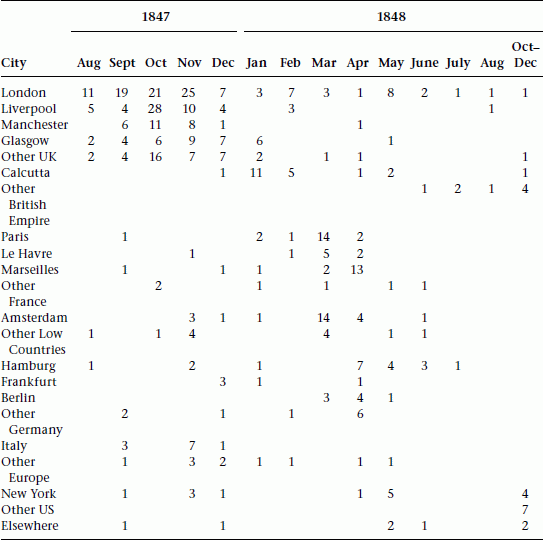
In January 1847 distress developed in London in response to railroad calls and the crisis came late in the summer. Åkerman stated that the distress was Anglo-French, but it had echoes in British-Indian trade, in Amsterdam and the Low Countries, and also in Germany and even New York. Some sense of the spread of the crisis is evident from the number of bankruptcies collected by Evans but not the value of the assets of the failed banks and firms. The data are more complete for Britain than for other countries since Evans reported only the ‘principal foreign failures’. Despite its serious deficiencies a table showing the monthly failures provides a useful impression of how the shock wave of the crisis spread. The British crisis is seen to have almost died away, except for London, when revolution in France and Germany produced the reactions of March and April 1848 that are probably under-recorded in Evans’s data.42
The failure of the A. Schaaffhausen Bank of Cologne on 29 March 1848 played a role in the development of German banking. The Prussian government allowed the bank to be saved through its conversion into a joint-stock company, despite its standing policy of opposition to credit expansion; this precedent paved the way for the substantial expansion of German banks in the 1850s with important consequences for German economic growth.43 Since Cologne had been a Hanseatic city, the bank was probably tied into the merchant banking network of London-Antwerp-Hamburg-Bremen-Le Havre-Marseilles featured so prominently by Evans. A local source claimed that Cologne was at the crossroads of trade between Holland, Brabant, France, and eastern and upper Germany and that the city suffered many bankruptcies as a consequence of the British crisis of 1825. The source admitted that apart from some financing of leather imports from South America, most banking finance was local and undertaken for heavy industry. Johann Wolter and Abraham Schaaffhausen got their start as leather merchants, purchasing South American hides from Spain, first through Amsterdam and then directly. Abraham, the son, was a merchant, commission agent, forwarder, and banker with international connections. The trouble in 1848, however, came largely from financing real estate investments in Cologne. Almost one-quarter of the portfolio of the bank consisted of land and loans to a single builder that together amounted to 1.6 million thalers compared to the bank’s capital of 1.5 million. As social
Table 8.1 Reported failures in the crisis of 1847–48, by cities (number of failures)
Source: Derived from names of firms and banks listed by D. Morier Evans, The Commercial Crisis, 1847–48 (1849; reprint edn, New York: Augustus M. Kelley, 1969), pp. 69, 74, 91–2, 103–4, 105–6, 112–13, 118–20, 123, 127.
unrest increased and depositors sought cash, the bank first took on a Dutch partner and then received help from the Prussian Bank’s branch in Cologne, the same bank’s branch in Münster, the Prussian Seehandlung (another state financial agency), and the Prussian lottery. Permission for A. Schaaffhausen to convert into A. Schaaffhausen’scher Bankverein may have been related to the fact that joint stock banks were forbidden to invest in building sites and all other forms of speculation.44
The boom leading up to the panic of 1857 was worldwide. Gold discoveries in California (1849) and Australia (1851) led to export spurts to those countries and enlarged the credit bases in Europe and the United States. It would have done so to a greater extent had India not been exporting far more than it was importing and beginning to receive, along with the United States, money from Britain which had been discouraged from investing on the Continent by the revolutions of 1848. The balance of payments surplus was financed by a payment in silver. Both Europe and the United States had railroad and banking booms. Expansion also came from joint-stock banks in Britain and Germany and from the Crédit Mobilier, Crédit Foncier, and Crédit Agricole in France which made large loans to trade and industry. Scandinavia in particular had been stimulated by the boom in trade generated by the repeal of the British Corn Laws, timber duties, and Navigation Acts.45 Bad harvests and the Crimean War, which cut off Russian exports, raised the price of grain for farmers worldwide. These were, in fact, golden years for British farmers, despite the repeal of the Corn Laws in 1846. After the war, grain prices sank as Russian supplies came back on the market, and railroad building declined. The dominoes started their collapse in Ohio – or, rather, the New York branch of an Ohio bank – and fell in New York, Ohio, Pennsylvania, Maryland, Rhode Island, and Virginia, and then in Liverpool, London, Paris, Hamburg, Oslo, and Stockholm. Evans’s data on bankruptcies for 1857 are sketchier than those for 1847 and the path of failures cannot be traced. The failure of the New York branch of the Ohio Life and Trust Company occurred around the same time as British withdrawals of funds from the United States in response to increases in interest rates in London.
The concentrated nature of the crisis from the Ohio Life revelation on 24 August to suspension of the Bank Act in London on 12 November through Hamburg’s loan from Austria (the Silberzug) on 10 December is striking. Clapham observed that the crisis appeared at almost the same moment in the United States, Britain, and Central Europe and was felt in South America, South Africa, and the Far East.46 Rosenberg calls it ‘the first worldwide crisis’. The chamber of commerce of Elberfeld asserted: ‘The world is a unit; industry and trade have made it so.’47
The crisis of 1866 is the tail end of one that began in 1864. Åkerman said that it parallels the 1857 crisis, insofar as it followed the Civil War as 1857 followed the Crimean War, and as the collapse of cotton in 1866 paralleled the collapse of wheat a decade earlier.48 The inclusion of 1864 eliminates a general view that the crisis was strictly British.49 The timing of the panic on Black Friday, 11 May 1866, was intimately tied to the Prussian-Austrian war, largely through stock market collapses attributable to rumors of war and then the advent of the war, and then to the corso forzoso of 11 May 1866, when the Italian government suspended convertibility of the lira into gold and in return for this privilege borrowed 250 million lire from the national bank.50 Like the Overend, Gurney collapse, the corso forzoso had been triggered by an internal run on notes against gold, stimulated by money withdrawals toward Paris that in turn had suffered from sales of foreign securities. The London market was shaky in mid-April because of rumors of war. The Berlin bourse panicked on 2 May with mobilization and again on 12 May when war broke out. The Prussian Bank raised its discount rate to 9 percent on 11 May. The panic in London that same day was part of a general rush for liquidity against a vulnerable company at a time of acute financial distress. Alfred André, a Parisian banker with major interests in Egypt, spent ‘an exhausting week’ in London looking after the interests of his firm at the time of the Overend, Gurney crisis. He returned to Paris on 17 May, having concluded that the finance companies were ruined and that business was paralyzed in Italy, Prussia, Austria, and Russia, with France standing up pretty well, but only for a moment.51
There is no obvious connection between the US gold crisis of September 1869 and the Austrian crisis of the same month. Both currencies were floating. Both countries had had investment booms following their wars, although the devastation from the conflict had been much greater in the United States. Wirth prefaced his brief discussion of the ‘great crash of 1869’, which preceded the real great crash of 1873, with remarks about German and Austrian investments in the United States, the invasion of European markets by US goods, and the extension of shipping and banking connections across the Atlantic.52 Since Wirth did not mention the US gold crisis, however, it seems unlikely that he was suggesting a connection. The accounts of the 1869 gold crisis in the United States ignore Austria.53 A possible link is through the price of wheat, which Jay Gould and Jim Fisk were trying to increase when they bid up the gold premium (for example, the discount on the greenback dollar). The difficulties following the September 1869 ‘crash’ were concentrated in Hungary, which was a wheat-growing country.54 Gould states that the United States could sell wheat to Britain in competition with the low-priced labor and water transportation from the Mediterranean with the gold agio at 45, but the United States could not sell wheat with gold below 40.55 The decline in the gold agio in the United States in September should have assisted Hungarian economic prospects.
The 1873 story begins with the Franco-Prussian indemnity that was one-tenth paid in gold in 1871 and led to substantial speculation in Germany which then spilled into Austria.56 Jay Cooke, a latecomer to railroad finance and seeking capital for railroads in Europe, overextended himself with the Northern Pacific; he tried to borrow in Frankfurt but could not compete with the German and Austrian building booms.57 Other shocks included the opening of the Suez Canal in 1869, the mistake of the German authorities in paying out new coin before withdrawing the old silver coins, the Chicago fire of 9 October 1871,58 and especially the excitement generated by German unification under the leadership of Prussia’s Bismarck. German acquisition of £90 million from the indemnity endangered stability in Britain because of the threat of conversion into gold. France deflated to pay the indemnity and was not affected by the inflation that occurred elsewhere in Europe.
A major question is the connection between the collapse in May 1873 in Austria and Germany after some months of distress and that in the United States in September. One link is through the changes in German investments in American railroads; initially German investors speculated in the railroads and western lands and then there was an abrupt halt to further investment. McCartney stated that 1873 is generally accepted as the first significant international crisis. The crisis erupted in Austria and Germany in May; spread to Italy, Holland, and Belgium and then to the United States in September; and then later involved Britain, France, and Russia. A second panic hit Vienna on 1 November but was shortlived.59 Morgenstern noted ‘clear evidence of transmission throughout the year, extended to Amsterdam and Zurich’ in his table of international stock market panics.60 In the fall of 1875, Baron Carl Meyer von Rothschild wrote to Gerson von Bleichröder and commented on the low state of stock prices everywhere, noting that ‘the whole world has become a city’.61
A series of less intimately related failures and panics followed, including the City of Glasgow in 1878, Union Générale in 1882, and the New York stock market in 1884; the European-wide stock market panics in 1887 over the threat of war between Russia and Turkey; the copper corner in 1888 in Paris with the failure of the Comptoir d’Escompte; and the Baring crisis of 1890, the Panama scandal of 1892, and the New York panic of 1893. Their propagation was studied in detail by Morgenstern62 and Pressnell who focused especially on the Baring crisis and attached particular importance to its impact on the Bank of England’s gold reserves.63 The 1890 Baring crisis produced financial stringency rather than panic in New York as British investors sold good US stocks to carry bad Latin American loans.64 One view is that the financial crisis in New York in October 1890 precipitated the Baring Brothers collapse in November by producing failures in London, which made it more difficult for Baring to continue. The Baring crisis, induced by difficulties in Argentina, brought a sharp decline in British lending worldwide and contributed strongly to economic crises in South Africa, Australia, and the United States for the next several years.65
The US crisis of 1907 began several years earlier in Italy, which had participated in the upswing of the first several years of the century.66 Speculation fed by credit had been rife. There were fictitious ventures and a steel trust that used funds ostensibly borrowed for real investment to speculate in its own securities; high dividends were paid with the cash from borrowings to stimulate investor interest. Distress set in in May 1905 with the collapse of many new companies. A second relapse occurred on the Genoa stock market in October 1906. By April and May 1907 lending from Paris and London had slowed and the distress became more acute. The Società Bancaria Italiana had started in 1898 with capital of 4 million lire, which was raised to 5 million in 1899, 9 million in 1900, 20 million in 1904, 30 million in 1905, and 50 million in March 1906. As the capital was increased, old and often troubled banks and new personnel were acquired.67 The head office of the bank in Milan did not know the risks that had been acquired by its branch in Genoa.68 In particular, the bank was deeply involved in advances on securities (riporti). Governor Stringher of the Banca d’Italia was worried because of the poor quality of its loans and the large amount it had borrowed from the central bank by December 1906. When Paris and London cut off new credits to Italy and to the United States in the spring of 1907, the upstart, marginal bank was doomed. Direct connections between Turin-Milan-Genoa and New York were limited. But Italian centers were connected to Paris; New York was connected mainly to London; and Paris and London to each other. Bonelli asserted that when Paris sold its British securities, and Paris and London both stopped lending, the colonial countries suddenly found themselves deprived of capital and were obliged to halt ongoing investment projects with consequent downward pressure on demand and output and employment and prices. The analogy between Italy in 1907 and a colonial territory is striking. Bonelli asserted that the Paris cut-off of loans to Italy would have had much more serious consequences if it not been for emigrant remittances, largely from the United States.69 There was a direct connection across the Atlantic, largely New York to Naples. Bonelli’s account focused on the narrow direct connections and contrasted with that of a contemporary observer, a New York banker named Frank Vanderlip, in a paper called ‘The Panic as a World Phenomenon’. Vanderlip asserted that the basic causes of the panic were the Boer War, the Russo-Japanese War, and the San Francisco earthquake. But after such a grandiose beginning, he discussed overtrading by newly formed trust companies and the need for an expansive currency.70
The international ramifications of 1929
President Hoover stated that part of the real cause of the Great Depression was expansion of production outside of Europe during World War I, which contributed to global oversupply when European production recovered after the war. In addition, there were the financial complications of reparations and war debts; an overvalued British pound and an undervalued French franc, and the recycling of German reparations after the Dawes Plan by American purchases of the bonds of German corporations and public bodies. Some blame attaches to the reduction of US interest rates in the summer of 1927 to assist Britain in maintaining the parity for the pound when US domestic purposes would have been better served by higher interest rates. When US stock prices increased in March 1928 and especially after June, US purchases of foreign bonds came to a halt. For a time, Germany, the Latin American countries, and Australia borrowed at short-term. Germany responded to the reduced inflow of money by deflating its economy so it would have the cash to make reparations payments. The payments positions of Argentina, Australia, Uruguay, and Brazil turned sharply adverse. Unable to fund their accumulations of short-term indebtedness or to borrow more, their currencies depreciated shortly after the stock market crash of October 1929, as the prices of wheat, coffee, rubber, sugar, silk, and cotton fell sharply.
An open-market program undertaken by the Federal Reserve Bank of New York on its own initiative, over the protest of the Federal Reserve Board in Washington, alleviated the credit squeeze early in 1929. There was an increase in international lending in the first half of 1930; the volume of international lending in the April-June quarter was larger than in any other quarter in the 1920s and the 1930s. However, the lower level of prices and the loss of confidence in Germany, especially after the National Socialist gains in the September 1930 elections, meant that financial distress continued. Banks in Central Europe, largely Austria and Germany, tried to improve their positions by bidding up the prices of their own stocks. Two private banks, the Banque Adam and the Banque Oustric, failed in Paris, the latter unleashed a scandal that implicated three government officials and led to the fall of the government. The deflationary Laval government came to power early in 1931. And then the rolling deflation started: the failure of the Credit Anstalt in Vienna in May, the failure of the Danatbank in Germany in July, the German standstill agreement of July, and withdrawals of money from London in August, that culminated in the decision of the British in September 1931 to break the link between the pound and gold. The gold bloc of France, Belgium, the Netherlands, and Switzerland started buying gold with US dollars and the withdrawal of gold from the United States reduced the reserves of US banks. Japan went off gold in December 1931. Deflation in the United States came from the depreciation of the British pound and the currencies of the sterling area countries that remained pegged to the pound and from the reduction of bank reserves. In February 1932 the Glass-Steagall Act made it possible to reflate through open-market operations, but it was too late. Bank failures continued to spread in a positive feedback debt deflation process of declining goods prices, bankruptcies, and bank failures. The US economy reached the bottom with the general Bank Holiday that began in March 1933 and the depreciation of the dollar in the spring of that year when the US gold parity of $20.67 was abandoned.
This history does not lead to the conclusion that the 1930s depression originated in the United States.