Chapter 19
Problems
How to Give Up
This chapter was very hard to write. It’s hard to write about things that need to be fixed. It’s hard to fix things that need to be fixed. I’ve tried my best to outline some of the issues that we are facing as a society, but I’ve missed many things.
By this point in the book, we’ve covered the basics of how the economy works.
But it’s crucial to know how the economy fails.
The State of the American Dream
I grew up in Kentucky, in the public school system, and my college was paid for via a very generous scholarship that was partially funded by the state lottery. I left Kentucky five days after I graduated school and headed out to Los Angeles for a wonderful job at Capital Group, an early career rotational program that would give me significant exposure to the industry.
But Los Angeles was huge. And I was small. The city changed me, in many ways, and then six months later, the pandemic hit. I was cooped up in a 350-square-foot studio (about the size of a very small bedroom) all alone. I was sitting on a cardboard box as my “chair” and my only interface with the outside world was through financial markets.
During those twelve months, we all watched policy decisions shape our reality.
The pandemic was a whirlwind lesson on how systems work—and how they can fail us. Essential workers were treated like heroes, but only at first. A few months in, their capes were ragged from carrying the immense burden of being both healers and morticians.
The pandemic highlighted the increasing bifurcation in our world. It didn’t just reveal a wealth gap; it exposed an economy built around unreasonable expectations. Some would risk their lives so another could get a cheeseburger delivered to their door, while healthcare workers wore trash bags because, welp, we just didn’t have enough personal protective equipment—or enough of anything, really.
So much of this book was shaped by that push and pull of abundance and scarcity.
We have a surplus of things we don’t need and a shortage of things we do need. We need more workers. We need more homes. We need more public transit. We need more green energy.
We need, we need, we need. This endless cycle of “need” can be exhausting to hear because a lot of this is not things that the average person can really go out and fix. If someone could flip a switch that helps enact policy around immigration reform and nuclear power plants, that would be amazing! But it takes collective action to achieve anything substantial.
The main theme of this book is that “people are the economy.” Countless poor policy choices have turned living in this economy into a tough gig. Many of us have witnessed the American Dream rot before our eyes. Higher education has become a luxury good, the housing crisis has exacerbated the cost of living, all backdropped by political stagnation and rapid (perhaps too rapid) technological advancement with things like AI.
One thing that was very striking to me about the last few years was the constant anger that bubbled underneath the surface. Nothing was working the way that it was supposed to. We were still dealing with the lingering effects of the pandemic, shipping constraints, rising energy costs, and natural disasters like droughts, floods, and fires. Wars unfolded. A crude list doesn’t even begin to cover it—big pharma; student loans; mass shootings; wealth inequality; the aftershocks of ZIRP; credit card debt; the debt ceiling is as dumb as possible; commercial real estate is terrifying; so on and so forth.
It’s scary. We are entering into the very, very vast unknown and it’s increasingly easy to trend toward negativity, especially if it feels like life is punching you in the face repeatedly.
We all want to be informed, but a gap exists between knowledge and action. We are all overwhelmed with information, but we’re alienated from any concrete sense of reality. We are pixels away from disaster, yet a vision for a safer world remains elusive.
Economy and Mental Health
This book has heavily focused on the importance of emotions—and the communication of emotions—in shaping our perception of the economy. The writer and director Paul Auster touched on the complex nature of understanding others, underscoring the necessity of communication in his book The Invention of Solitude:
Impossible, I realize, to enter another’s solitude. If it is true that we can ever come to know another human being, even to a small degree, it is only to the extent that he is willing to make himself known. A man will say: I am cold. Or else he will say nothing, and we will see him shivering. Either way, we will know that he is cold. But what of the man who says nothing and does not shiver? Where all is intractable, here all is hermetic and evasive, one can do no more than observe. But whether one can make sense of what he observes is another matter entirely. I do not want to presume anything.
Auster notes that while it’s impossible to totally understand another person, we can glean insight from their actions and expressions. For example, a person might shiver, indicating they are cold. That’s helpful! But what about people who don’t do anything? They might be freezing, they might not be freezing, but they don’t say anything.
This scenario can be seen in the economy, too: There are moments when the economy visibly “shivers,” indicating issues with GDP, inflation, or the labor market. But there are also times when the economy doesn’t visibly shiver but still carries an undercurrent of distress.
Just because the economy isn’t visibly shivering doesn’t mean that things are great, and just because the economy is shivering doesn’t mean it will be cold forever. There is a human side to this. The vibes, the data, all of it, influence how we feel about the economy and our place in it, of course. But there is something deeper going on here.
The current global mental health crisis profoundly affects the economy. This impact is reflected in both absenteeism and presenteeism at work, where individuals are less effective in their jobs due to mental health issues. The Lancet Global Health published a paper analyzing the economic impacts of mental health that stated:
From addiction to dementia to schizophrenia, almost 1 billion people worldwide suffer from a mental disorder. Lost productivity as a result of two of the most common mental disorders, anxiety and depression, costs the global economy U.S. $1 trillion each year. In total, poor mental health was estimated to cost the world economy approximately $2.5 trillion per year in poor health and reduced productivity in 2010, a cost projected to rise to $6 trillion by 2030.
So sure, mental health challenges can influence workforce productivity, contribute to absenteeism, and lead to reduced job performance—which matter, but not more than how people are doing in the day-to-day. Some things supersede efficiency metrics, such as the well-being of humans. We have a mental health crisis that impacts vibes sometimes more than economic output does.
So, Auster’s reflections on personal understanding resonate deeply with the economic landscape. Just as we struggle to comprehend another’s internal world fully, trying to figure out how to care for one another, interpreting the economic “vibes” requires looking beyond surface data to understand the underlying human factors driving the economy.
The Shifting Nature of Work
There’s a lot to say about the state of mental health and the labor market in the context of the early 2020s. I graduated right into the pandemic; I spent six months in the office, then—boom! It really changed my relationship with work and did the same for many of my peers. A lot of people my age (early to late twenties, even beyond) seem to have a new sort of relationship with work, haunted by their early adulthood not going as they expected it to.
For instance, Gen Z has experienced three major economic downturns even though some of them are barely in their mid-twenties. These crises occurred during their formative years, which has shaped their worldview, their relationships with others, and how they interact with themselves.
Erik Baker wrote an incredible piece, “The Age of the Crisis of Work,” in which he explored the mismatch that workers were experiencing en masse in the 2020s:
[Within work there is] an inchoate sense of disillusionment. Tendrils of dissatisfaction are solidifying. Talk of a crisis of work suggests that many people today understand work itself, I think accurately, as a governing institution in its own right, analogous in some ways to the state…. work functions as a nation within a nation—an imagined community, in Benedict Anderson’s famous definition. Its moral health is of obscure but paramount significance.
Baker likened work to a benign tumor; it exists, but it is not a crisis in and of itself. Work has evolved around unnecessary provisions (like meetings that could have been an email, excessive middle-management approval layers, and an overemphasis on accreditation) and the age of surplus created the jobs of excess. The only way to stay ahead is to produce, produce, produce, but that’s been increasingly strange because…what are we producing?
When people sat back after the pandemic, too many truths began to break the pattern of the story we had told ourselves in this age of industrial maturity about the work we do. Baker wrote, “Once the mascot of American entrepreneurship, the entire tech industry is now in disgrace. The outright frauds (Theranos, Juicero, etc.) occasionally seem preferable to the many companies that are actually disrupting things.” (Author’s emphasis.)
The stories of the industries that we used to revere are breaking apart. Things we thought were good can be kind of evil in reality (Facebook, other social media platforms, and so on). Heroes have become villains. And in that process, many came to the realization (especially in the rather work-obsessed United States) that work might not be the key to self-actualization.
For some people it is—but for the vast majority of people, it might not be. And that’s okay! But it’s also where our work story gets messed up: Work isn’t what we thought it would be.
Demographics
With the rise of individualism, especially in Western cultures, there’s been a notable increase in feelings of loneliness and isolation. Asking for help is foundational to existence, as are the feelings of belonging and purpose that can only be found by allowing ourselves to become enmeshed in interdependent communities.
But we ignore this. And we try to solve the problems that require community support with our own personal resources and solutions, or reach for some numbing mechanism, and then get frustrated when we can’t do the stuff and things that require the support of others.
Gen Z and Millennials are the first generations to truly be nihilistic. The loss of religion, extreme political polarization, the constant news flow, blah, blah—we are all very familiar. It creates a sense of “lmao okay, what is going on” that translates widely to massive disillusionment with a system and the suffering that takes place within that system.
When Systems Fail
There is frustration with the nine-to-five, with work not fulfilling the promise that it did for the boomers. There is no beginner mode anymore, a starter salary is not what it used to be, and the way we work and live has had to evolve in relation to that.
There have been a lot of blowups in recent years. Whether it is tulip bulbs or internet companies, the same sort of energy persists: people want in, they want money, and they want it now. The unprofitable internet companies that raised millions of dollars defined a time of superfluity that would only be amplified in the coming years—as a much bigger financial crisis shortly followed.
The year 2008 was very impactful for everyone. A lot of kids (myself included) saw their caregivers battle against uncontrollable economic forces. There were job losses, home foreclosures, a decimation of household wealth; almost no one was left unscathed (except the bankers who had caused the crisis).
The younger generations were furious as they witnessed a system fail in a way they couldn’t comprehend. Economic stability, job stability, financial stability—all of those were big question marks. An image of parents holding their heads in their hands at the dining room table as they tried to figure out how to pay the mortgage is seared into the minds of many.
It was a systemic failure that resulted in economic inequality and social disparities, and it didn’t seem as though the consequences were there for those who had caused it. The Golden Age of Grift had begun, and the first rug had been pulled. It was a world of fraud and deceit.
Around this same time, social media started to pop up. For the first time ever, everything was broadcasted to the world, and feelings became assets that could be traded for likes and retweets.
We don’t have many physical third spaces—places to go that aren’t work or home or school. The online world became the gathering space, a way to find and build community in a seemingly desolate landscape of individualism. So people started posting.
But that era was also defined by the rising power of corporations. Several laws that passed in the 2010s ended up turning the United States into three corporations in a trench suit—a monopoly. That gave corporations a lot of freedom, but it also gave advertisers a lot of power. Advertising became the economic model of the 2010s!
Our nervous systems became profit machines for anyone who could produce a fast-paced pleasure-producing candy dream. Eyeballs became monetization tools, creating a strange layer of interaction between consumers and advertisers. To advertisers, you are really nothing but clicks in the grand scheme of Making Money, and they are going to make you click! Somehow!
Of course, the buildup from the dot-com bubble to the 2008 crisis was exacerbated by the pandemic of 2020. For the Zoomers who were still in school, online learning replaced in-person lectures and shifted socialization. For the Zoomers who had just begun their careers (including myself), working from home became the only option. And death was the only constant. That shifted how a lot of people thought about work and life. People we titled “essential workers”—those in service, medical, transportation, agriculture, and some other fields—still had to go to work during the pandemic. Everything that had been bad before the pandemic only got worse.
For the past forty years, productivity has increased but wages have remained relatively stagnant. The minimum wage hasn’t increased. The cost of living has skyrocketed, especially during the recent inflation crisis. And we all watched the horrific treatment of “essential workers,” the people who kept food on our table, worked in meatpacking plants, staffed hospitals, and treated those who were sick. We all bore witness to the degradation caused by that treatment: The nurses didn’t have enough PPE and had to wear trash bags, factories were overrun with covid cases, yet some workers were still forced to go to work, teachers tried to keep kids safe in a world that seemed increasingly intent on killing them, and countless more examples.
All of that shaped the way people think about work.
When we started getting to the other side of the pandemic, the narrative quickly became about bringing people back into the office—addressing the labor shortage, and the immediate demand for more workers. We never stopped to grieve. Instead, the important thing was getting the economy booming again.
Getting the economy booming again begins with education, but that’s something we repeatedly seem to ignore. For trade school graduates, there is a reluctance by employers to train employees because of cost (along with a myriad of other problems with getting new people into trade positions). For university graduates, there is no guarantee that they will find a job, especially one related to the major they studied. In the United States, healthcare and benefits are tied to employment, which is kind of bonkers.
There is no real safety net; if you stumble, you can fall pretty hard.
Traditional work hasn’t really worked over the past decade or so. Hence the rise of the gig economy and other income streams to try to plug the economic gap. People are trying to put together puzzle pieces that never really fit quite right.
People ask what the “revolution” will look like, and I don’t know the answer to that (or else this would be a very different book). But I think the way we think about work is evolving—whether that be working from home, using tactics such as quiet quitting, working side jobs, or giving ourselves space to discover what we really care about. People need to be supported. The labor market should shift to become about ownership; support; safety nets. There are so many things that can be done for the people who make this economy work.
Your Eyeballs Are Dollar Signs
Given the sheer volume of information bombarding us all the time, it’s simple to see how we have entered a world where our attention has become the ultimate commodity. When we log on to the internet, we are immediately exposed to thirty different things—from gut-wrenching to wondrous—in the span of one minute.
This can lead to cognitive dissonance, especially when we define ourselves through the lens of the content we consume—be it TikTok videos or Instagram Reels—which places artificial limits on our self-conception.
This media, whether it be images, videos, newsletters, or podcasts, distances us from reality. This all leads us to blur the line between feeling and action. As Susan Sontag wrote, “Thinking about images of suffering is not the same as doing anything about suffering. To treat the images of suffering as equivalent to the suffering itself is to participate in a cult of nostalgia.”
The idea that “because I saw this image of war, I contributed to stopping the war” fosters a false sense of agency, of personal familiarity with far-off events and people. We live in a media ecosystem that’s designed to outrage us. And we can see this clearly in the composition of pieces—the words and narratives published even by mainstream outlets. For example:
-
In October 2022, Bloomberg published a piece titled “Forecast for US Recession Within Year Hits 100% in Blow to Biden.” That did not happen. But it certainly scared people.
-
The New York Times is known for publishing pretty terrible headlines (something something clickbait). During late 2023 with the Israel-Gaza war, they published the headline “Israeli Strike Kills Hundreds in Hospital, Palestinians Say” which has several problems, including inflammatory language and grouping Palestinians with the terrorist group Hamas. The article also included a photo of a bombed-out building that wasn’t even associated with the hospital in question.
Social Media Makes It Worse
Social media only amplifies all of this. A place built to air grievances, where virality is a function of saying wrong things loudly, and incentives are totally misaligned. Eyeballs are monetization tools, and the only way that you are going to attract them is if you give them something to stare at.
There’s also the symbolism involved with social media.
-
Showing anxiety is the way to prove that you care.
-
People will attach themselves to opinion because there is safety in certainty, even if the certainty is misplaced. Emotional regulation via based takes.
But the problem with this is that it creates grandstanding, where someone’s personality and self-worth becomes completely tied into the suffering of others. The takes become completely detached from those that some claim to be advocating for because it’s all signaling to others that they get it. Social desirability bias, the idea of making yourself into something that you aren’t, in order to be good enough for others.
This creates a commodification of our feelings.
Social media platforms in particular have evolved into a kind of “sociological marketplace” where experiences are traded, liked, and shared based on their perceived value. Whether it’s a scenic vacation, a gourmet meal, or even personal grief, everything is at risk of being transformed into a consumable asset.
For example, the compulsion to capture the “perfect” Instagram photo can distract from the genuine enjoyment of a moment. Instead of immersing ourselves in the beauty of a sunset or the joy of hanging out with buds, we may find ourselves analyzing angles, lighting, and potential captions—creating an asset out of the experience. Which is annoying to call out, because there is an element of just letting people live their lives, but still—what happens when everything becomes consumable? We try to assetify everything we experience to give it a sense of value on the sociological marketplace. We prevent ourselves from fully experiencing the world when we hyper-analyze what we think, what we are feeling, and what it “means” according to various psychological theories, as opposed to simply feeling the feeling.
“Therapycoded invalidation,” a term coined by Visa Veerasamy, is the idea that our ability to understand and express ourselves has become limited by the growing influence of therapeutic language. While therapy and self-awareness are undeniably beneficial, there’s a risk when every emotion or experience is filtered through this predetermined diagnostic lens. Instead of simply feeling sadness, joy, or anger, we might jump to self-analyze, label, and even pathologize our emotions. It’s as though we’re constantly trying to fit our feelings into neat boxes defined by a broader societal or psychological framework, which can prevent us from experiencing them in their raw, unfiltered form.
And to be fair, there is a balance between living life and allowing ourselves to assetify our feelings and whatnot, as well as being mindful of how experiences can get commodified. But when we get so deep into attaching some sort of value to what we feel like we should feel, when we develop entire complexes around it, that’s where it can get really dicey. Susan Sontag would say we do this to give a sense of superiority over our experiences, constantly analyzing and therefore alienating ourselves from what we are doing.
This all happens because we feel like we are running out of time, running out of money, running out of space to think. There have been many efforts to make the internet into a third place, and it is, in a way. But you still log off eventually. You put down the phone or close out the tab on the computer, and it’s still you, rattling around, somatically (soulfully?) alone.
Media Literacy Crisis
There is a definite media literacy crisis in the United States. The limitations of the words we choose end up shaping the narratives we tell ourselves. Andy Clark, a philosopher and cognitive scientist, warned in his book The Experience Machine:
Human minds are not elusive, ghostly inner things. They are seething, swirling oceans of prediction, continuously orchestrated by brain, body, and world. We should be careful what kinds of material, digital, and social worlds we build, because in building those worlds we are building our own minds too.
And that’s where we are at right now. It’s about eyeballs. At any cost. A part of this is the unfortunate business model of media—to drive clicks, you have to freak people out. But there are consequences to clickability!
There is empirical evidence for this, as pointed out by David Rozado, Ruth Hughes, and Jamin Halberstadt in their 2022 paper “Longitudinal Analysis of Sentiment and Emotion in News Media Headlines Using Automated Labelling with Transformer Language Models.”
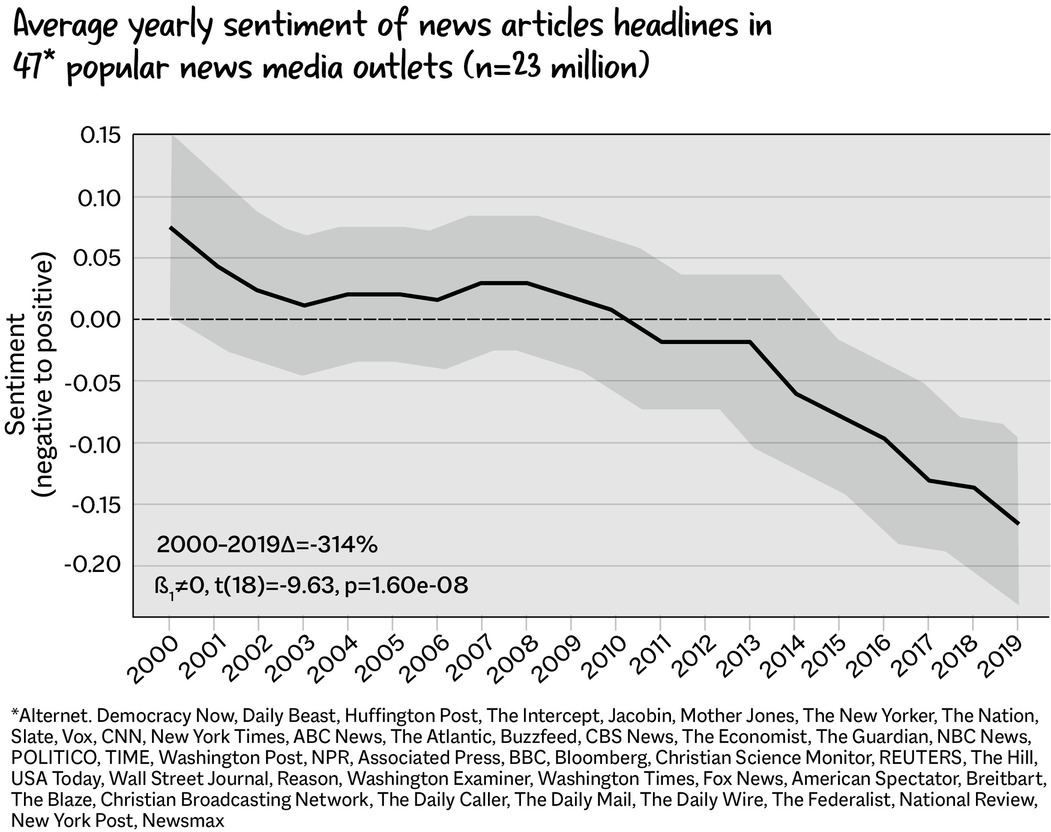
We are constantly getting riled up. The worst part is that the things we get riled up about are often figments of our imagination. They are real, of course, but there is whipped cream on top, fluff and froth to exacerbate each and every issue, so we become reactive, frustrated, and mad.
As Krista Tippett, the host of the podcast On Being, put it, “I don’t actually think we are equipped…to be delivered catastrophic and confusing news and pictures, 24/7. We are analog creatures in a digital world.”
This has created a very deep and prevalent sense of nihilism in the younger generations because they are constantly marketed the idea of Realness—but in the throes of the sociologist Jean Baudrillard’s simulacra and simulation: “We live in a world where there is more and more information, and less and less meaning…. What every society looks for in continuing to produce, and to overproduce, is to restore the real that escapes it.”
The same pundits that imply their wisdom can save the world from ending, hypothetically, are also the people sowing seeds of distrust in the discourse, postulating on Twitter about recessions, and often proclaiming that things are Much Worse Than They Actually Are. The marginal cost of plausible bullshit is effectively zero.
As Anne Applebaum, a reporter at The Atlantic, wrote:
The constant provision of absurd, conflicting explanations and ridiculous lies—the famous “firehouse of falsehoods”—encourages many people to believe that there is no truth at all. The result is widespread cynicism. If you don’t know what’s true, after all, then there isn’t any-thing you can do about it. Protest is pointless. Engagement is useless.
Because of this cynicism, we engage with nostalgia.
Media, Nostalgia, and Consumerism
Commemorating the past feels easier than critically engaging with the present. We like to stay in pristine museum walls versus building new things! Especially because we tend to remember the past as being better than it actually was, and we often treat the present moment as far worse than it actually is.
Reminiscing about the good old days can be a dangerous form of reactivity. Nostalgia isn’t merely a passive act of remembering the past, it’s a reaction to circumstances. In times of political upheaval, technological advancement, and societal changes, people tend to turn toward a past that seems simpler, stable, and familiar. And it’s a process:
-
We reinvent the past: The idea of the past being more unpredictable than the future is a nod to the reinvention of time that we often do in our own heads.
-
And then we remake it: We tend to look back fondly on moments that might not warrant such warmth—but then we go on and remake those feelings with our technology and our movies and our music. As cultural theorist and artist Svetlana Boym wrote in her book The Future of Nostalgia, “technological advances and special effects are frequently used to recreate visions of the past, from the sinking Titanic to dying gladiators and extinct dinosaurs.”
And it’s mostly because we are scared: It’s a form of escapism that protects us from thinking about the overwhelming speed at which we’re hurtling toward some eventual inevitability. Boym again: “Nostalgia inevitably reappears as a defense mechanism in a time of accelerated rhythms of life and upheavals.”
There are three important things to think about when it comes to the psychology of nostalgia, including hope, imagination, stagnation, and nihilism:
-
Hope requires imagination—and imagination requires work.
-
Nostalgia encourages stagnancy, and we are in a cultural moment that reinforces this.
-
As nostalgia deepens, innovative thought becomes rare, and hope for the future shrivels up, consumer sentiment dips. We’ve seen spending habits get weird, with people throwing all their cash into Dogecoin. Nihilism becomes the forcing function for companies and investments because people give up hope, so they just sort of gamble it all away.
To be fair, I do think there is a place for nostalgia! It’s nice to share the past with people, and memories are the foundation of our personhood.
But nostalgia can be a means of abdicating ourselves from the responsibility to imagine and create a better world. It’s a form of forgetting but also of escapism. “The problem with prefabricated nostalgia,” Boym wrote, “is that it does not help us to deal with the future.”
How do you dream about the future when you’re always looking backward? The stories we tell on a broad scale are becoming less inspiring. So we reach for new iterations of the past—the way it “could have been”—hoping that this past will become our future. But we just get stuck in a loop.
Things Are All the Same Now
But from an economic perspective, it can get a bit skewed. As Derek Thompson points out: “It’s crazy how many different forces in Hollywood are pushing toward infinitely recurring IP loops. Original stories need to shoot the moon with reviews and buzz to have a chance at $100m, while middlingly reviewed renditions of familiar IP throw up $200 million without breaking a sweat.”
It’s cheaper to be nostalgic! There’s less risk, both for the consumer and the movie producer. Think of The Super Mario Bros. Movie, the Marvel Cinematic Universe, the Barbie movie, and the constant franchise reboots as the monetization of familiarity. They exist within a risk minimization bubble fueled by economic uncertainty.
Save money. Make more movies. Don’t innovate.
This also results in the commodification of self, a way for us to align with stories and narratives (increasingly told by brands). We begin to define ourselves by what we end up consuming, by brands. Just look at any gym influencer or some of the conversations on various subreddits like r/streetwearstartup and r/DidntKnowIWantedThat about new merch product drops or must-haves.
As we now know, consumer spending is 70% of GDP growth, so think about all the powerful entities who monetarily benefit when we feel loyal to the brands we follow and the products we buy, to the point where they become part of our identities. As technologist and writer Toby Shorin framed it, we have “an economy where culture is made in service of brands. To be even more literal: cultural production has become a service industry for the supply chain.”
It’s almost as if the economic machinery thinks, “Why reinvent the wheel when you can just repolish the old one?” Take the resurgence of 1990s and early 2000s fashion trends: bucket hats, platform shoes, and baggy jeans.
Brands aren’t delving into new territories; they’re digging into their old catalogs and simply re-releasing classic designs. Even the return of vinyl records in a digital age echoes this sentiment. It’s the economics of familiarity. Why chance innovation when the past offers a seemingly guaranteed ROI? In essence, the consumer world is caught in an economically driven nostalgia loop: Recycle, resell, repeat.
What GME Really Meant
In a similar way to nostalgia and consumerism and media literacy, the fate of AMC and GameStop are actually signs of a broader shift, reflecting the ways investing has evolved alongside changes in people’s lives. These instances symbolize more than mere market anomalies; they are indicative of a new era where retail investors and online communities have a significant impact on the stock market’s dynamics.
There is a huge amount of resentment bubbling underneath the surface from people who are frustrated and angry at a system that has abandoned them.
Memefication was also a big part of that time. Memes create a narrative, which ultimately drives value. It doesn’t have to be a narrative about how a company is going to produce a certain amount of revenue; it can just be the power of everyone deciding what is going to happen.
At one point, meme stonks—shares of companies that gain popularity through social media and online forums—accounted for more than 25 percent of all volume traded on the stock market. AMC’s market cap grew to a healthy $33 billion and somehow it became larger than half the other companies in the S&P 500.
The first couple years of the 2020s were haunted by loneliness. We were deep in the throes of the pandemic, and people were desperate for connection. They used the stock market as a way to find community, a tool to connect with other people. Social investing apps became all the rage.
Community drove AMC and GameStop. The power of Reddit gave people a platform to drive the collective belief behind the value of an asset. One way to destroy a system that you don’t believe in is to bet against it.
So the meme stonk era was driven by narratives, by the collective belief behind the value of an asset, which was driven by a craving for community. SPACs, GameStop, and so many money-making methods that arose during that time were the results of people testing the limits, memefying things all in an effort to reimagine wealth generation.
The idea of the financial industry as the gatekeeper of the ivory tower of money is still accurate, but it isn’t as accurate as it used to be. In contrast, memefication is a function of information access, and the market was fueled by that. This weird era demonstrated the growing power of the retail investor, as well as the structural cracks in the markets.
The market was no longer driven by fundamentals, it was driven by memes. It was no longer a metaphor, but a living structure—the stonk market, characterized by a lot of get-rich-quick ideology, loneliness, irrational behavior, and pervasive fear as humans were haunted by those animal spirits.
Economic Inequality and Cooperation
In 2013, Peter Turchin published a paper titled “The Strange Disappearance of Cooperation in America” that explored the idea of inequality driving cooperation. It’s the idea that if people are feeling good, they are generally going to work well together.
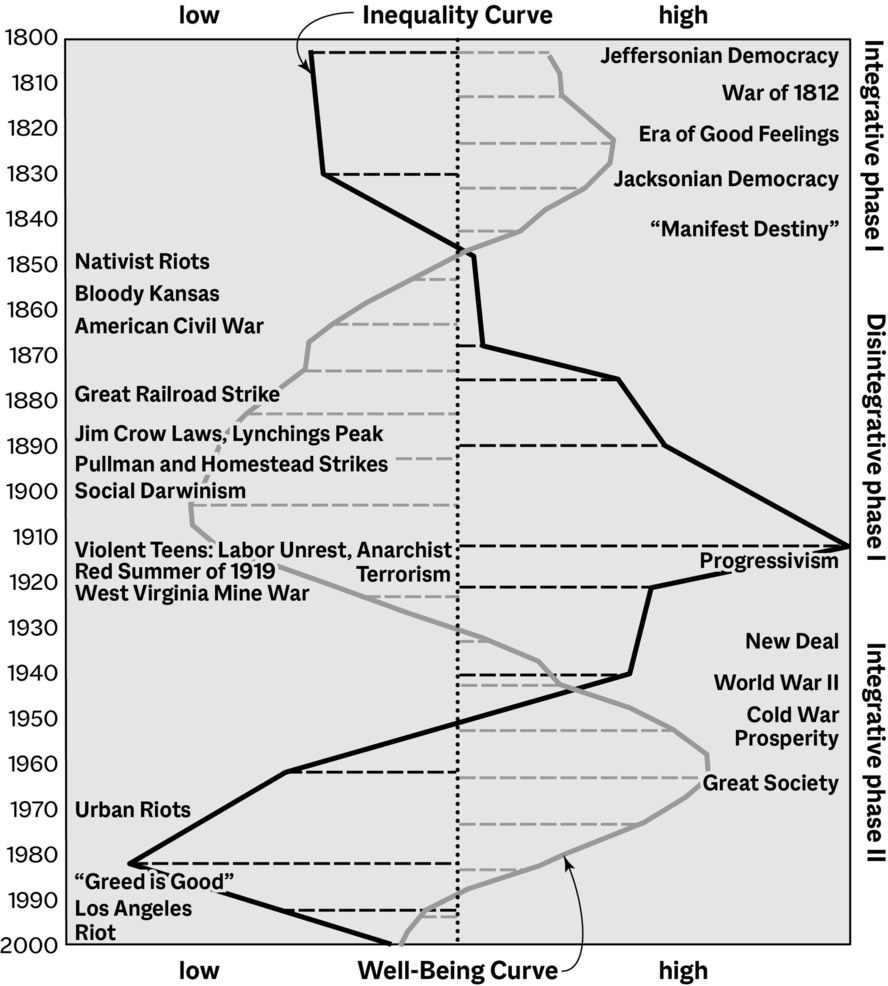
As we all know, economic inequality has increased, as shown by the increase in the income share of the top 1 percent. Political polarization has increased based on the number of filibusters in the Senate.
A few things Turchin highlights in the piece are really important:
You may think that political polarization is not so bad. What’s wrong with different political parties holding strong opinions about how this country should be governed? The problem is, the clash of ideas inevitably leads to the clash of personalities. As political positions become separated by a deep ideological gulf the capacity for compromise disappears and political leaders become increasingly intransigent. The end result is political gridlock, something that became abundantly clear in the last few years, but has been developing over the last few decades…. What we have then, is a “strange disappearance” of cooperation at all levels within the American society: from the neighborhood bowling leagues to the national-level economic and political institutes.
When we talk about setting policy, the idea of cooperation is really important. If people can’t agree on what to do and how to do it, it becomes impossible to do what needs to be done. We need to find ways to cooperate with one another.
When we don’t really understand what is going on but pretend we do, we create systems that trap us further. As Tom Nichols, a staff writer at The Atlantic, tweeted, “There is no bill you can pass, no social program, that will solve the problem of a dentist or realtor who has decided that life is just too goddamn dull and that they’re gonna spice up their week by getting some tactical gear and cosplaying the Second Civil War.”
I’m really fascinated by the lack of cooperation and the polarization and the doomerism—how loud and confidently people will talk about what presumably is the end of their world. I am not sure why there tends to be an undercurrent of “If things collapse, I will be okay because I have gold bars” because if things do end up falling apart, they tend to exist within a state of rubble rather than a state of utility, but alas.
And I get it! The thrill of rooting for downfall, waiting for stocks to go down, and the expectation that “This time, I will be right” or whatever is inherently exciting. But it isn’t useful.
I think it’s okay to say, “Banks are failing, inflation is high, we have existed in a state of excess for years,” because all of these things are true, but to simply bemoan these facts without developing a tangible plan to improve things (even on a micro level) is a passive course of action that yields no process, and, therefore, no results.
Lack of cooperation and doomerism are heavy on the spirit—and they can drown us in ineptitude if we aren’t careful.
So how do we fix it?