Chapter 18
Old Guy and New Theories
And though they can seem dull, these schools of thought affect countless real-world outcomes, because when our politicians and leaders are zealous disciples of a particular doctrine, it shows up in their policy decisions and can have repercussions for generations.
Take, for instance, President Ronald Reagan and trickle-down economics (Reaganomics)—the absurd idea that tax cuts for the wealthy would somehow benefit everyone. When Reagan took office in 1981, the economy was experiencing severe stagnation and high inflation—stagflation. The whole idea of supply side economics is that if a government lowers taxes and decreases regulation, businesses and entrepreneurs will produce more things. So Reagan looked at the economic situation—which desperately needed production of more things—and enacted the Economic Recovery Tax Act (ERTA), as well as the Tax Reform Act.
The idea was that these tax cuts would help everyone—but nothing really flowed down from those who got the tax cuts. Similar story with the Tax Cuts and Jobs Act of 2017—the money basically went right into the stock market, bolstering buybacks and dividends, rather than helping the broader economy.
Economics and politics are very intertwined. There are many ways in which economic events have influenced politics, including the 2008 financial crisis, the Eurozone crisis, Brexit, and the U.S.-China trade war.
-
The Great Financial Crisis of 2008 was the beginning (or perhaps the catalyst) for a rise in populism, as people felt that government leaders didn’t respond properly to the catastrophe.
-
The buckling of Greece, Spain, and Italy raised questions about the financial sustainability of the EU and the constraints of the eurozone.
-
Brexit was a function of the cost of EU membership and regulations, and has resulted in the stagnation of the United Kingdom.
-
The U.S.-China trade war was a function of trade imbalance and the desire to bring manufacturing jobs back to the United States, with profound political implications.
In this chapter, I’ll walk you through the economic theories most relevant to your daily life and provide light on the more controversial theories and their integration into the political landscape.
Classical Economics
Classical economics is a school of thought that emerged during the late eighteenth and early nineteenth centuries. This theory asserts that markets have a natural ability to self-regulate and that government intervention is generally unnecessary. The core assumption of classical economics is the belief in market efficiency, the theory that free markets, driven by supply and demand, will allocate resources efficiently.
It’s a great concept, right? “Just leave it to the markets!” But as you and I are painfully aware, markets are not moral compasses; they are simply moneymaking machines. And that’s fine! But markets end up operating out of the self-interest of those who play a big role in them. This can easily lead to a monopoly, where one firm gains a lot of power and market share over all other firms, which isn’t very free or even a market past a certain point as there are no competitors anymore.
Free markets, or markets where people can conduct business based on their own self-interest and the pursuit of profit, are also fuzzy in the real world. There is a need for societal welfare and stability! The United States is probably one of the freest markets in the world, but we are now seeing some of the consequences of that.
Free markets can exacerbate income and wealth inequality. They can also create externalities like pollution, because making money sometimes matters more than the environment. That gets into short-term focus, profits over sustainability. Public goods, such as education and health, similarly may be deemed “unprofitable” for businesses but are crucial for societal well-being. Additionally, issues like monopolies, anti-competitive behaviors, and the risks associated with excessive corporate power can translate economic influence into political power. Striking a balance between individual pursuits and societal welfare becomes essential.
So is the free market doing what it was supposed to do? A lot of conversations and research papers have been dealing with this for centuries. The eighteenth-century Scottish economist Adam Smith’s “invisible hand,” the idea of laissez-faire, let-it-all-go-with-the-wind ideology, is a guiding force of many classical economics conversations. Producers specialize in what they are good at, making what and how much is needed, creating a beautiful web of interdependence and goodness.
Thomas Malthus, with his rather gloomy predictions about population growth outpacing food supply, instilled a sense of urgency in studying demographic impacts on economies. David Ricardo’s theories on comparative advantage became a cornerstone of international trade principles, suggesting that nations should specialize in producing goods where they hold efficiency over their trading partners. Meanwhile, John Stuart Mill’s work extended economic discussions to include the broader social impacts, and his considerations of equity and justice in the distribution of wealth provided an early bridge between economics and ethics. Together, these thinkers provided the pillars that would support much of economic thought and policy for centuries to come.
It’s very much a chicken-and-egg sort of problem that highlights how complex these conversations can get. If the market is so good at doing its job, it shouldn’t need government support, right? And maybe the government support is somehow politically motivated, because nobody wants a melting stock market on their hands when they’re in office, right? And if the government keeps sticking its nose into stuff, bad firms may remain afloat, creating distorted market signals, and the free market can’t do what it’s meant to do.
Keynesian Economics
The early-twentieth-century English economist John Maynard Keynes and the field of Keynesian economics love the government. Government intervention is everything; it’s perfect and beautiful and lovely. To Keynes, government spending is the way out of recession, a way to get the economy moving and grooving again, a way to reduce unemployment. This theory arose in the 1930s during the Great Depression, when people were devastated by economic collapse. The New Deal, led by President Franklin D. Roosevelt, which pushed for increased government spending on infrastructure development, job creation, and social welfare, is a classic example of Keynesian policy.
Keynes theorized that when consumer confidence needs a boost, money from the government is the boost that people need. It will get them to spend again. The more people spend, the more money is a-flowin’ in the Economic Kingdom. Mandating tax cuts, government spending, and unemployment benefits via expansionary fiscal policy is the solution to saving the sinking ship.
Of course, nothing is ever that simple, and a lot of Keynes’s work highlights that complexity. Excessive government spending can be inflationary, and there is a vibes-based approach to how much government spending is the right amount of government spending. But for Keynes, as long as the government gets things moving again, the economy will recover.
Monetarism
In contrast, monetarism, developed by Milton Friedman and Anna Schwartz, emphasizes the control of money supply to manage the economy. This has caused a number of M2 (a measure of money supply) charts to be posted to Twitter with the “pointing guys” meme. The idea is that if the money supply gets big, so does inflation. “Inflation is always and everywhere a monetary phenomenon,” Friedman said.
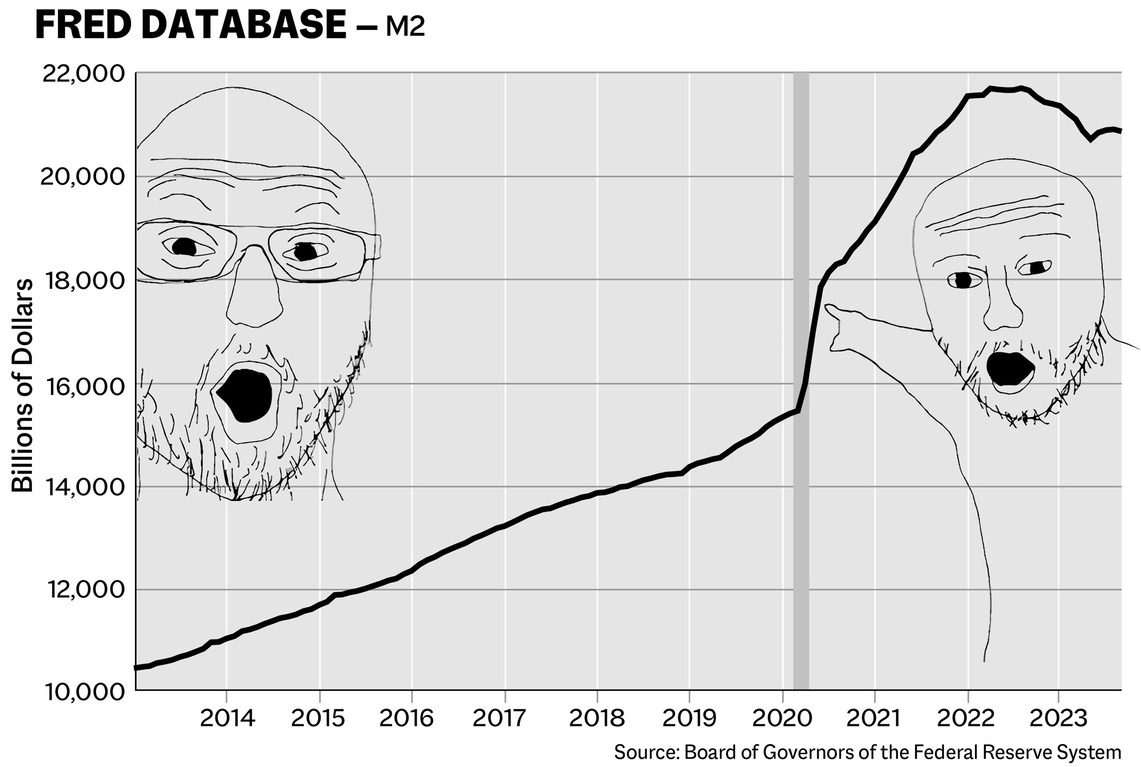
However, this is wrong; 1 percent money growth leads to only about 0.3 percent average higher inflation—it’s not one for one, according to the Bank for International Settlements article “Does Money Growth Help Explain the Recent Inflation Surge?” Inflation is not always and everywhere a monetary phenomenon.
Monetarism falls prey to the same issues that Keynesian economics does: It’s really hard to figure out how much of something is good and how much is bad, and the answer is usually a balance between them!
New Growth Theory
New growth theory (NGT) is a newer economic concept that points out a lot of the human aspects of what people have to deal with. It highlights the role of human desires and unlimited wants in driving economic productivity. People’s constant pursuit of profit creates growth. Human aspirations create economic progress. It challenges the idea that growth is influenced by factors outside our locus of control, such as government policy and technological advances. It recognizes that our capitalistic hamster brains can move the economy forward. NGT says that because we are little money garbage raccoons, we will always be throwing elbows to try to do things better or make new things in order to make a profit. Knowledge is an asset! Innovation should be nurtured!
Of course, this works in theory. But there are lots of questions. Eventually growth has diminishing returns! Growth hacks don’t work forever! Both endogenous (growth driven from within the economy without the need for external forces—innovation, education, and research are key) and exogenous (growth outside the economic system—technological advancements and government policies are key) neoclassical models can’t really explain growth in the long run because they often do not fully account for factors like technological advancements, changes in consumer preferences, geopolitical shifts, or environmental constraints.
Other Theories
There are also theories such as Modern Monetary Theory and Marxism, two very different schools of thought that both revolve around the idea of doing things differently.
Modern Monetary Theory (MMT) focuses on government spending. It says “Let governments spend” under the assumption that governments should be allowed to spend as much as they want, since they can create new money and use various mechanisms, such as raising taxes, to control inflation. The key is that a government, with its own sovereign currency, can’t run out of money the same way people or businesses do because it can just create more. MMT says that the government can embark on a massive spending campaign to correct the economy, funding things such as job creation and public projects, all without immediate concern about creating a deficit. This is a good idea in theory, but in practice, it hasn’t worked out.
Marxism focuses on social classes and the struggles that exist between them. In capitalist societies, the owning class (those who control the means of production, including factories, land, and money) exploit the working class (those who sell their labor for wages). The owning class takes the surplus generated by the workers and uses it to become richer. Members of the working class, who are unable to save any of the surplus for themselves, experience economic inequality and a lack of control over their labor and lives.
To explain this further, imagine the sweet town of Cookieville, where the MegaBite Bakery owns a factory where the bakers Chip and Crumb bake $100 worth of cookies every day. However, they are paid only $20 a day each. The owners of the MegaBite Bakery, even though they don’t bake, take the remaining $60 surplus for themselves just because they control the factory. Though the bakery enjoys its surplus output, Chip and Crumb are economically disadvantaged and unable to increase their small wage because they do not own any of the factory resources. Marxism argues that we should stop this inequality by moving toward a classless society where resources and surplus are distributed equally or according to need. Chip and Crumb must seize the means of production!
A passage in Karl Marx’s Economic and Philosophic Manuscripts of 1844 expands on the above idea—that as we talk about the economy, it’s good to reflect on human well-being:
The less you eat, drink and read books; the less you go to the theatre, the dance hall, the public house; the less you think, love, theorize, sing, paint, fence, etc., the more you save—the greater becomes your treasure which neither moths nor dust will devour—your capital. The less you are, the more you have; the less you express your own life, the greater is your alienated life—the greater is the store of your estranged being.
What Marx was talking about is what we give up for want of “having”: When all this ends, you can’t take your money with you. It’s really easy to get lost in these theories, to think, number one, that the theory is all that matters and that, number two, one must agree with all of it to agree with any of it. But it doesn’t. And you don’t. The world is a series of puzzle pieces, and you are the builder.
Existence is hard, and a lot of economic theory doesn’t capture that because, well, why would it? The book Dancing After Hours by Andre Dubus is an exploration of normalcy—how people exist in the world. There is one section that talks about the shopping cart theory:
“There’s something about taking the cart back instead of leaving it in the parking lot,” she said. “I don’t know when this came to me; it was a few years ago. There’s a difference between leaving it where you empty it and taking it back to the front of the store. It’s significant.”
“Because somebody has to take them in.”
“Yes. And if you know that, and you do it for that one guy, you do something else. You join the world….You move out of your isolation and become universal.” (Author’s emphasis.)
We are increasingly forgetting about our commonalities. Many people have explored the disintegration of communities that has come with suburbanization and social media-ization, but it’s becoming increasingly stark. The complexity scientist Peter Turchin explored this in his 2013 piece “The Strange Disappearance of Cooperation in America,” and so many parts of it still ring true: “What we have then, is a ‘strange disappearance’ of cooperation at all levels within the American society: from the neighborhood bowling leagues to the national-level economic and political institutes.”
We are breaking away from one another. This is not a novel phenomenon—as the piece outlines, the same thing happened in ancient and medieval empires. However, polarization is bad; it leads to less progress and eventual stagnation.
To avoid this, we need a world where participation is incentivized and encouraged versus the zero-sum individualistic culture and focused on innovation that truly makes the world better. There is an element of figuring out how to tap into what people are passionate about and giving them the space to explore it. As George Saunders wrote in Congratulations, by the Way: Some Thoughts on Kindness, “Find out what makes you kinder, what opens you up and brings out the most loving, generous, and unafraid version of you—and go after those things as if nothing else matters. Because, actually, nothing else does.”
We are living in a world of increasing differentials, where our best case is becoming less probable and we are having to develop new models of thinking. We might be all experiencing the “same thing” as our economic world changes around us, but it shows up for all of us differently. And that is important to remember.
Many more economic concepts influence today’s economic analysis, but most of them boil down to “Well, hmm, maybe, actually.” Human behavior is not always predictable and is influenced by various factors, including emotions, social pressures, and individual circumstances. Though economic theory provides a framework for understanding behavior, it may not fully capture the complexity and nuances of real-world human decisions. There is no precise way to analyze phenomena driven by something as goofy as people’s actions.
History has shown us instances where adhering strictly to economic orthodoxy or an established set of economic beliefs that set the precedent for managing economic issues, without room for nuances or flexibility, has led to disastrous outcomes.
For example:
-
The Gold Standard and the Great Depression
Orthodoxy: The gold standard was championed as a mechanism to ensure fiscal discipline and monetary stability because everything would be tied to the value of gold, but during the Great Depression it magnified the crisis by preventing monetary expansion. Countries that left the gold standard earlier recovered faster.
Weakness Highlighted: The belief that fixed exchange regimes (like the gold standard) provide superior economic stability. Even today, debates about fixed versus floating exchange rates get into this idea, with some still advocating for fixed regimes despite the clear lack of flexibility.
-
Austerity Measures in the Eurozone Crisis
Orthodoxy: High public debt leads to economic instability, so austerity (reduced public spending and increased taxes) is necessary for economic recovery and to regain market confidence. But in countries like Greece, austerity (the government not being able to spend to save the economy) led to deep recessions, high unemployment, and social upheaval.
Weakness Highlighted: The assumption that markets always favor austerity in times of crisis, or that the government having discipline with money is always preferable to growth-focused policies. This debate remains relevant as nations grapple with high public debts today.
-
Washington Consensus and Latin America
Orthodoxy: Free-market reforms, privatization, and deregulation are the keys to rapid economic development. While some countries benefited, many saw increased inequality, social unrest, and inconsistent economic growth.
Weakness Highlighted: The idea that there’s a one-size-fits-all blueprint for economic development. Many of the Washington Consensus policies are still advocated for in various forms today, especially by international financial institutions.
-
1997 Asian Financial Crisis
Orthodoxy: Capital account liberalization, or the idea that allowing capital to flow freely across borders is essential for economic growth. Rapid capital inflow followed by sudden outflow contributed to the crisis. Countries with capital controls, like India and China, were less affected.
Weakness Highlighted: The unquestioned belief in the virtues of completely open financial markets. While today there’s broader acknowledgment of the risks, many still argue for free flow of money without sufficient safeguards.
-
Efficient Market Hypothesis and the 2008 Financial Crisis
Orthodoxy: Financial markets are efficient and always reflect all available information. This assumption was the core theory of many financial models and risk assessment tools. The 2008 crisis revealed how markets can be shortsighted, driven by herd behavior, and how financial “innovations” can hide risks.
Weakness Highlighted: Blind faith in market efficiency and the dangers of relying too heavily on models that don’t account for extreme events or irrational behavior. The debate about market efficiency and the role of regulation remains alive today.
In piecing together the valuable aspects of these theories, one common thread emerges: balance. Economic theories can offer essential insights, but they often need to be tempered with a dose of real-world pragmatism. The key for policymakers and economists alike is to blend the wisdom from various theories, apply them judiciously, and remain adaptive to the ever-changing dynamics of the global economy. This adaptability, coupled with a thorough understanding of past lessons, can provide a more comprehensive tool kit for addressing future economic challenges.
Humans are complex, and the world we live in is complex, too. Remember that the next time someone is screaming at you on TV about this being the one problem wreaking havoc on everything. It never is just one thing! A lot of factors end up causing problems—and a lot of factors can be solutions.