Chapter 6
GDP and the Economy
GDP is the total market value of all finished goods and services produced within a country’s borders. It serves as a comprehensive scorecard of a country’s economic health, measuring both (1) the total income in the economy and (2) the total expenditure on what an economy produces (goods and services).
Measuring GDP
GDP is usually expressed in an equation:
GDP = C + G + I + NX
Where
C = consumption
G = government purchases
I = investment
NX = net exports
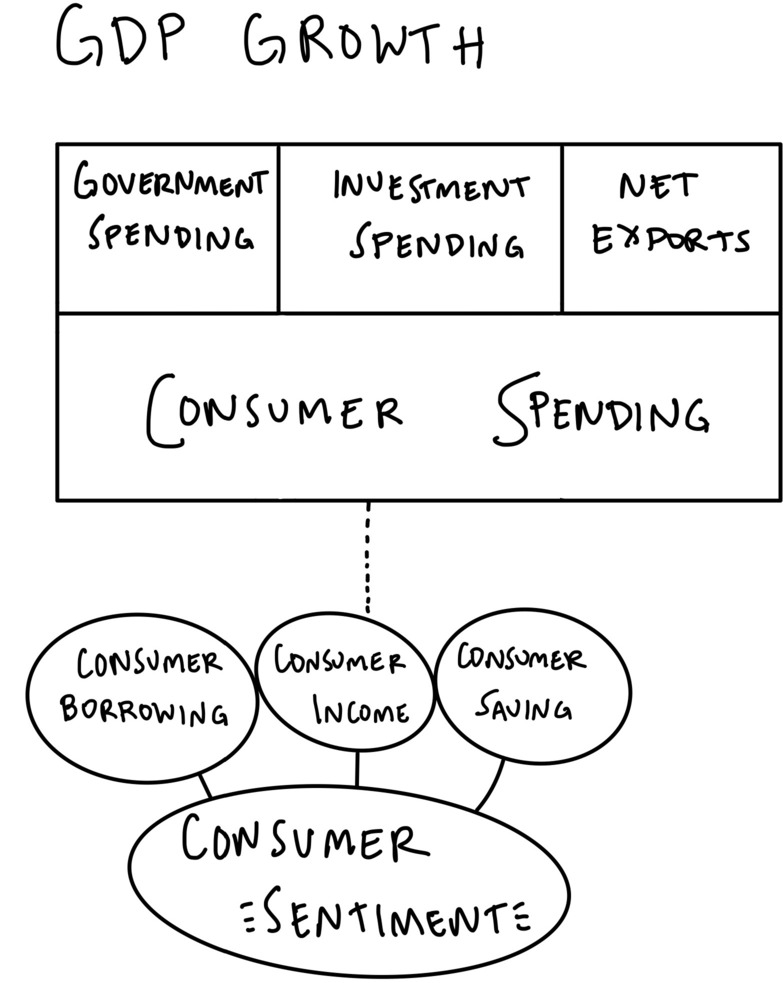
Most economists explain GDP via a pie chart, but I think it makes more sense to explain it with a diagram, where we can zoom in on consumer spending, the most critical component of GDP.
Consumption
This is what people buy. It is normally divided into three main categories: nondurable goods (things that don’t last long, such as food and gasoline), durable goods (things that last a long time, such as cars and furniture), and services (getting things done, such as getting a haircut and going to the doctor). Consumer sentiment serves as a baseline input for all of this, as how people feel about the general economic situation ultimately impacts what they do and buy. Consumer spending is fueled by:
-
Income: How much money people are making in their jobs
-
Borrowing: How much people are borrowing and how often they are using their credit cards to finance purchases
-
Savings: How much people are saving from their income and how much they are spending relative to how much they make
Investment
This is people and businesses spending money on things that will generate economic benefits over a long period. It could be the auto parts factory getting a new machine to produce components faster (this is known as business fixed investment), someone buying a newly constructed house—rather than an old house—(residential investment), or clothing stores stocking up on sweaters for the holiday season (inventory investment).
Government Purchases
Government purchases can range from desks for government offices to tankers for the military. This is money spent directly on goods and services that the government buys, and it excludes government transfers such as stimulus checks, because the money from those goes back into the economy when people spend them.
Net Exports
This is the dollar value of the products that we buy from other countries (imports) minus the dollar value of products that other countries buy from us (exports). Put simply, it refers to all the things that U.S. companies make that are shipped overseas (exports) and all the things that people in the United States buy from overseas (imports). This is used to measure what share of the things consumed or invested in within the United States are produced domestically.
Finally, the difference between nominal and real GDP is pretty important.
-
Nominal GDP: This measures the value of goods and services at current prices, thus including the effects of inflation. It doesn’t provide an accurate picture of economic growth, as price increases can inflate GDP figures without reflecting real output.
-
Real GDP: Adjusted for inflation, it reflects the actual growth in goods and services, offering a more accurate depiction of economic progress.
The Gingerbread Yeti Economy
Let’s say there is a country called Gingerbread Yeti, a booming nation populated by giant gingerbread people who have a strong and growing economy. Its nominal GDP is calculated as follows:
-
Consumption = $17 trillion. The Gingerbread Yeti people are consuming roughly $17 trillion in goods every year! We could further break this down into nondurable goods, durable goods, and services, but the main thing is that the people are spending!
-
Government purchases = $6 trillion. The Gingerbread Yeti government has bought a bunch of military tankers, which contributed to GDP growth.
-
Investment = $5 trillion. Gingerbread Yeti businesses are spending money on new machinery and buying up newly constructed gingerbread houses.
-
Net exports = ($1 trillion). Gingerbread Yeti businesses also sold a lot of goods abroad! However, the country imported more goods than it exported, leading to the negative number.
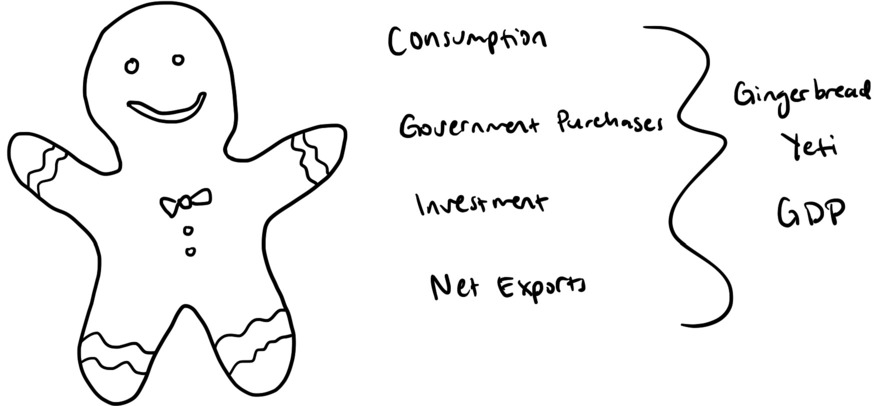
So the nominal GDP of the Gingerbread Yeti economy is roughly $27 trillion. Not bad! Assuming an inflation rate of 2 percent, the Gingerbread Yeti economy has a Real GDP of:
Nominal GDP = $27 trillion
Deflator (1 + the inflation rate) = 1 + 0.02 = 1.02
Real Nominal GDP = Nominal GDP / Deflator Rate = $26.47 Trillion
But how economies grow, including the Gingerbread Yeti Economy, matters. Contrary to popular belief, government debt isn’t always a bad thing. But too much of anything, from Sour Patch Kids watermelon candy to government debt, is harmful.
Debt-Fueled Growth
Fiscal growth, or economic expansion influenced by government policies on spending and taxation, can sometimes lead to short-term increases in nominal GDP. This happens when a government either boosts its spending or cuts taxes, stimulating the economy.
However, this type of growth can often be fueled by increased borrowing, leading to higher national debt. While such debt-fueled growth can initially uplift economic indicators like nominal GDP, it may threaten the economy’s long-term health.
-
When is it okay? Debt-fueled growth is considered healthy when it involves investment in productive assets, when interest rates are low, and when the debt-to-GDP ratio is stable or decreasing. This indicates that the economy is growing in proportion to its debt.
-
When is it not okay? Debt-fueled growth is concerning when debt is already at unsustainable levels with no clear repayment plan. It’s also concerning when creditors lose confidence—meaning that no one trusts that the debt will be used efficiently.
Rating agencies such as Fitch, Moody’s, and S&P play a significant role in determining the path of debt-fueled growth. In August 2023, Fitch Ratings, one of the rating agencies that evaluates government creditworthiness, downgraded the United States due to worries over the national debt and fiscal deterioration. S&P had already downgraded the United States back in 2011 because of the government shutdown fiasco over the debt ceiling.
Fitch pointed out that legislators seemingly did not care that there was no safety net for Social Security and Medicare costs despite the rapidly aging population, as well as the lack of a medium-term fiscal framework, complex budgeting, and the continued fights over the debt ceiling. It also cited concerns over rising interest expenses. The Fed was raising rates to battle inflation, but that had created a substantial burden for the U.S. government to make the payments on government debt. Interest expenses surged in 2023, growing by about 50 percent to $1 trillion.
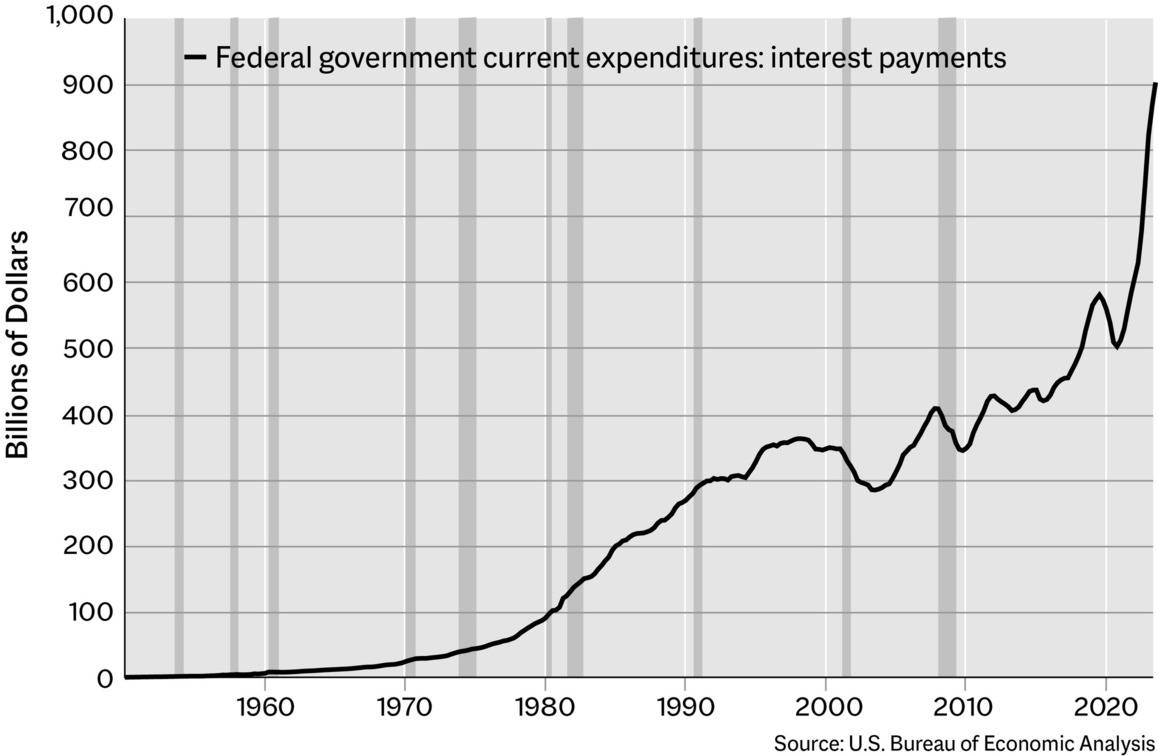
Basically, Fitch was saying, “The U.S. debt situation kind of sucks, and it’s only getting worse.” But GDP is growing, so everything is okay, right?
Right?
What Does GDP Really Mean?
There’s a point to be made that GDP is not a reliable measure of our economy in a social-media, hyper-online, tech-driven world. That seems like a big thing to write about in an economics-oriented book, but the big thing that’s important for you to take away is that our economy has changed, but our measurement methodology hasn’t.
What does it mean to have a “strong” GDP? Does it mean that people are healthy and happy (what even is happiness?), or does it just mean that they are spending money? And if they are spending money, does that somehow mean that they are happy and healthy?
There are a few different ways to slice and dice the data.
Real GDP per capita (remember, we want to control for inflation, which is why we are using real and not nominal GDP) is a preferred measure of calculating consumer well-being. This is a country’s total GDP divided by its population. It tells us how much an average person can buy in a year. It measures the economic output per person.
Productivity is another possible measure. This is a driving force of economic growth that is equal to the ratio between output volume and input volume and therefore shows how efficiently labor and capital—such as factories and equipment—are used to produce something.
The Productivity Paradox
GDP might not be an accurate reflection of the economy. Many people have written about how GDP kind of sucks, but a more important consideration is how the suck manifests in our lives. When we use metrics that kind of suck and those metrics say that things suck, we get a double dose of suck. This margin of suck is essential: If the metric can’t even measure how much things suck but then loudly underscores that yes indeed, things suck, it is a very bad combination for consumer sentiment!
We live in a consumption-on-demand world, with our lives designed around the presumption that we can and should be constantly consuming—fast fashion, shopping malls, and advertising being the main revenue models of many of our big tech and retail companies. Everything can be bought quickly—and discarded quickly, too.
This is another trade-off of economic growth. It’s really nice to have a big, booming economy, as the Gingerbread Yeti people do, but there are costs to unconstrained bigness and boomness. One of the biggest prices we pay lies in our tendency to focus on short-term gains at the expense of long-term stability. Currently, we are seeing this play out in the form of severe harm to our climate and workers’ mental health, and the phenomenon of “planned obsolescence.” This is the hyper-consumptionist concept of intentionally designing products to have a limited life span—a strategy that so many companies have implemented to increase their profits.
Think about how silly it is that we “need” to buy a new cell phone every few years because the phone simply stops working. Reflect on the alarming reality that global temperatures keep rising and have reached 2.5°C above preindustrial averages, putting 30 percent of the earth’s species at risk in areas surpassing their thermal adaptation thresholds. Think about the countless workers experiencing severe burnout who don’t have enough sick days to take time off work to recover.
Growth at Any Cost
Growth at any cost isn’t humane. When we put the economy ahead of human lives, it creates perverse incentives that benefit only a few (usually the very wealthy). A few schools of thought—including degrowth, ecological economics, postgrowth, and more—challenge the idea of GDP as the main measure of progress.
-
Degrowth: This philosophy asserts that in order to address environmental issues and social inequalities, advanced economies need to reduce their scale of production and consumption. Instead of focusing on “growing” the economy, it emphasizes creating an economy that meets human needs within ecological limits.
-
Ecological Economics: This school of thought focuses on sustainability. It posits that economies are bound by environmental limits and that we should aim for an equilibrium rather than perpetual growth.
-
Postgrowth: This theory suggests that societies can achieve prosperity and well-being without perpetual economic expansion. It emphasizes the importance of developing new indicators of progress, ones that better reflect societal well-being and ecological health.
They propose that progress should be evaluated based on the quality of life, equal access to resources, and the environmental impacts of human activity. Going back to the point about spending money versus being happy, we constantly focus on the idea of the Capital-C Consumer as a tool for economic growth, which has worked in the past, but at a cost. It’s no secret that consumerism, the focus on material possessions and the endless pursuit of economic growth, isn’t really that great for either us or the planet. There is a passage from Matt Haig’s Notes on a Nervous Planet that’s always stuck with me:
If everyone is spending hour after hour on their phones, scrolling through texts and timelines, that becomes normal behavior…. If everyone is maxing out their credit cards to pay for things they don’t really need, then it can’t be a problem. If the whole planet is having a kind of collective breakdown, then unhealthy behavior fits right in. When normality becomes madness, the only way to find sanity is by daring to be different. Or daring to be the you that exists beyond all the physical clutter and mind debris of modern existence.
In a world that sees us merely as vectors for economic growth, how can we truly be ourselves?
Looking to the Future
The way that we think about the economy is going to have to evolve. It probably can’t be based on Big Growth forever. As economists at the Federal Reserve Bank of Dallas wrote in 2022, “As trend GDP growth slows due to aging demographics and slower productivity gains, there may be more frequent periods of negative GDP growth without an increase in unemployment, making the distinction between increasing slack and declining activity more relevant than in the past.” (Author’s emphasis.)
A rising GDP often signifies economic growth, and nations worldwide have long pursued policies to boost this number. However, as we grapple with global challenges such as climate change, income inequality, and diminishing natural resources, there is a growing awareness that we need a rethinking of success that goes beyond our current economic metrics—a global consensus for change. It’s becoming increasingly clear that GDP alone may not be a holistic measure of well-being or societal progress.
So when we talk about “growth,” and GDP, we must consider all of these other policies—safety nets, fiscal frameworks, budgeting, and more. Growth doesn’t matter if there is nothing to support people. Of course, as I’ve discussed extensively, data shape our reality—but a large portion of the data are influenced by vibes. And if the vibes get worse, so will the economic reality. As Terry Pratchett wrote in Night Watch:
Tomorrow the sun will come up again, and I’m pretty sure that whatever happens we won’t have found Freedom, and there won’t be a whole lot of Justice, and I’m damn sure we won’t have found Truth. But it’s just possible that I might get a hard-boiled egg.
We seek many things. The simplest ones, such as hard-boiled eggs, are usually the most reliable, especially compared to more complicated ones such as Freedom, Truth, and GDP.