CHAPTER TWENTY-SEVEN
The Links of Interdependent Co-Arising
Interdependent Co-Arising (pratitya samutpada, literally “in dependence, things rise up”) is a deep and wonderful teaching, the foundation of all of Buddhist study and practice. Pratitya samutpada is sometimes called the teaching of cause and effect, but that can be misleading, because we usually think of cause and effect as separate entities, with cause always preceding effect, and one cause leading to one effect. According to the teaching of Interdependent Co-Arising, cause and effect co-arise (samutpada) and everything is a result of multiple causes and conditions. The egg is in the chicken, and the chicken is in the egg. Chicken and egg arise in mutual dependence. Neither is independent. Interdependent Co-Arising goes beyond our concepts of space and time. “The one contains the all.”
The Chinese character for cause  has the character “great” inside of a rectangle. Cause is great, yet, at the same time, limited. The Buddha expressed Interdependent Co-Arising very simply: “This is, because that is. This is not, because that is not. This comes to be, because that comes to be. This ceases to be, because that ceases to be.” These sentences occur hundreds of times in the discourses of both the Northern and Southern transmissions. They are the Buddhist genesis. I would like to add this sentence: “This is like this, because that is like that.”
In the sutras, this image is given: “Three cut reeds can stand only by leaning on one another. If you take one away, the other two will fall.” For a table to exist, we need wood, a carpenter, time, skillfulness, and many other causes. And each of these causes needs other causes to be. The wood needs the forest, the sunshine, the rain, and so on. The carpenter needs his parents, breakfast, fresh air, and so on. And each of those things, in turn, has to be brought about by other conditions. If we continue to look in this way, we’ll see that nothing has been left out. Everything in the cosmos has come together to bring us this table. Looking deeply at the sunshine, the leaves of the tree, and the clouds, we can see the table. The one can be seen in the all, and the all can be seen in the one. One cause is never enough to bring about an effect. A cause must, at the same time, be an effect, and every effect must also be the cause of something else. Cause and effect inter-are. The idea of a first or only cause, something that does not itself need a cause, cannot be applied.
After the Buddha passed away, many schools of Buddhism began to describe Interdependent Co-Arising more analytically. In the Visuddhimagga (Path of Purification) of the Theravada School, Buddhaghosa listed twenty-four kinds of “conditions” (Pali: paccaya), “the necessary and sufficient conditions for something to arise”: (1) root-cause, (2) object, (3) predominance, (4) priority, (5) continuity, (6) co-nascence, (7) mutuality, (8) support, (9) decisive support, (10) pre-nascence, (11) post-nascence (a cause can be born after the effect), (12) repetition, (13) karma, (14) karma-result, (15) nutriment, (16) faculty, (17) dhyana, (18) path, (19) association, (20) dissociation, (21) presence, (22) absence, (23) disappearance, and (24) non-disappearance.
In the Sarvastivada School, four kinds of conditions (pratyaya) and six kinds of causes were taught, and this later became part of the teachings of the Vijñanavada School of Buddhist psychology. According to this analysis, all four kinds of conditions must be present for every thing that exists.
The first of the four kinds of conditions is the “cause condition,” “seed condition,” or “root condition” (hetu-pratyaya), just as the seed is the cause condition of the flower. There are said to be six kinds of “cause conditions”:
(1) Motivating or creative force (karana-hetu). Each conditioned dharma is the “general cause” for all things except itself. It is a copresent cause, offering no obstacles, because no dharma constitutes an obstacle to the arising of dharmas prone to arising. This condition has the function of empowering and not restricting.
(2) Concurrent condition (sahabhu-hetu). Sometimes two root conditions need to be present at the same time. If we draw a line “AB,” A and B both have to be there. The same is true of lamp and lamplight. All pairs of opposites are like that; one cannot be present without the other. Above and below come into existence at the same time, as do the ideas “being” and “nonbeing.” These coexistent dharmas mutually condition one another.
(3) Seed condition of the same kind (sabhaga-hetu). Similars cause similars. Rice produces rice. Wholesome causes bring about wholesome effects. Faith and joy, for example, make a stable practice possible. And unwholesome causes bring about unwholesome effects.
(4) Associated condition (samprayukta-hetu). A wholesome and an unwholesome seed support each other in giving rise to something. This is called “association” or “correspondence,” and it applies only to mental events. Someone gives money to his church because he feels guilty about the wrong livelihood that has allowed him to make the money. The seed of guilt due to wrong livelihood is unwholesome. Giving is wholesome. The result is that the elders of the church tell him that they want him to transform his livelihood more than they want his money. This will hurt his pride, but can lead to much happiness in the future and can help alleviate his guilt.
(5) Universal condition (sarvatraga-hetu). The cause is present everywhere, in every part of our body as well as throughout the universe. The Six Elements of earth, water, fire, air, space, and consciousness are examples of universal conditions.
(6) Ripening condition (vipaka-hetu). In our store consciousness, not everything ripens at the same time. When we bring home bananas, some ripen before the others. When we hear a Dharma talk, some of the seeds sown ripen right away, while others might take many years. A seed of one kind can also transform and ripen into something different. At first, an orange is a blossom, then it is something green and sour, and later it ripens into a sweet fruit. A seed of love can ripen as a seed of anger. When we begin our sitting meditation, we may feel confined and agitated. After a while, our meditation may ripen into something quite relaxing and enjoyable.
The second kind of condition, according to the Sarvastivadins, is called “condition for development” (adhipati-pratyaya). This can help certain seeds develop or can obstruct their development. Everyone has a seed of faith, or confidence, for example. If you have friends who water this seed in you, it will grow strong. But if you meet only favorable conditions, you will not realize how precious this seed is. Obstacles along the path can help our determination and compassion grow. Obstacles teach us about our strengths and weaknesses, so that we can know ourselves better and see in which direction we truly wish to go. One could say that the Buddha’s practice of austerity was unfavorable to the development of his path, but if he had not undertaken those practices and failed in them, he would not have learned and later taught the Middle Way. When your intention is strong, unfavorable conditions will not dishearten you. In difficult moments, you will stick to your friends, fortify your convictions, and not give up.
The third kind of condition is the “condition of continuity” (samanantara-pratyaya). For something to exist there needs to be a continuous succession, moment after moment. For our practice to develop we need to practice every day — walking meditation, listening to Dharma teachings, practicing mindfulness of the four foundations in all our activities, staying with the same Sangha, and practicing the same teachings. If we put a frog on a plate, it will jump right off. If you do not practice steadily, you’ll be like a frog on a plate. But when you decide to stay in one place until your practice fully develops, we can say that you have reached the state of “froglessness” and have begun to practice “continuity.”
The fourth kind of condition is “object as condition” (alambana-pratyaya). If there is no object, there cannot be a subject. For us to have confidence, there has to be an object of our confidence. When we feel despair, we feel despair about something — our idea of the future, our idea of happiness, or our idea of life. When we are angry, we have to be angry at someone or something. According to the Buddha, all phenomena are objects of mind. When we perceive the image or sign of any phenomenon, we know that the object of our perception resides within our own consciousness.

Can we live in a way that helps us see the causes that are present in the effects and the effects that are present in the causes? When we see this way, we begin to have insight into Interdependent Co-Arising, and this is Right View. In early Buddhism, we speak of Interdependent Co-Arising. In later Buddhism, we use the words interbeing and interpenetration. The terminology is different, but the meaning is the same.
After hearing the Buddha teach about Interdependent Co-Arising, Ananda said, “Venerable Lord, the teaching of Interdependent Co-Arising appears to be deep and subtle, but I find it quite simple.” The Buddha replied, “Do not say that, Ananda. The teaching of Interdependent Co-Arising is indeed deep and subtle. Anyone who is able to see the nature of Interdependent Co-Arising is able to see the Buddha.”1 Once you can see into the nature of Interdependent Co-Arising, you will be guided by your insight and you will not lose your practice.
The teaching of impermanence is implicit in the teaching of Interdependent Co-Arising. How could we live if we were not nourished by multiple causes and conditions? The conditions that make it possible for us to exist and to change come from what is not us. When we understand impermanence and nonself, we understand Interdependent Co-Arising. In this gatha, Nagarjuna links Interdependent Co-Arising with emptiness:
All phenomena that arise interdependently,
I say that they are empty.
Words come to an end, because their message is false.
Words come to an end, because there is a Middle Way.2
All teachings of Buddhism are based on Interdependent Co-Arising. If a teaching is not in accord with Interdependent Co-Arising, it is not a teaching of the Buddha. When you have grasped Interdependent Co-Arising, you bring that insight to shine on the three baskets (tripitaka) of the teachings.3 Interdependent Co-Arising allows you to see the Buddha, and the Two Truths4 allow you to hear the Buddha. When you are able to see and hear the Buddha, you will not lose your way as you traverse the ocean of his teachings.
Interdependent Co-Arising: “this is because that is and this is not because that is not,” is one of the most important of all Buddhist teachings. The insight into Interdependent Co-Arising can enable the practitioner to understand interbeing, the Middle Way, and nonduality. The Buddha presented the teachings on Interdependent Co-Arising in many different ways and using a number of striking images, like the image of two bundles of reeds leaning on each other to support each other. The image of Indra’s Net is also very beautiful.
The Teaching of the Twelve Links of Conditioned Genesis Is Designed to Explain Karma and Samsara
The Twelve Links, which we see repeated one hundred or more times in the sutras, are one way to explain Interdependent Co-Arising, but not necessarily the best.
Most students of Buddhism think that the Buddha taught there are twelve links (nidanas) in the “chain” of Interdependent Co-Arising.5 Looking into the explanations of the Twelve Links, we shall see that the way they have been explained by many ancestral teachers has not helped us to go from the historical into the ultimate dimension. The secret of skillful adaptation lies in looking deeply in order gradually to be able to let go of ideas of being and nonbeing, birth and death. Teachings that do not help us let go of these notions cannot help us to enter the space that lies outside of the conceptual realm.
In the Katyayanagotra Sutra (Samyukta Agama 301) the sentence: “This is because that is” is able to help us skillfully to be in contact with emptiness. (This sutra is equivalent to Kaccanagotta Sutta in the Samyutta Nikaya, SN 12:15, translated as Discourse on the Middle Way in the Plum Village chanting book.)6 Even though this sentence uses words like “is,” “is not,” “this,” “that,” still it helps us to let go of these notions while the Twelve Links cling to the notions of being and nonbeing. The Twelve Links are ignorance, formations, consciousness, mind/body, six senses and sense objects, contact, feeling, craving, grasping, being, birth and old age, and death.
The way the Twelve Links have been explained does not belong to the deep teachings of the Buddha and cannot help us be in contact with emptiness. Here we have to use the methodology of the reliance (see this page) that says: “Rely on the deep-meaning sutras and not on the superficial-meaning sutras.” The superficial meaning is not necessarily wrong, but its function and role are other. The Twelve Links are used in the sutra to explain karma and samsara and not to put us in contact with emptiness and the space of the ultimate dimension.
Cause and Result in the Three Times and on Two Levels
The ancestral teachers have divided the Twelve Links into the three times: past, present, and future. Ignorance and formations belong to the past; consciousness, mind/body, the six-sense fields, contact, feelings, craving, grasping, and being belong to the present; and birth, old age, and death belong to the future. It is said that because in our former lives we were ignorant and had made formations (explained as karma), in this life we have consciousness, psyche-soma, six-sense fields, contact, feelings, craving, grasping, and being. Because there is being in this life, in the next life we shall have to be born, grow old, and die, and we shall have to continue in samsara. Ignorance and karmic formations are the cause in the past. Consciousness, psyche-soma, six-sense fields, contact, feelings, craving, grasping, and becoming are the result in the present. Feelings, craving, grasping, and being in the present will be the cause of birth, old age, and death in the future. These are the two levels of cause and result.
This is the way teachers of the past and many teachers today explain the Twelve Links. It is said that dependent on ignorance there is consciousness; dependent on consciousness, there is the mind/body; dependent on the mind/body, are the sense organs and objects; dependent on the sense organs and objects, is contact; dependent on contact, is feeling; dependent on feeling, is craving, dependent on craving, is grasping; dependent on grasping, is being; dependent on being, we have to be born again and die and continue in the cycle of samsara.
This is the understanding of most Vietnamese and Chinese Buddhists concerning the Twelve Links. But it leads to a serious misunderstanding: because there is craving and grasping there is being. Because there is being, we have to be born and die again and again. Bhava is being and the opposite is nonbeing, abhava. We make “being” the culprit, and think that the path to liberation is nonbeing and that we must practice in order to realize nonbeing. However, the Buddha taught clearly that both being and nonbeing are wrong views. People say if you want to avoid the cycle of birth and death (samsara) you have to come to nonbeing and therefore the aim of a Buddhist practitioner is annihilation or eternal death.
Sometimes the Buddha talks of only four, five, six, or seven links and there seems to be no need for Twelve Links. In the Mahavibhashashastra, volume twenty-four, it says: “Because the Buddha deeply understood the different capacities of living beings, he taught Interdependent Co-Arising in many ways. Sometimes he taught one link, sometimes two, three, four, up to twelve.” The four links are: ignorance, formations, being (and nonbeing), and birth (and death).
The Twelve Links have been described and commented on in a linear way as a vertical chain so that one link just gives rise to the next link, which makes the interdependent character of all the links difficult to see. The second link of the twelve (samskara in Sanskrit) has been explained as volitional actions. Samskara in Buddhism does not mean action, but formations: physical, physiological, and psychological phenomena. In the Twelve Links, people have been forced to explain formations as impulses, mistaken impulses, or volitional actions, but that is forcing a new meaning on the word because people wanted to show that consciousness arises from past action. But the Twelve Links were not taught by the Buddha to justify a theory of the cycle of samsara or birth and death. When we say that formations condition consciousness, we mean that in ignorance we construe formations as being separate realities outside of each other. This way of looking at things makes discriminatory consciousness possible, and at the same time discriminatory consciousness makes seeing formations as separate realities possible.
According to the traditional explanation of the Twelve Links, feelings lead to craving. That is only part of the truth because only pleasant feelings lead to craving, and that is only true of people who do not practice and people who do not have wisdom. Someone who practices like a Buddha, an arhat, or an enlightened lay person knows that pleasant feelings can lead to suffering and are dangerous, and so those feelings do not lead to craving.
So this link only presents part of the truth. If it is a painful feeling, it will lead to avoidance, aversion. So if we want to present the true spirit of Buddhism, we have to say that contact leads to pleasant and painful feelings, and that feelings can lead to hatred and aversion and not always to craving and grasping. Grasping means being attached to, being bound by, or craving. Craving is not just craving for being. It can also be craving for non-existence. People who do not want to live or who commit suicide long for nonbeing.
In the Digha Nikaya (DN 22), the Buddha teaches three kinds of craving (tanha): thirst for the desire realm (kama-tanha), thirst for existence (bhava-tanha) and thirst for nonexistence (vibhava-tanha). The aim of our practice is to go beyond existence and nonexistence, not just to go beyond existence. The Twelve Links of Interdependent Co-Arising as they are usually explained are not able to show that.
In the Katyayanagotra Sutra, the Buddha teaches that Right View is the view that goes beyond being and non-being. According to the usual explanation of the Twelve Links, there is just the desire to escape from being. This gives rise to a huge misunderstanding, and people say that Buddhism just aims at removing being in order to arrive at nonbeing, and that Buddhism is a path that teaches nihilism, so that the aim of a Buddhist practitioner is nothingness, eternal death.
Tens of Western scholars who studied Buddhism at the end of the nineteenth and beginning of the twentieth century have come to this conclusion. They say that to overcome samsara means that on attaining arhatship, the saint will never be born again. One of the reasons for this huge misunderstanding is the mistaken transmission of Buddhist teachings by Buddhists themselves.
Therefore instead of saying that grasping leads to being, we should say that grasping leads to being and nonbeing. Being and nonbeing, according to the Katyayanagotra Sutra, are two ideas that obscure Right View. Instead of saying that being leads to birth, we should say that being and nonbeing lead to birth and death. In our head, we have become used to the idea that when we are born we come into being out of nonbeing and when we die we go from being into nonbeing. If we remove the idea of being and nonbeing, there is no more idea of birth and death. That is a way of looking from the cognitive point of view and not the etiological.
Interdependent Co-Arising is pointing to an understanding of cognition and is not an attempt to explain a dogma or theory. The aim of the Twelve Links as we now have them in so many sutras is to explain the phenomenon of samsara and rebirth for people of average understanding.
The Buddha usually began the Twelve Links with old age and death to help us get in touch with suffering and find its roots. This is closely linked to the teachings and practice of the Four Noble Truths. It was after the lifetime of the Buddha that teachers more often than not began with ignorance, to help prove why there is birth and death. Ignorance became a kind of first cause, even though the Buddha always taught that no first cause can be found. If ignorance exists, it is because there are causes that give rise to and deepen ignorance. The Buddha was not a philosopher trying to explain the universe. He was a spiritual guide who wanted to help us put an end to our suffering.
When we hear from commentators that some links are causes (namely ignorance and formations), and others are effects (namely birth and old age and death), we know that this is not consistent with the Buddha’s teaching that everything is both a cause and an effect. To think that ignorance gives rise to formations, which later give rise to consciousness, which then gives rise to mind/body would be a dangerous oversimplification. When the Buddha said, “Ignorance conditions formations,” he meant that there is a relationship of cause and effect between ignorance and formations. Ignorance nourishes formations, but formations also nourish ignorance. The tree gives rise to and nourishes its leaves, but the leaves also nourish the tree. Leaves are not just the children of the tree. They are also the mother of the tree. Because of the leaves, the tree is able to grow. Every leaf is a factory synthesizing sunshine to nourish the tree.
The interbeing of leaf and tree is parallel to the interbeing of the Links of Interdependent Co-Arising. We say that ignorance conditions formations, but ignorance also conditions consciousness, both through formations and directly. Ignorance conditions mind/body as well. If there were no ignorance in mind/body, mind/body would be different. Our six organs and the six objects of these organs also contain ignorance. My perception of the flower is based on my eyes and on the form of the flower. As soon as my perception becomes caught in the sign “flower,” ignorance is there. Therefore, ignorance is present in contact, and it is also present in feelings, craving, grasping, coming to be, birth, and old age and death. Ignorance is not just in the past. It is present now, in each of our cells and each of our mental formations. If there were no ignorance, we would not become attached to things. If there were no ignorance, we would not grasp the objects of our attachment. If there were no ignorance, the suffering that is manifesting right now would not be there. Our practice is to identify ignorance when it is present. Grasping is in formations, feelings, coming to be, birth, and old age and death. Our infatuations, our running away from this or toward that, and our intentions can be seen in all the other links. Every link conditions every other link and is conditioned by them.
With this understanding, we can abandon the idea of a sequential chain of causation and enter deeply the practice of Interdependent Co-Arising that will help us be in touch with the ultimate dimension. It is not that consciousness is there before mind/body, but that consciousness and mind/body inter-are. The six fields of the senses are part of mind and body, they are not just a result of mind/body.
Moreover, craving is not the only mental formation that accompanies feeling. Sometimes a feeling is not accompanied by craving, but by aversion. Sometimes the feeling is not accompanied by ignorance, but by understanding, lucidity, or loving kindness, and the outcome will not be craving or aversion. To say that feeling brings about craving is not precise enough. Feeling with attachment and ignorance brings about craving. In any description of the links, whether it is four, five, nine, ten, or twelve links, we must link each link with all the other links. This is what the Heart Sutra means when it tells us, “No interdependent origins.” The Links are “empty,” because each of them would not exist without all the others. Feeling cannot be without craving, grasping, being, birth, old age and death, ignorance, formations, and so on.
The usual way of presenting Interdependent Co-Arising in terms of the Twelve Links is not enough to help people be in touch with the true Right View; in other words, the view that goes beyond being and nonbeing, birth and death, eternal and annihilated, coming and going, etc. Right View is the foundation of the Noble Eightfold Path, the royal road that leads to nirvana. Right View is not just the belief in the fruits of good and evil action. It is the highest insight for the practitioner of the spiritual path. It is the insight into no birth, no death; no defiled, no immaculate; no being, no nonbeing; no same, no different; no coming, and no going. It is the insight into Interdependent Co-Arising that puts an end to all extreme views, all discrimination, all division, which are the root of all afflictions like fear, resentment, despair, and craving. Without Right View, it is not truly possible to have Right Thinking, Right Speech, Right Action, and all the other seven limbs of the Noble Eightfold Path.
Not only is the doctrine of the Twelve Links as it is usually taught unable to help us come to that insight, but it also leads us to the harmful misunderstanding that the aim of the practice is eternal death. This wrong view has been held by so many people, including a monk disciple of the Buddha named Yamaka, and the Twelve Links have been inserted into many sutras where they do not belong. These sutras are, to name a few: the Katyayanagotra Sutra (Samyukta Agama 301), Skillful Adaptation Connecting to Emptiness (Samyukta Agama 293), Teaching on Great Emptiness (Samyukta Agama 297), Interdependent Co-Arising of Phenomena (Samyukta Agama 296), Absolute Truth of Emptiness (Samyukta Agama 297).
The purpose of all these sutras is to propound the absolute truth, and inserting the Twelve Links into them causes inconsistencies, if our understanding of the Twelve Links is the normal understanding of a linear progression, which cannot help us be in touch with emptiness, nirvana, and true understanding. The Sutra on Skillful Adaptation Connecting to Emptiness is specifically about touching emptiness through Interdependent Co-Arising. The formula sunyata-prati-samyukta-pratityasamutpada-anulomata means precisely “the skillful adaptation of Interdependent Co-Arising is able to lead us into being in touch with emptiness.” If the links are to help us be in touch with emptiness, they have to be understood in terms of the deepest teachings of the Buddha and not as an explanation of rebirth in the cycle of samsara.
Tidying Up the Links
It is time for us to present the teaching of Independent Co-Arising in a way that is easy and approachable for people of our time.
In the light of what has been said above, we can present a teaching of the Ten Links that can help us be in touch with emptiness. The Ten Links are as follows:
(1) Ignorance
(2) Formations
(3) Consciousness
(4) Mind/body
(5) Pleasant and painful feelings
(6) Craving and aversion
(7) Grasping and rejecting
(8) Being and nonbeing
(9) Birth and death
(10) Samsara
You will see that this schema does not have the links of the six-sense fields and contact. That is because these links are already understood as being part of formations, consciousness, and mind/body. Since birth and death are conceptually so close to each other, they are one link, and samsara, the cycle of bondage, has been added as the tenth link.
We can explain the Ten Links as follows: when there is ignorance, people see formations (in terms of separate entities lying outside of each other); because of this, they see consciousness as the subject (separated from its object); they see body separated from mind; there are pleasant, neutral, and painful feelings based on body and mind; co-arising with these feelings come the craving (if they are pleasant) and the aversion (if they are painful); with this arises the desire to grasp or to reject. With this arises the attachment to ideas of being and nonbeing, and as a result of this we are continually imprisoned in the idea of birth and death; we have to cycle in samsara and are not able to realize nirvana. Strictly speaking, the two links of consciousness and mind/body are not necessary, because formations include the Five Skandhas that have all aspects of body and consciousness, but in some cases to add them in can make for more clarity.
We study Interdependent Co-Arising in order to diminish the element of ignorance in us and to increase the element of clarity. When our ignorance is diminished, craving, hatred, pride, doubt, and views are also diminished; and love, compassion, joy, and equanimity are increased. In other words, the transformation of ignorance leads to the transformation of all other links in the chain or the transformation of any of the links entails the transformation of all the others. If we can guard the six senses and practice mindfulness of feelings and perceptions, we can also transform the rest of the cycle, including ignorance.
As you can see, there is also a positive side to the links, although Buddhist teachers since the time of the Buddha seem to have overlooked this. We need to find words to describe the Interdependent Co-Arising of positive states of mind and body, and not just of negative states. The Buddha taught that when ignorance ends, there is clear understanding. He didn’t say that when ignorance ends, there is nothing.
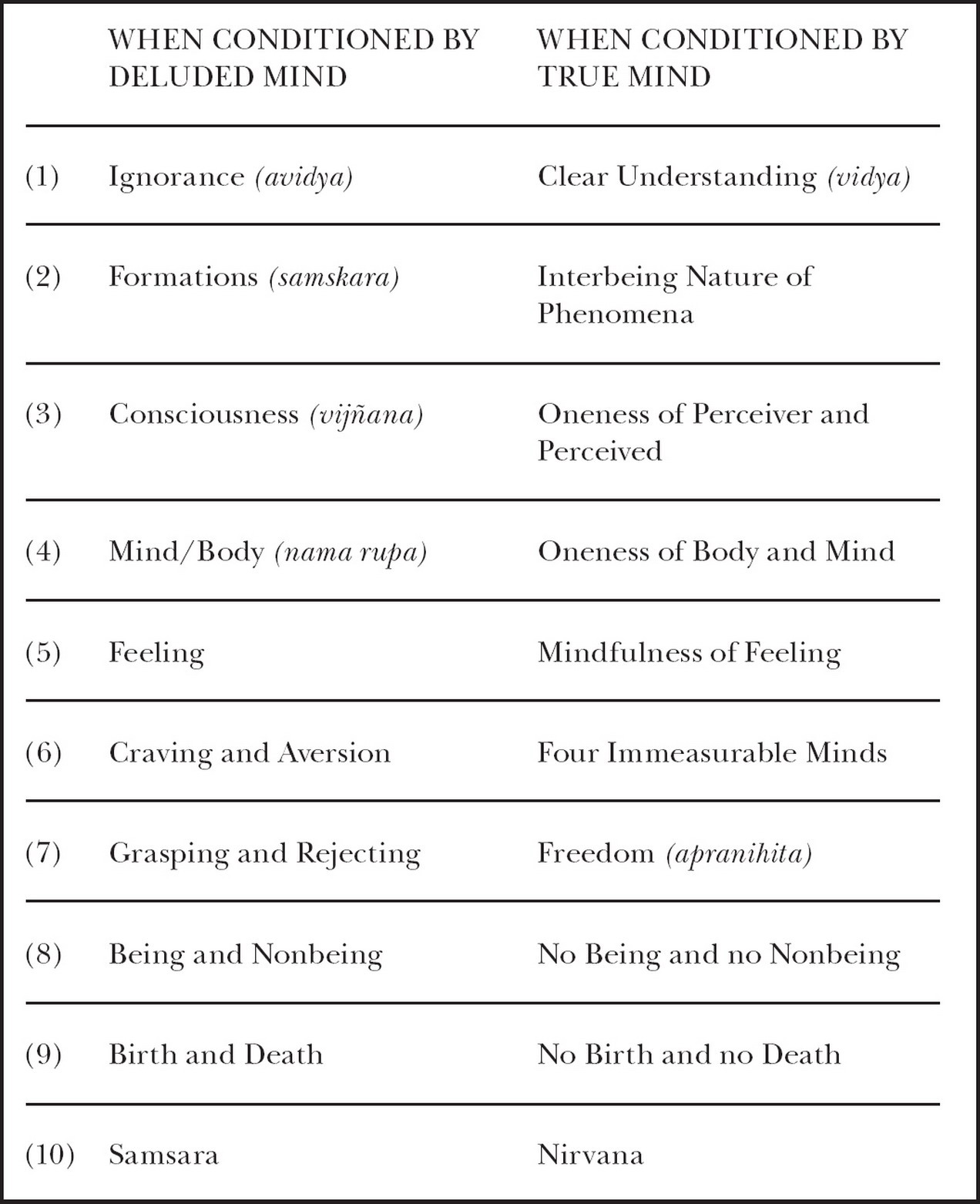
There is co-arising conditioned by deluded mind and co-arising conditioned by true mind. The world, society, and the individual have been formed by a cycle of conditions based on deluded mind. Naturally, in a world based on deluded mind, there is suffering and affliction. But when conditions are based on true mind, they reflect the wondrous nature of reality. Everything depends on our mind.
Those who teach the links of Interdependent Co-Arising need to understand their positive side, and the role of the links in helping us to be in touch with nirvana. In this light, we learn to see that there is a cycle that helps us be in touch with nirvana, just as there is a cycle that helps us be in touch with samsara.
Ignorance (avidya) is the lack of light. It is connected to deluded mind. Understanding or wisdom (vidya) is connected to true mind. The presence of light means the absence of darkness. The presence of ignorance means the absence of understanding. The Buddha said, “When ignorance comes to an end, understanding arises.”7 Just as ignorance conditions the other links of deluded mind, so wisdom conditions other links of true mind.
The second link, formations, is the object of our perception. As far as deluded mind is concerned, they are separate entities. When there is wisdom, we see that formations or conditioned things do not have a separate nature and depend on each other to exist. The father depends on the son and the son on the father. If there were no son there could be no father, and if there were no father there could be no son. Seeing things as separate entities just makes our ignorance deeper. So, not only does ignorance condition formations, but formations condition ignorance. Seeing things lying in each other, interpenetrating each other, strengthens our wisdom and comes from our wisdom. Consciousness, the third link, is an important formation. It is important enough for us to be able to make it a separate link. When it belongs to the sphere of deluded mind, it is known as discriminatory consciousness, because its function is to discriminate the perceiver from the perceived and make the objective world seem to be separate from the observer.
When the Buddha looks at a flower, he knows that the flower is his own consciousness. This is the state of consciousness when it is a link in a positive cycle. There is nothing wrong with consciousness but, having realized that all formations inter-are, we come to realize that there is not a separate world outside of consciousness, nor is there a separate consciousness outside of the world. It is the wisdom of nonduality that understands that the subject of consciousness is not separate from the object of consciousness.
Consciousness is the base for distinguishing, planning, helping, and doing good work. That kind of consciousness is present in the Buddha and the bodhisattvas. The Buddha said, “How lovely is the city of Vaishali.” He said, “Ananda, don’t you think that the rice fields are lovely? Shall we go into town and share the Dharma?” These statements are based on lucid consciousness, consciousness full of understanding, care, and love.
Consciousness is described in the Vijñanavada schema in terms of eight consciousnesses, and these are transformed into Four Wisdoms. When the seeds of awakening, love, and compassion in store consciousness have been developed and matured, store consciousness (alayavijñana) is transformed and becomes the Great Mirror Wisdom that reflects the reality of all that is. All the seeds that can become the Great Mirror Wisdom are already present in store consciousness. We only have to water them. Great Mirror Wisdom is the outcome of the practice of being in touch with the true nature of things by contemplation on interbeing, impermanence, and non-self.
We have to learn the ways to use our consciousness as a tool of transformation. Our six sense organs — eyes, ears, nose, tongue, body, and mind — can contribute toward the arising of Great Mirror Wisdom. We see that the Buddha also has six senses that enter into contact with six sense objects, but he knows how to guard his senses so that more internal knots will not be tied. The Buddha uses his six senses skillfully and realizes wonderful things. The first five consciousnesses become the Wisdom of Wonderful Realization. We can use these five consciousnesses to serve others. Mind consciousness, upon emancipation, becomes the Wonderful Observation Wisdom, wisdom that can see things as they are. The Wisdom of Equality comes from the seventh consciousness, manas. Manas is the number one discriminator. It says, “This is me. This is mine. This is not mine.” That is manas’s specialty. We have to keep this consciousness, so that it can become the Wisdom of Equality. Our consciousness has to be transformed and not thrown away. Wonderful Observation Wisdom transforms manas into the Wisdom of Equality. We are one. We are equal. I may think that you are my enemy, but while touching the ultimate dimension, I see that you and I are one. Sometimes we only need to touch the Earth once, and the Wisdom of Equality appears right in the heart of our manas consciousness. Wonderful Observation Wisdom takes the place of the sixth consciousness, mind consciousness. Before the disappearance of ignorance, the sixth consciousness gives rise to many wrong perceptions, like seeing a rope as a snake, and a lot of suffering. Thanks to “transformation at the base” — the store-consciousness becoming Great Mirror Wisdom — the sixth consciousness can be transformed into Wonderful Observation Wisdom.
The fourth wisdom, Great Mirror Wisdom, brings about miracles. In the past, our eye consciousness made us infatuated or put us in the dark. Now, with our eyes open, we can see the Dharmakaya, the natural world, as the teaching body of the Buddha. When our mind is clear like a calm river, the sixth consciousness is Wonderful Observation Wisdom, and our store consciousness is Great Mirror Wisdom.
The fourth link in our schema of the Ten Links is mind/body. Mind/body (nama-rupa) is the Five Aggregates. We don’t say, “The Five Aggregates are suffering,” and throw them away. If we do, there will be nothing left — no nirvana, no peace, and no joy. We need an intelligent policy for taking care of our garbage.
We have body and mind, and in the sphere of deluded mind we experience them as a duality and our mind becomes alienated from our body. When we sit in front of the computer, we often forget that we have a body. With wisdom, we can experience body and mind as the same reality. Bodhisattvas have body and mind, and the Buddha has a body and a mind. We do not need to throw away our body in order to experience liberation, and we should not see our body as a prison and obstacle for our mind. We practice to realize an embodied mind and a mindful body. In such a body and mind, there is no longer ignorance, no more formations as separate realities, and no more discriminatory consciousness. The function of this mind/body is to awaken and liberate beings.
The fifth link in our schema is pleasant, painful, and neutral feelings (also one of the Five Aggregates). When we practice mindfulness, we learn how to handle our feelings, which means recognizing, embracing, and transforming painful feelings and nourishing the true happiness within us, not allowing ourselves to be dominated by neutral feelings. So the positive side of feelings is mindfulness of feelings. Every contact of the senses and every feeling has clarity and calmness.
When the six senses and their objects make contact, this contact gives rise to a pleasant, unpleasant, or neutral feeling. When a bodhisattva sees a child suffering, she knows how it feels to suffer, and she also has an unpleasant feeling. But because of that suffering, concern and compassion arise in her and she is determined to act. Bodhisattvas suffer like the rest of us, but in a bodhisattva, feelings do not give rise to craving or aversion.
When a bodhisattva sees a beautiful flower, she recognizes that the flower is beautiful. But she also sees the nature of impermanence in the flower. That is why there is no attachment. She has a pleasant feeling, but it does not create an internal formation. Emancipation does not mean that she suppresses all feelings. When she comes into contact with hot water, she knows it is hot. Feelings are normal. In fact, these feelings help her dwell in happiness, not the kind of happiness that is subject to sorrow and anxiety, but the kind of happiness that nourishes. When you practice breathing, smiling, being touched by the air and the water, that kind of happiness does not create suffering in you. It helps you be strong and sane, able to go further on your way toward realization. Buddhas, bodhisattvas, and many others have the capacity of enjoying a pleasant feeling, the kind of feeling that is healing and rejuvenating, without becoming attached. The feeling that we have when we see people oppressed or starving can give rise in us to concern, compassion, and the willingness to act with equanimity, not with attachment.
The sixth link is craving and aversion in the cycle of deluded mind, and the Four Immeasurable Minds in the cycle of true mind.
When feelings and contact are protected, they lead not to craving and aversion but to love, compassion, joy, and equanimity — the Four Immeasurable Minds.8 When we see people suffering or in pain or when we see them enjoying themselves in a foolish way, a feeling in us gives rise to the energy of loving kindness — the desire and the capacity to offer real joy, and this leads to the energy of compassion — the desire and the capacity to help living beings put an end to their suffering. This energy gives rise to joy in us, and we are able to share our joy with others. It also gives rise to equanimity — not taking sides or getting carried away by the images and sounds brought to us through contact and feelings. Equanimity does not mean indifference. We see the ones we love and the ones we hate equally, and try our best to make both of them happy. We accept the flowers and the garbage with neither attachment nor aversion. We treat both with respect. Equanimity means to let go, not to abandon. Abandoning causes suffering. When we are not attached, we are able to let go.
The seventh link is grasping and rejecting in the cycle of deluded mind, and freedom in the cycle of true mind.
The Four Immeasurable Minds are the basis for freedom. When we are in touch with things by means of the mind of love, we do not run away or seek, and that is the basis of freedom. Aimlessness takes the place of grasping.
The eighth link is being and nonbeing in the cycle of deluded mind, and Right View, or the insight that overcomes both the notions of being and nonbeing, in the cycle of true mind.
In his first Dharma talk, the Buddha cautioned his disciples not to be attached to either bhava or vibhava, being or nonbeing, because bhava and vibhava are just constructs of the mind. Reality is somewhere in between. With the transformation of grasping into freedom, we see both being and nonbeing as creations of our mind, and we ride the waves of birth and death. We don’t mind birth. We don’t mind death. If we have to be born again to continue the work of helping, that is okay.
The ninth link is birth and death in the realm of deluded mind, and no birth and no death in the realm of true mind.
The leaf has the appearance of being born and dying, but it is not caught in either. The leaf falls to the earth without any idea of dying, and is born again by decomposing at the foot of the tree and nourishing the tree. The cloud has the appearance of dying, but if we look we see that it can never die, it can only become rain or snow. When a leaf is born, we can sing Happy Continuation. When a leaf falls, we can sing Happy Continuation. When we have awakened understanding, birth is a continuation and death is a continuation, birth is an appearance and death is an appearance. People also appear to be born, grow old, and die.
The tenth link is samsara in the sphere of deluded mind, and nirvana in the sphere of true mind.
In the eleventh century in Vietnam, a monk asked his meditation master, “Where is the place beyond birth and death?” The master replied, “In the midst of birth and death.” If you abandon birth and death in order to find nirvana, you will not find nirvana. Nirvana is in birth and death. Nirvana is birth and death. It depends on how you look at it. From one point of view, it is birth and death. From another, it is nirvana.
When we have freedom, what seemed to be suffering becomes Wondrous Being. It can also be called the Kingdom of God or nirvana. Someone who is free has the ability to establish a Pure Land, a place where people do not need to run. Wondrous Being is beyond being and nonbeing. If a bodhisattva needs to manifest being, if he needs to be born in this world, he will be born in this world. There is still life, but he is not caught in ideas of being, nonbeing, birth, or death.
Let us not present the teaching of the Buddha as an attempt to escape from life and go to nothingness or nonbeing. Bodhisattvas vow to come back again and again to serve, not because of craving but because of their concern and willingness to help.
Imagine one thousand people whose minds are full of misperceptions, wrong views, envy, jealousy, and anger. If they come together, they will create a hell on Earth. The surroundings they live in, their daily lives, and their relationships will all be hellish. If two people full of misunderstanding live together, they create a hell realm for each other. How much greater the hell of one thousand people!
To make hell into paradise, we only need to change the mind on which it is based. To change the minds of one thousand people, it may be necessary to bring in some element from the outside, like a Dharma teacher or a group of people practicing the Dharma. Imagine one thousand people who do not have wrong perceptions, anger, or jealousy, but who have love, understanding, and happiness. If these people come together and form a community, it will be paradise. The mind of the people is the basis of paradise. With your deluded mind, you make hell for yourself. With your true mind, you make paradise. If two people come together with true mind, they make a small paradise for themselves. If a third person wants to join them, they should be careful. “Should we let him join us or not?” If their paradise is solid, they can allow him to join. With two true minds, there is hope that one deluded mind can be gradually transformed. Later, there will be three true minds, and this small paradise will continue to grow.
Many volumes have been written about the Twelve Links of Interdependent Co-Arising based on deluded mind. We have to open a new door and teach the practice of the Links based on true mind in order to bring about a world of peace and joy.
From the positive point of view we can explain: when there is wisdom, people see the nature of formations as interbeing, and because of this they realize that consciousness as the subject is not separate from its object. They see the body and mind as two aspects of the same reality and as inseparable from each other, and they know how to take care of painful feelings and nourish feelings of true happiness. From this come compassion and inclusiveness and the desire to transform and help the situation or the person. This ability to stay with the situation as it is, to see the interbeing nature of all things, means that they are free from the notions of being and nonbeing and the notions of birth and death that depend on the notions of being and nonbeing, and they can transform their suffering at the base, realizing nirvana.
According to the Udana 8.3, “There is bhikkhus, the unborn, the nonbeing, the non-made, the non-conditioned to be a way out for the born, the being, the made, the conditioned.” Based on this, we can establish Five Links:
(1) Ignorance
(2) Birth and death (the born)
(3) Being and nonbeing (the being)
(4) Doer and inheritor of action (the made)
(5) Conditioned and unconditioned (the conditioned)
From the positive point of view: wisdom takes us beyond birth and death and ideas of being and nonbeing; there is no longer a separate self who owns the body and mind and performs actions and receives the result of those actions. Nor are there formations that lie outside of each other. There is not a conditioned world that is separate from the world of conditioning. When we see deeply the conditioned, we are in touch with the unconditioned. In short, there can be many ways of presenting Interdependent Co-Arising that can help us be in touch with Right View, and the best way of presenting it is nonlinear and shows how every link is linked to all the others simultaneously. There is no link that can be there before the others, for example:
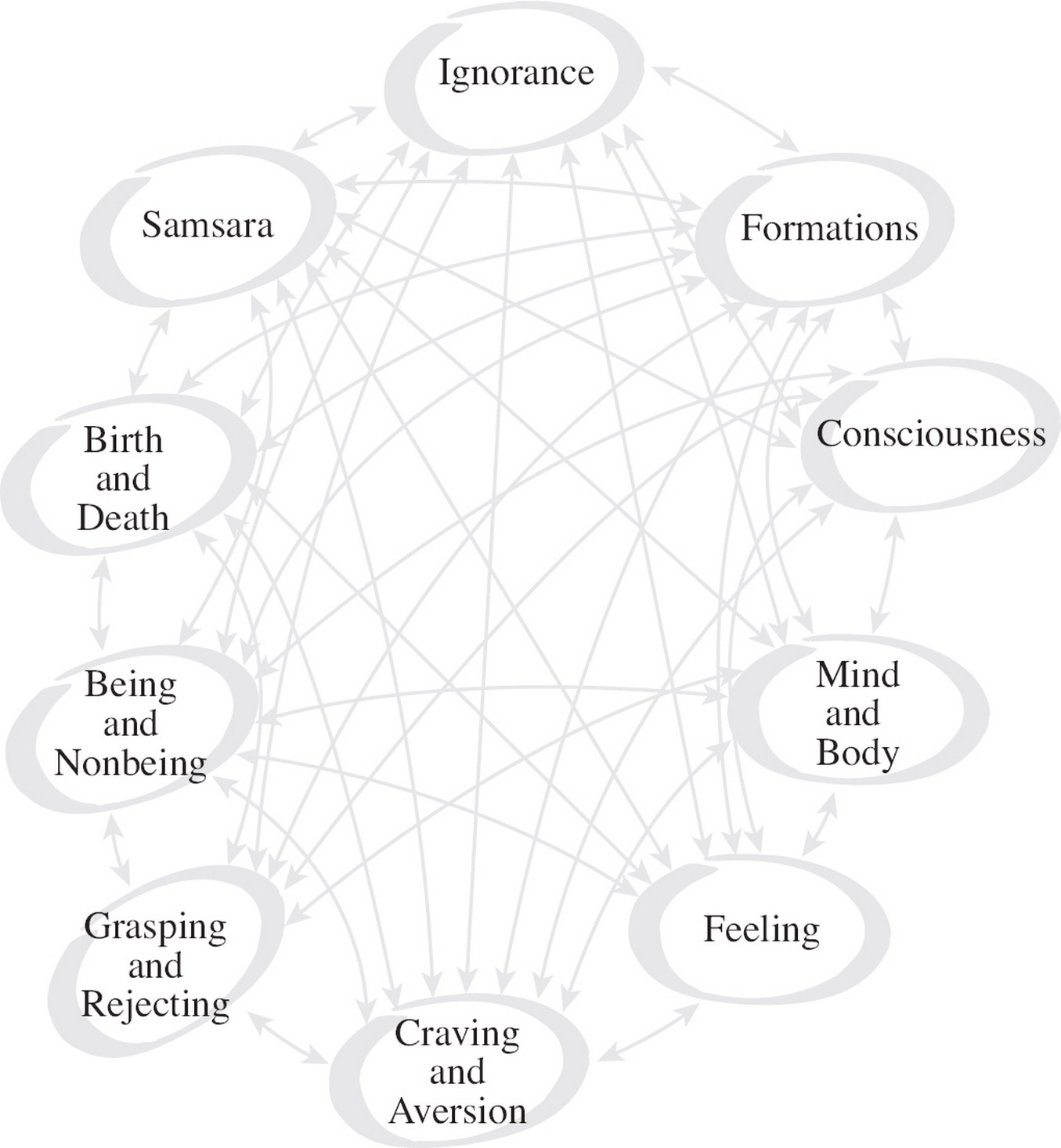
The greatest advantage of the Ten or the Five Links as described above is that being and nonbeing are one and the same link, as are birth and death. For as long as we have the idea of being, we have to have the idea of nonbeing; and when the Buddha said “being,” he always meant “nonbeing” as well, as in the Katyayanagotra Sutra, where the Buddha says that Right View is the view that transcends being and nonbeing. If we do not make this clear, people will continue to think that being is the culprit that makes us suffer birth, old age, and death. Being and nonbeing are ideas in our head, just as birth and death are ideas, they are not objective realities; and it is the ideas we have to transcend if we want to experience nirvana.

1 Mahanidana Sutta, Digha Nikaya 15.
2 Mahaprajñaparamita Shastra.
3 The three baskets are Sutras (teachings of the Buddha), Vinaya (rules of conduct), and Abhidharma (systematized presentations of the teachings).
5 The earliest discourse in which the Buddha talked about a chain of causes was the Mahanidana Sutta, Digha Nikaya 15, although in that discourse, only nine links are given. In later teachings, the list was expanded to twelve.
6 Thich Nhat Hanh, Chanting from the Heart (Berkeley, CA: Parallax Press, 2013).
7 Samyutta Nikaya IV, 49 and 50.