CHAPTER SEVEN
Touching Our Suffering
In the Pali version of the Discourse on Turning the Wheel of the Dharma, the Buddha told the five monks,
As long as the insight and the understanding of these Four Noble Truths in their three stages and twelve aspects, just as they are, had not been fully realized, I could not say that in this world with its gods, maras, brahmas, recluses, brahmans, and men, someone had realized the highest awakening. Monks, as soon as the insight and understanding of the Four Noble Truths in their three stages and twelve aspects, just as they are, had been realized, I could say that in this world with its gods, maras, brahmas, recluses, brahmans, and men, someone had realized the highest awakening.
In the Chinese version of the sutra, the Buddha said,
Monks, the experience of the three turnings of the wheel with regard to each of the Four Truths gives rise to eyes of awakened understanding, and therefore I declare before gods, spirits, shramanas, and brahmans of all times that I have destroyed all afflictions and reached full awakening.
The wheel of the Dharma was put in motion twelve times — three for each of the Four Noble Truths. To understand the Four Noble Truths, not just intellectually but experientially, we have to practice the twelve turnings of the wheel.
The first turning is called “Recognition.” We sense that something is wrong, but we are not able to say exactly what it is. We make some effort to escape, but we cannot. We try to deny our suffering, but it persists. The Buddha said that to suffer and not know that we are suffering is more painful than the burden endured by a mule carrying an unimaginably heavy load. We must, first of all, recognize that we are suffering and then determine whether its basis is physical, physiological, or psychological. Our suffering needs to be identified.
Recognizing and identifying our suffering is like the work of a doctor diagnosing an illness. He or she says, “If I press here, does it hurt?” and we say, “Yes, this is my suffering. This has come to be.” The wounds in our heart become the object of our meditation. We show them to our doctor, and we show them to the Buddha, which means we show them to ourselves. Our suffering is us, and we need to treat it with kindness and nonviolence. We need to embrace our fear, hatred, anguish, and anger. “My dear suffering, I know you are there. I am here for you, and I will take care of you.” We stop running from our pain. With all our courage and tenderness, we recognize, acknowledge, and identify it.
The second turning of the wheel is called “Encouragement.” After recognizing and identifying our pain, we take the time to look deeply into it in order to understand its true nature, which means its causes. After observing our symptoms, the doctor says, “I will look deeply into it. This illness can be understood.” It may take him a week to conduct tests and inquire about what we have been eating, our attitudes, how we spend our time, and so on. But he is determined to understand our illness.
Our suffering — depression, illness, a difficult relationship, or fear — needs to be understood and, like a doctor, we are determined to understand it. We practice sitting and walking meditation, and we ask for guidance and support from our friends and, if we have one, our teacher. As we do this, we see that the causes of our suffering are knowable, and we make every effort to get to the bottom of it. At this stage, our practice can still be “set back” (ashrava).
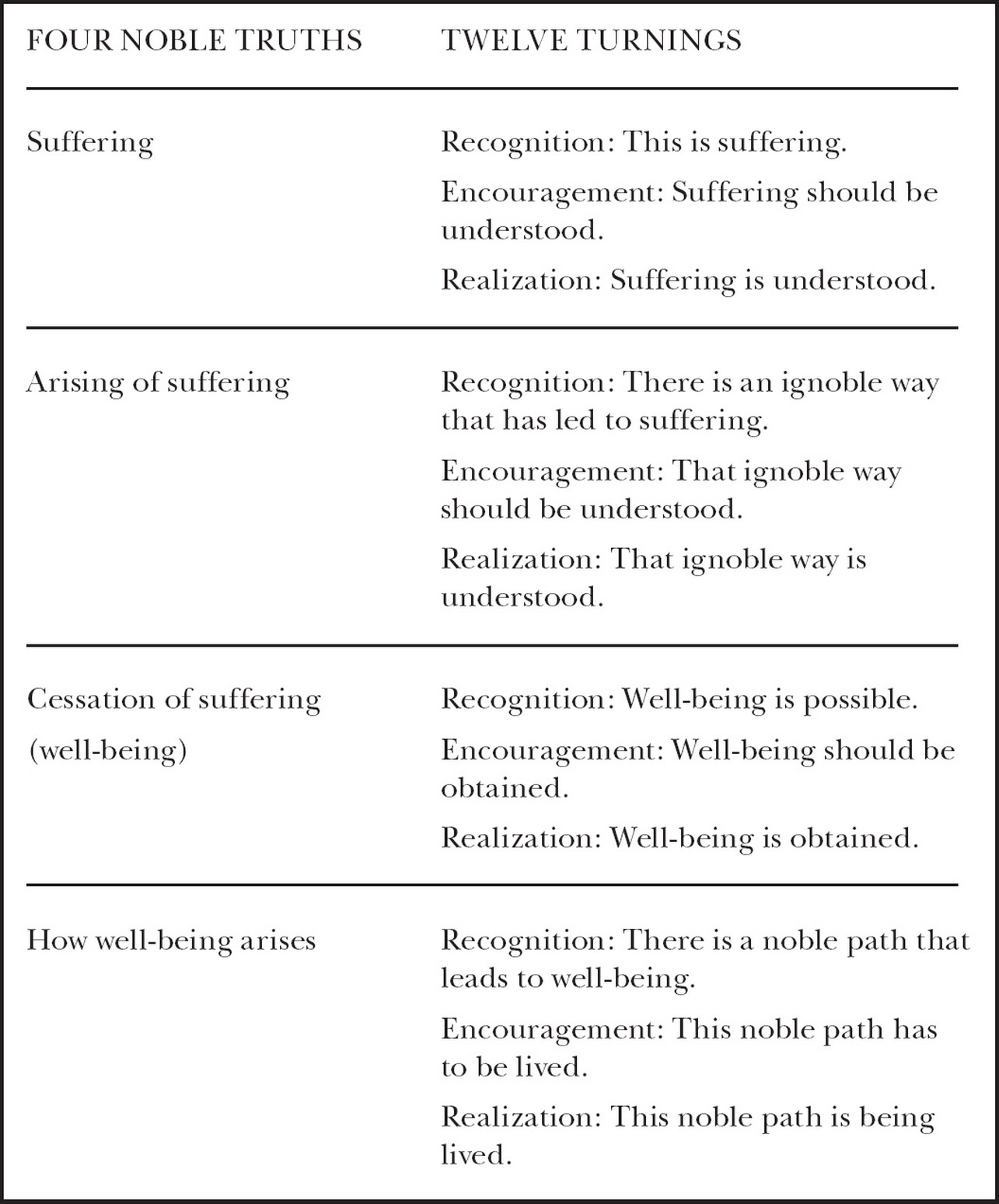
The third turning of the wheel is called “Realization” and can be expressed as, “This suffering has been understood.” We realize the efforts begun during the second turning. The doctor tells us the name and all the characteristics of our illness. After studying, reflecting upon, and practicing the First Noble Truth, we realize that we have stopped running away from our pain. We can now call our suffering by its specific name and identify all of its characteristics. This alone brings us happiness, joy “without setbacks” (anashrava).
Still, after we have successfully diagnosed our ailment, for a time we continue to create suffering for ourselves. We pour gasoline on the fire through our words, thoughts, and deeds and often don’t even realize it. The first turning of the wheel of the Second Noble Truth is the “Recognition”: I am continuing to create suffering. The Buddha said, “When something has come to be, we have to acknowledge its presence and look deeply into its nature. When we look deeply, we will discover the kinds of nutriments that have helped it come to be and that continue to feed it.”1 He then elaborated four kinds of nutriments that can lead to our happiness or our suffering — edible food, sense impressions, intention, and consciousness.
The first nutriment is edible food. What we eat or drink can bring about mental or physical suffering. We must be able to distinguish between what is healthful and what is harmful. We need to practice Right View when we shop, cook, and eat. The Buddha offered this example. A young couple and their two-year-old child were trying to cross the desert, and they ran out of food. After deep reflection, the parents realized that in order to survive they had to kill their son and eat his flesh. They calculated that if they ate such and such a proportion of their baby’s flesh each day and carried the rest on their shoulders to dry, it would last the rest of the journey. But with every morsel of their baby’s flesh they ate, the young couple cried and cried. After he told this story, the Buddha asked, “Dear friends, do you think the young man and woman enjoyed eating their son’s flesh?” “No, Lord, it would not be possible for them to enjoy eating their son’s flesh.” The Buddha said, “Yet many people eat the flesh of their parents, their children, and their grandchildren and do not know it.”2
Much of our suffering comes from not eating mindfully. We have to learn ways to eat that preserve the health and well-being of our body and our spirit. When we smoke, drink, or consume toxins, we are eating our own lungs, liver, and heart. If we have children and do these things, we are eating our children’s flesh. Our children need us to be healthy and strong.
We have to look deeply to see how we grow our food, so we can eat in ways that preserve our collective well-being, minimize our suffering and the suffering of other species, and allow the earth to continue to be a source of life for all of us. If, while we eat, we destroy living beings or the environment, we are eating the flesh of our own sons and daughters. We need to look deeply together and discuss how to eat, what to eat, and what to resist. This will be a real Dharma discussion.
The second kind of nutriment is sense impressions. Our six sense organs — eyes, ears, nose, tongue, body, and mind — are in constant contact (sparsha) with sense objects, and these contacts become food for our consciousness. When we drive through a city, our eyes see so many billboards, and these images enter our consciousness. When we pick up a magazine, the articles and advertisements are food for our consciousness. Advertisements that stimulate our craving for possessions, sex, and food can be toxic. If after reading the newspaper, hearing the news, or being in a conversation, we feel anxious or worn out, we know we have been in contact with toxins.
Movies are food for our eyes, ears, and minds. When we watch TV, the program is our food. Children who spend five hours a day watching television are ingesting images that water the negative seeds of craving, fear, anger, and violence in them. We are exposed to so many forms, colors, sounds, smells, tastes, objects of touch, and ideas that are toxic and rob our body and consciousness of their well-being. When you feel despair, fear, or depression, it may be because you have ingested too many toxins through your sense impressions. Not only children need to be protected from violent and unwholesome films, TV programs, books, magazines, and games. We, too, can be destroyed by these media.
If we are mindful, we will know whether we are “ingesting” the toxins of fear, hatred, and violence, or eating foods that encourage understanding, compassion, and the determination to help others. With the practice of mindfulness, we will know that hearing this, looking at that, or touching this, we feel light and peaceful, while hearing that, looking at this, or touching that, we feel anxious, sad, or depressed. As a result, we will know what to be in contact with and what to avoid. Our skin protects us from bacteria. Antibodies protect us from internal invaders. We have to use the equivalent aspects of our consciousness to protect us from unwholesome sense objects that can poison us.
The Buddha offered this drastic image: “There is a cow with such a terrible skin disease that her skin is almost no longer there. When you bring her close to an ancient wall or old tree, all the living creatures in the bark of the tree come out, cling to the cow’s body, and suck. When we bring her into the water, the same thing happens. Even when she is just exposed to the air, tiny insects come and suck.” Then the Buddha said, “This is our situation, also.”
We are exposed to invasions of all kinds — images, sounds, smells, touch, ideas — and many of these feed the craving, violence, fear, and despair in us. The Buddha advised us to post a sentinel, namely mindfulness, at each of our sense doors to protect ourselves. Use your Buddha eyes to look at each nutriment you are about to ingest. If you see that it is toxic, refuse to look at it, listen to it, taste it, or touch it. Ingest only what you are certain is safe. The Five Mindfulness Trainings3 can help very much. We must come together as individuals, families, cities, and a nation to discuss strategies of self-protection and survival. To get out of the dangerous situation we are in, the practice of mindfulness has to be collective.
The third kind of nutriment is volition, intention, or will — the desire in us to obtain whatever it is that we want. Volition is the ground of all our actions. If we think that the way for us to be happy is to become president of a large corporation, everything we do or say will be directed toward realizing that goal. Even when we sleep, our consciousness will continue to work on it. Or suppose we believe that all our suffering and the suffering of our family has been brought about by someone who wronged us in the past. We believe we will only be happy if we inflict harm on that person. Our life is motivated solely by the desire for revenge, and everything we say, everything we plan, is to punish that person. At night, we dream of revenge, and we think this will liberate us from our anger and hatred.
Everyone wants to be happy, and there is a strong energy in us pushing us toward what we think will make us happy. But we may suffer a lot because of this. We need the insight that position, revenge, wealth, fame, or possessions are, more often than not, obstacles to our happiness. We need to cultivate the wish to be free of these things so we can enjoy the wonders of life that are always available — the blue sky, the trees, our beautiful children. After three months or six months of mindful sitting, mindful walking, and mindful looking, a deep vision of reality arises in us, and the capacity of being there, enjoying life in the present moment, liberates us from all impulses and brings us real happiness.
One day, after the Buddha and a group of monks finished eating lunch mindfully together, a farmer, very agitated, came by and asked, “Monks, have you seen my cows? I don’t think I can survive so much misfortune.” The Buddha asked him, “What happened?” and the man said, “Monks, this morning all twelve of my cows ran away. And this year my whole crop of sesame plants was eaten by insects!” The Buddha said, “Sir, we have not seen your cows. Perhaps they have gone in the other direction.” After the farmer went off in that direction, the Buddha turned to his Sangha and said, “Dear friends, do you know you are the happiest people on Earth? You have no cows or sesame plants to lose.” We always try to accumulate more and more, and we think these “cows” are essential for our existence. In fact, they may be the obstacles that prevent us from being happy. Release your cows and become a free person. Release your cows so you can be truly happy.
The Buddha presented another drastic image: “Two strong men are dragging a third man along in order to throw him into a fire pit. He cannot resist, and finally they throw him into the glowing embers.” These strong men, the Buddha said, are our own volition. We don’t want to suffer, but our deep-seated habit energies drag us into the fire of suffering. The Buddha advised us to look deeply into the nature of our volition to see whether it is pushing us in the direction of liberation, peace, and compassion or in the direction of suffering and unhappiness. We need to be able to see the kinds of intention-food that we are consuming.
The food of consciousness is the fourth of the four kinds of food. There are two kinds of consciousness: the collective and the individual. The food of consciousness means that we consume consciousness. There are different kinds of consciousness food. Some are healthy and nutritive and some are toxic. In the collective consciousness there are many toxic foods such as anger and despair. If we allow ourselves to consume that kind of food, we shall be poisoned. So we should not spend time close to or in a community that has a great deal of hatred and despair. We need to find a collective consciousness to be with that is not filled with hatred and despair, where all day long the people who live there just think about compassion and helping others.
The individual consciousness also has toxins. The hells, hungry ghost, and animal realms are in us. If we want them to appear, they can appear right away. We only need to press a button and Pandora’s box will open. If we sit there and allow the negative thinking connected to past experiences to come up, we are eating the toxic matter of consciousness. Many of us sit and think, and the more we think, the more angry, upset, and in despair we become.
Nevertheless, in our consciousness, besides the seeds of the gods, the ashuras, the hell realms, the hungry ghosts, and the animals, are the seeds of Hearer Disciples, Self-achieved Buddhas, bodhisattvas, and fully enlightened Buddhas. We have as many channels in our consciousness as a ten-channeled television. Why do we not push the button of the Buddha or Bodhisattva channel? Sitting alone, we push on the hungry ghost or animal channel and eat the food they produce, just like the ruminants chew the cud. In the past we have experienced hatred, we have been abused and maltreated. All these events have been buried in our consciousness and we have not been able to transform them. We chew the cud of our suffering, our despair, like the cows chew the regurgitated grass. Every time we think about being abused, we are abused once again. But actually that is not happening now; it is all over. Thinking like this, we can be abused every day, even though our childhood may have had a great deal of happiness and sweet moments. We ruminate on our hatred, suffering, and despair and it is not healthy food.
Our mindful breathing and steps are able to pull us out of thinking and help us be in touch with the wonderful things of the present moment, nourishing us and bringing back the joy of being alive. We are happy as we walk, happy as we sit, and happy as we eat when we know how to stay in the present moment and stop the thinking.
The Buddha offered another dramatic image to illustrate this: “A dangerous murderer was captured and brought before the king, and the king sentenced him to death by stabbing. ‘Take him to the courtyard and plunge three hundred sharp knives through him.’ At noon a guard reported, ‘Majesty, he is still alive,’ and the king declared, ‘Stab him three hundred more times!’ In the evening, the guard again told the king, ‘Majesty, he is not yet dead.’ So the king gave the third order: ‘Plunge the three hundred sharpest knives in the kingdom through him.’ ” Then the Buddha said, “This is how we usually deal with our consciousness.” Every time we ruminate on the past, it is like stabbing ourselves with a sharp knife. We suffer, and our suffering spills out to those around us.
When we practice the first turning of the First Noble Truth, we recognize suffering as suffering. If we are in a difficult relationship, we recognize, “This is a difficult relationship.” Our practice is to be with our suffering and take good care of it. When we practice the first turning of the Second Noble Truth, we look deeply into the nature of our suffering to see what kinds of nutriments we have been feeding it. How have we lived in the last few years, in the last few months, that has contributed to our suffering? We need to recognize and identify the nutriments we ingest and observe, “When I think like this, speak like that, listen like this, or act like that, my suffering increases.” Until we begin to practice the Second Noble Truth, we tend to blame others for our unhappiness.
Looking deeply requires courage. You can use a pencil and paper if you like. During sitting meditation, if you see clearly a symptom of your suffering, write it down. Then ask yourself, “What kinds of nutriments have I been ingesting that have fed and sustained this suffering?” When you begin to realize the kinds of nutriments you have been ingesting, you may cry. Use the energy of mindfulness all day long to be truly present, to embrace your suffering like a mother holding her baby. As long as mindfulness is there, you can stay with the difficulty. Practice does not mean using only your own mindfulness, concentration, and wisdom. You also have to benefit from the mindfulness, concentration, and wisdom of friends on the path and your teacher. There are things that even a child can see but we ourselves cannot see because we are imprisoned by our notions. Bring what you have written to a friend and ask for his or her observations and insights.
If you sit with a friend and speak openly, determined to discover the roots of your suffering, eventually you will see them clearly. But if you keep your suffering to yourself, it might grow bigger every day. Just seeing the causes of your suffering lessens your burden. Shariputra, one of the Buddha’s great disciples, said, “When something takes place, if we look at it deeply in the heart of reality, seeing its source and the food that nourishes it, we are already on the path of liberation.” When we are able to identify our suffering and see its causes, we will have more peace and joy, and we are already on the path to liberation.
In the second stage of the Second Noble Truth, “Encouragement,” we see clearly that real happiness is possible if we can stop ingesting the nutriments that cause us to suffer. If we know that our body is suffering because of the way we eat, sleep, or work, we vow to eat, sleep, or work in ways that are healthier. We encourage ourselves to put an end to the causes of our suffering. Only by a strong intention not to do things in the same way can we keep the wheel in motion.
Mindfulness is the energy that can help us stop. We investigate the kinds of nutriments we now ingest and decide which ones to continue to eat and which to resist. We sit and look together with our friends, with our family, and as a community. Mindfulness of ingestion, protecting our body and mind, protecting our families, society, and the environment are important topics for us to discuss. When we direct our attention toward our suffering, we see our potential for happiness. We see the nature of suffering and the way out. That is why the Buddha called suffering a holy truth. When we use the word “suffering” in Buddhism, we mean the kind of suffering that can show us the way out.
There are many practices that can help us face our suffering, including mindful walking, mindful breathing, mindful sitting, mindful eating, mindful looking, and mindful listening. One mindful step can take us deep into the realization of beauty and joy in us and around us. Tran Thai Tong, a great meditation master of thirteenth-century Vietnam, said, “With every step, you touch the ground of reality.” If you practice mindful walking and deep listening all day long, that is the Four Noble Truths in action. When the cause of suffering has been seen, healing is possible. We vow to refrain from ingesting foods that make us suffer, and we also vow to ingest foods that are healthy and wholesome.
In the third turning of the wheel of the Second Noble Truth, “Realization,” we not only vow but we actually stop ingesting the nutriments that create our suffering. Some people think that to end suffering, you have to stop everything — body, feelings, perceptions, mental formations and consciousness — but that is not correct. The third stage of the Second Noble Truth can be described as, “When hungry, I eat. When tired, I sleep.” When someone has realized this stage, she has a certain lightness and freedom. What she wants to do is fully in accord with the mindfulness trainings, and she does nothing to cause herself or others harm.
Confucius said, “At thirty, I was able to stand on my own feet. At forty, I had no more doubts. At fifty, I knew the mandate of Earth and Sky. At sixty, I could do what I wanted without going against the path.” The last of the ten ox herding pictures in the Zen tradition is called “Entering the Marketplace with Open Hands.” You are free to come and go as you please. This is the action of non-action. Suffering no longer arises. This stage is not something you can imitate. You have to reach this stage of realization within yourself.
At the end of the nineteenth century in Vietnam, Master Nhat Dinh asked the king for permission to retire from being abbot of a national temple so he could live in a mountain hut and take care of his aging mother. Many officials made offerings to the master and begged him to found another temple, but he preferred to live simply, in great peace and joy. One day his mother fell ill and needed fish to eat. He went down to the marketplace, asked some vendors for a fish, and carried it back up the mountain. Onlookers asked, “What is a Buddhist monk doing with a fish?” But someone of Master Nhat Dinh’s realization could do as he pleased without going against the precepts. At the third stage of the Second Noble Truth, you only have to be yourself. The form is not important. But be careful! First there has to be genuine insight, genuine freedom.


1 Samyutta Nikaya II, 47. See also this page, Discourse on Right View.
2 Discourse on the Son’s Flesh, Samyukta Agama 373 (Taisho 99). Also Samyutta Nikaya II, 97.
3 See Thich Nhat Hanh, For a Future To Be Possible: Commentaries on the Five Mindfulness Trainings, Revised Edition (Berkeley: Parallax Press, 1998). See also chapter 12 and 13 of this book.